Projects
MoD - Mapping on Demand (DFG Research Unit)
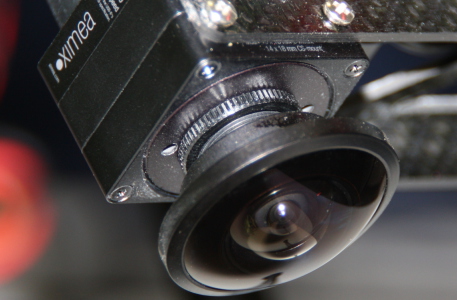
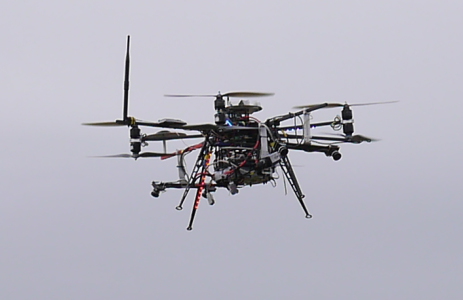
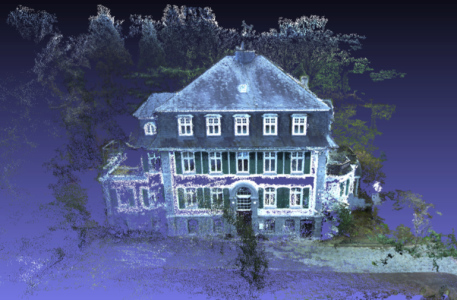
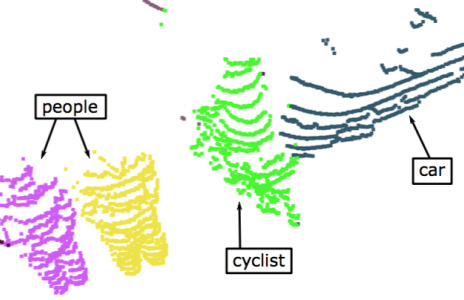
The goal of the project is the development and testing of procedures and algorithms for the fast three-dimensional identification and mensuration of inaccessible objects on the basis of a semantically specified user inquiry. The sensor platform is a lightweight autonomously flying drone. It uses the visual information from cameras for navigation, obstacle detection, exploration and object acquisition.
Monitoring Farmland Abandonment by multitemporal and multisensor remote sensing imagery (MOFA)
The research project studies an area in the border region of Poland and Ukraine. With the fall of the Iron Curtain the region experienced drastic changes in political and socio- economic structures. Large farmland areas become abandoned and gradual processes of forest succession take place on the abandoned land. The aim of the project is the development of adequate strategies to monitor farmland abandonment, using multitemporal SAR and multispectral remote sensing data. Finally enhanced maps should be provided, which enable more detailed analysis of the gradual process of land cover transitions. (PI: B. Waske; funding: German Research Foundation (DFG) WA 2728/2-1)
Remote sensing based retrieval of biomethane potential (BMP) of crops, with regard to the EnMAP mission
The project aims on the development of methods to quantify the biomethane potential of crops. The IGG sub-project deals with the development of adequate classification and regression strategies for an enhanced mapping of energy crops and retrieval of biophysical parameters by combining SAR and hyperspectral images. The specific aims of the projects are (i) development of a one-class-classifier (OCC) for mapping energy crops, (ii) adaption of recent regression methods (e.g., support vector regressions) and further development of ensemble based regression methods, and (iii) development of innovative concepts for sensor fusion to estimation biophysical parameters with higher accuracy. (PI: B. Waske; funded by: DLR / BMWi FKZ 50 EE 1011).
Structural-ecolgical mapping of river courses, using TerraSAR-X and RaipdEye data
Development of robust and (semi-)automated methods that can be used for (pre) mapping in structure-ecological surveys of river courses. Additionally, we traget change detection methods that will be specifically adapted in order to verify if proposed renaturation actions have been carried out without dedicated field surveys. The project is based on a combined analysis of SAR and multispectral remote sensing data from the high-resolution satellite systems TerraSAR-X and RapidEye. The project targets fundamental mapping requirements addressed by the EU water framework directive (PI: B. Waske; funded by: DLR / BMWi FKZ 50EE0917).
Modelling the spatio-temporal variability of crop and cropping system processes under heterogeneous field conditions
(Sub-project within TR32: Transregional Collaborative Research Centre 32)
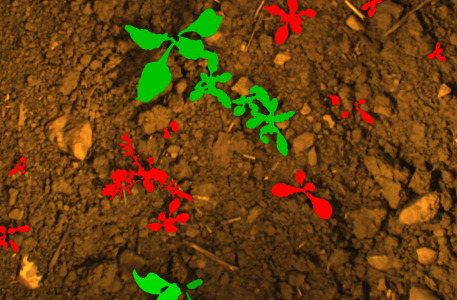
The soil, vegetation and the lower atmosphere are key compartments of the Earth, where almost all activities of mankind take place. This region is characterized by extremely complex patterns, structures and processes that act at different time and space scales. However, the spatial variability of crop and cropping system processes is not well understood. Crops are not only affected by environmental conditions, but also by agricultural management.
The key focus of the sub-project is on managed vegetation in agro-ecosystems used for crop production. Remote sensing technologies will be explored to obtain model parameters and data for model testing over larger areas of cropped land. As about one third of the study site is arable land the proposed project section fills an important gap in the regional modelling of the soil-vegetation-atmosphere system. (Co-PI: B. Waske; funding: German Research Foundation (DFG) SFB TR32)