Wolfgang Förstner
retired Contact:Email: wfoerstn@nulluni-bonn.de
Tel: +49 – 228 – 73 – 2716
Fax: +49 – 228 – 73 – 27 12
Office: Nussallee 15, 1. OG, room 1.001
Address:
University of Bonn
Photogrammetry, IGG
Nussallee 15
53115 Bonn
Research Interests
- Image Analysis
- Statistical Modelling
- Pattern Recognition
- Machine Leaning
- Semantic Modelling
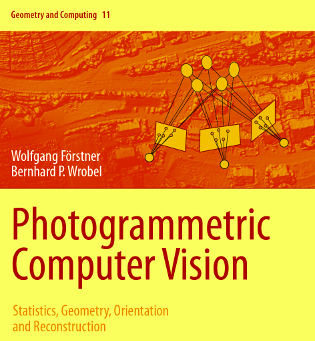
Book: Photogrammetric Computer Vision
Photogrammetric Computer Vision (W. Förstner, B. P. Wrobel, Springer 2016)online available (10/2016)
Short CV
Wolfgang Förstner, born 1946, studied Geodesy at Stuttgart University (1967-1971), where he also finished his PhD in 1976 and his habilitation in 1989. After his “Referendarzeit´´ he worked at the Survey Department of Nordrhein-Westfalen (1974-1979). Until 1989 he was research scientist at the Institute for Photogrammetry of the Technical University Stuttgart. From 1990-2012 he chaired the Department of Photogrammetry at Bonn University. He published more than 200 scientific papers, supervised appr. 70 Bachelor and Master Theses and more than 30 PhD Theses. From 1994-2001 he was vice president of the German Association for Pattern Recognition (DAGM). He served as associated editor of IEEE Transactions on Pattern Analysis and Machine Intelligence 2008-2012.
Awards
- ISPRS Karl-Kraus-Medal award for the textbook Photogrammetric Computer Vision – Statistics, Geometry, Orientation and Reconstruction (2020)
- Brock Award of the International Society of Photogrammetry and Remote Sensing (2016)
- Honorary Doctorate of the Technical University of Graz (2011)
- Honorary Doctorate of the Leibniz University of Hannover (2011)
- Fellow of the International Society of Photogrammetry and Remote Sensing (2010)
- Photogrammetric (Fairchild) Award of ASPRS (2005)
- DAGM main award (2000, with A. Brunn, S. Heuel)
- Cino Cassinis Award of ISPRS (2000)
- DAGM award (2001, with M. Luxen)
- DAGM main award (1998, with S. Abraham)
- DAGM award (1997, with S. Abraham)
- DAGM main award (1989, with M. Sester)
- Carl-Pulfrich-Award (1987, with H. Schewe)
Software
Private
Publications
2023
- W. Förstner, “Friedrich Ackermann’s scientific research program,” Geo-spatial Information Science, pp. 1-10, 2023. doi:10.1080/10095020.2023.2231273
[BibTeX] [PDF]@Article{foerstner23:friedrich, author = {Wolfgang Förstner}, journal = {Geo-spatial Information Science}, title = {Friedrich Ackermann’s scientific research program}, year = {2023}, number = {0}, pages = {1-10}, volume = {0}, doi = {10.1080/10095020.2023.2231273}, eprint = {https://doi.org/10.1080/10095020.2023.2231273}, publisher = {Taylor & Francis}, url = {https://www.tandfonline.com/doi/pdf/10.1080/10095020.2023.2231273?download=true}, } - D. Barath, D. Mishkin, M. Polic, W. Förstner, and J. Matas, “A Large-Scale Homography Benchmark,” in Proc. of the IEEE/CVF Conf. on Computer Vision and Pattern Recognition (CVPR), 2023, pp. 21360-21370.
[BibTeX] [PDF]@InProceedings{Barath2023cvpr, author = {Barath, Daniel and Mishkin, Dmytro and Polic, Michal and F\"orstner, Wolfgang and Matas, Jiri}, title = {A Large-Scale Homography Benchmark}, booktitle = cvpr, year = {2023}, pages = {21360-21370}, url = {https://openaccess.thecvf.com/content/CVPR2023/papers/Barath_A_Large-Scale_Homography_Benchmark_CVPR_2023_paper.pdf}, }
2021
- K. Schindler and W. Förstner, “Photogrammetry,” in Computer Vision, A Reference Guide, 2nd Edition, K. Ikeuchi, Ed., , 2021. doi:10.1007/978-3-030-63416-2
[BibTeX] [PDF]
This comprehensive reference provides easy access to relevant information on all aspects of Computer Vision. An A-Z format of over 240 entries offers a diverse range of topics for those seeking entry into any aspect within the broad field of Computer Vision. Over 200 Authors from both industry and academia contributed to this volume. Each entry includes synonyms, a definition and discussion of the topic, and a robust bibliography. Extensive cross-references to other entries support efficient, user-friendly searches for immediate access to relevant information. Entries were peer-reviewed by a distinguished international advisory board, both scientifically and geographically diverse, ensuring balanced coverage. Over 3700 bibliographic references for further reading enable deeper exploration into any of the topics covered. The content of Computer Vision: A Reference Guide is expository and tutorial, making the book a practical resource for students who are considering entering the field, as well as professionals in other fields who need to access this vital information but may not have the time to work their way through an entire text on their topic of interest.
@InCollection{schindler2021inbook, author = {Konrad Schindler and Wolfgang F{\"{o}}rstner}, booktitle = {{Computer Vision, {A} Reference Guide, 2nd Edition}}, title = {Photogrammetry}, editor = {{K. Ikeuchi}}, abstract = {This comprehensive reference provides easy access to relevant information on all aspects of Computer Vision. An A-Z format of over 240 entries offers a diverse range of topics for those seeking entry into any aspect within the broad field of Computer Vision. Over 200 Authors from both industry and academia contributed to this volume. Each entry includes synonyms, a definition and discussion of the topic, and a robust bibliography. Extensive cross-references to other entries support efficient, user-friendly searches for immediate access to relevant information. Entries were peer-reviewed by a distinguished international advisory board, both scientifically and geographically diverse, ensuring balanced coverage. Over 3700 bibliographic references for further reading enable deeper exploration into any of the topics covered. The content of Computer Vision: A Reference Guide is expository and tutorial, making the book a practical resource for students who are considering entering the field, as well as professionals in other fields who need to access this vital information but may not have the time to work their way through an entire text on their topic of interest. }, http = {{https://link.springer.com/content/pdf/bfm%3A978-3-030-63416-2%2F1.pdf}}, doi = {10.1007/978-3-030-63416-2}, page = {968--970}, year = {2021}, } - W. Förstner, Bayes-Schätzung und Maximum-Likelihood-Schätzung, 2021.
[BibTeX] [PDF]
Das Ziel dieser Notiz ist das Prinzip der Bayes-Schätzung und der Maximum-Likelihood-Schätzung zu erläutern.
@misc{foerstner2021bayesml,
author = {W. F{\"o}rstner},
title = {{Bayes-Sch{\"a}tzung und Maximum-Likelihood-Sch{\"a}tzung}},
year = 2021,
url = {https://www.ipb.uni-bonn.de/pdfs/foerstner2021bayesml.pdf},
abstract = {Das Ziel dieser Notiz ist das Prinzip der Bayes-Sch{\"a}tzung und der Maximum-Likelihood-Sch{\"a}tzung zu erl{\"a}utern.},
}
2020
- W. Förstner, “Symmetric Least Squares Matching – Sym-LSM,” Institut für Photogrammetrie, Universität Bonn 2020.
[BibTeX] [PDF] [Code]@TechReport{foerstner2020report-sym-lsm, author = {F{\"o}rstner, Wolfgang}, title = {{Symmetric Least Squares Matching -- Sym-LSM}}, institution = {Institut für Photogrammetrie, Universität Bonn}, year = {2020}, codeurl = {https://www.ipb.uni-bonn.de/symmetric-least-squares-matching}, }
2017
- W. Förstner, Some Comments on the Relations of Photogrammetry and Industry, 2017.
[BibTeX] [PDF]@Unpublished{foerstner2017misc, title = {{Some Comments on the Relations of Photogrammetry and Industry}}, author = {W. F{\"o}rstner}, note = {Note for Photogrammetric Record}, year = {2017}, owner = {wf}, url = {https://www.ipb.uni-bonn.de/pdfs/foerstner17comments.pdf}, } - W. Förstner and K. Khoshelham, “Efficient and Accurate Registration of Point Clouds with Plane to Plane Correspondences,” in 3rd International Workshop on Recovering 6D Object Pose, 2017.
[BibTeX] [PDF]
We propose and analyse methods to efficiently register point clouds based on plane correspondences. This is relevant in man-made environments, where most objects are bounded by planar surfaces. Based on a segmentation of the point clouds into planar regions and matches of planes in different point clouds, we (1) optimally estimate the relative pose(s); (2) provide three direct solutions, of which two take the uncertainty of the given planes into account; and (3) analyse the loss in accuracy of the direct solutions as compared to the optimal solution. The paper presents the different solutions, derives their uncertainty especially of the suboptimal direct solutions, and compares their accuracy based on simulated and real data. We show that the direct methods that exploit the uncertainty of the planes lead to a maximum loss of 2.76 in accuracy of the estimated motion parameters in terms of the achieved standard deviations compared to the optimal estimates. We also show that the results are more accurate than the classical iterative closest point and iterative closest plane method, but the estimation procedures have a significantly lower computational complexity. We finally show how to generalize the estimation scheme to simultaneously register multiple point clouds.
@InProceedings{foerstner2017ws, author = {Wolfgang F{\"o}rstner and Kourosh Khoshelham}, title = {{Efficient and Accurate Registration of Point Clouds with Plane to Plane Correspondences}}, booktitle = {3rd International Workshop on Recovering 6D Object Pose}, year = {2017}, abstract = {We propose and analyse methods to efficiently register point clouds based on plane correspondences. This is relevant in man-made environments, where most objects are bounded by planar surfaces. Based on a segmentation of the point clouds into planar regions and matches of planes in different point clouds, we (1) optimally estimate the relative pose(s); (2) provide three direct solutions, of which two take the uncertainty of the given planes into account; and (3) analyse the loss in accuracy of the direct solutions as compared to the optimal solution. The paper presents the different solutions, derives their uncertainty especially of the suboptimal direct solutions, and compares their accuracy based on simulated and real data. We show that the direct methods that exploit the uncertainty of the planes lead to a maximum loss of 2.76 in accuracy of the estimated motion parameters in terms of the achieved standard deviations compared to the optimal estimates. We also show that the results are more accurate than the classical iterative closest point and iterative closest plane method, but the estimation procedures have a significantly lower computational complexity. We finally show how to generalize the estimation scheme to simultaneously register multiple point clouds.}, url = {https://www.ipb.uni-bonn.de/pdfs/foerstner17efficient.pdf}, } - W. Förstner and K. Khoshelham, Supplement to: Efficient and Accurate Registration of Point Clouds with Plane to Plane Correspondences, 2017.
[BibTeX] [PDF]@Unpublished{foerstner2017misc, title = {{Supplement to: Efficient and Accurate Registration of Point Clouds with Plane to Plane Correspondences}}, author = {Wolfgang F{\"o}rstner and Kourosh Khoshelham}, year = {2017}, url = {https://www.ipb.uni-bonn.de/pdfs/foerstner17efficient_supp.pdf}, } - J. Schneider, C. Stachniss, and W. Förstner, “On the Quality and Efficiency of Approximate Solutions to Bundle Adjustment with Epipolar and Trifocal Constraints,” in ISPRS Annals of Photogrammetry, Remote Sensing and Spatial Information Sciences, 2017, pp. 81-88. doi:10.5194/isprs-annals-IV-2-W3-81-2017
[BibTeX] [PDF]
Bundle adjustment is a central part of most visual SLAM and Structure from Motion systems and thus a relevant component of UAVs equipped with cameras. This paper makes two contributions to bundle adjustment. First, we present a novel approach which exploits trifocal constraints, i.e., constraints resulting from corresponding points observed in three camera images, which allows to estimate the camera pose parameters without 3D point estimation. Second, we analyze the quality loss compared to the optimal bundle adjustment solution when applying different types of approximations to the constrained optimization problem to increase efficiency. We implemented and thoroughly evaluated our approach using a UAV performing mapping tasks in outdoor environments. Our results indicate that the complexity of the constraint bundle adjustment can be decreased without loosing too much accuracy.
@InProceedings{schneider2017uavg,
title = {On the Quality and Efficiency of Approximate Solutions to Bundle Adjustment with Epipolar and Trifocal Constraints},
author = {J. Schneider and C. Stachniss and W. F\"orstner},
booktitle = {ISPRS Annals of Photogrammetry, Remote Sensing and Spatial Information Sciences},
year = {2017},
pages = {81-88},
volume = {IV-2/W3},
abstract = {Bundle adjustment is a central part of most visual SLAM and Structure from Motion systems and thus a relevant component of UAVs equipped with cameras. This paper makes two contributions to bundle adjustment. First, we present a novel approach which exploits trifocal constraints, i.e., constraints resulting from corresponding points observed in three camera images, which allows to estimate the camera pose parameters without 3D point estimation. Second, we analyze the quality loss compared to the optimal bundle adjustment solution when applying different types of approximations to the constrained optimization problem to increase efficiency. We implemented and thoroughly evaluated our approach using a UAV performing mapping tasks in outdoor environments. Our results indicate that the complexity of the constraint bundle adjustment can be decreased without loosing too much accuracy.},
doi = {10.5194/isprs-annals-IV-2-W3-81-2017},
url = {https://www.isprs-ann-photogramm-remote-sens-spatial-inf-sci.net/IV-2-W3/81/2017/isprs-annals-IV-2-W3-81-2017.pdf},
}
2016
- W. Förstner, “A Future for Learning Semantic Models of Man-Made Environments,” in Proc. of Int. Conf. on Pattern Recognition (ICPR), 2016.
[BibTeX] [PDF]
Deriving semantic 3D models of man-made environments hitherto has not reached the desired maturity which makes human interaction obsolete. Man-made environments play a central role in navigation, city planning, building management systems, disaster management or augmented reality. They are characterised by rich geometric and semantic structures. These cause conceptual problems when learning generic models or when developing automatic acquisition systems. The problems appear to be caused by (1) the incoherence of the models for signal analysis, (2) the type of interplay between discrete and continuous geometric representations, (3) the inefficiency of the interaction between crisp models, such as partonomies and taxonomies, and soft models, mostly having a probabilistic nature, and (4) the vagueness of the used notions in the envisaged application domains. The paper wants to encourage the development and learning of generative models, specifically for man-made objects, to be able to understand, reason about, and explain interpretations.
@InProceedings{foerstner2016future, title = {{A Future for Learning Semantic Models of Man-Made Environments}}, author = {W. F{\"o}rstner}, booktitle = {Proc. of Int. Conf. on Pattern Recognition (ICPR)}, year = {2016}, abstract = {Deriving semantic 3D models of man-made environments hitherto has not reached the desired maturity which makes human interaction obsolete. Man-made environments play a central role in navigation, city planning, building management systems, disaster management or augmented reality. They are characterised by rich geometric and semantic structures. These cause conceptual problems when learning generic models or when developing automatic acquisition systems. The problems appear to be caused by (1) the incoherence of the models for signal analysis, (2) the type of interplay between discrete and continuous geometric representations, (3) the inefficiency of the interaction between crisp models, such as partonomies and taxonomies, and soft models, mostly having a probabilistic nature, and (4) the vagueness of the used notions in the envisaged application domains. The paper wants to encourage the development and learning of generative models, specifically for man-made objects, to be able to understand, reason about, and explain interpretations.}, url = {https://www.ipb.uni-bonn.de/pdfs/foerstner16Future.pdf}, } - W. Förstner and B. P. Wrobel, Photogrammetric Computer Vision – Statistics, Geometry, Orientation and Reconstruction, Springer, 2016.
[BibTeX]@Book{foerstner2016photogrammetric, title = {{Photogrammetric Computer Vision -- Statistics, Geometry, Orientation and Reconstruction}}, author = {W. F{\"o}rstner and B. P. Wrobel}, publisher = {Springer}, year = {2016}, } - J. Schneider, C. Eling, L. Klingbeil, H. Kuhlmann, W. Förstner, and C. Stachniss, “Fast and Effective Online Pose Estimation and Mapping for UAVs,” in Proc. of the IEEE Intl. Conf. on Robotics & Automation (ICRA), 2016, p. 4784–4791. doi:10.1109/ICRA.2016.7487682
[BibTeX] [PDF]
Online pose estimation and mapping in unknown environments is essential for most mobile robots. Especially autonomous unmanned aerial vehicles require good pose estimates at comparably high frequencies. In this paper, we propose an effective system for online pose and simultaneous map estimation designed for light-weight UAVs. Our system consists of two components: (1) real-time pose estimation combining RTK-GPS and IMU at 100 Hz and (2) an effective SLAM solution running at 10 Hz using image data from an omnidirectional multi-fisheye-camera system. The SLAM procedure combines spatial resection computed based on the map that is incrementally refined through bundle adjustment and combines the image data with raw GPS observations and IMU data on keyframes. The overall system yields a real-time, georeferenced pose at 100 Hz in GPS-friendly situations. Additionally, we obtain a precise pose and feature map at 10 Hz even in cases where the GPS is not observable or underconstrained. Our system has been implemented and thoroughly tested on a 5 kg copter and yields accurate and reliable pose estimation at high frequencies. We compare the point cloud obtained by our method with a model generated from georeferenced terrestrial laser scanner.
@InProceedings{schneider16icra, title = {Fast and Effective Online Pose Estimation and Mapping for UAVs}, author = {J. Schneider and C. Eling and L. Klingbeil and H. Kuhlmann and W. F\"orstner and C. Stachniss}, booktitle = icra, year = {2016}, pages = {4784--4791}, abstract = {Online pose estimation and mapping in unknown environments is essential for most mobile robots. Especially autonomous unmanned aerial vehicles require good pose estimates at comparably high frequencies. In this paper, we propose an effective system for online pose and simultaneous map estimation designed for light-weight UAVs. Our system consists of two components: (1) real-time pose estimation combining RTK-GPS and IMU at 100 Hz and (2) an effective SLAM solution running at 10 Hz using image data from an omnidirectional multi-fisheye-camera system. The SLAM procedure combines spatial resection computed based on the map that is incrementally refined through bundle adjustment and combines the image data with raw GPS observations and IMU data on keyframes. The overall system yields a real-time, georeferenced pose at 100 Hz in GPS-friendly situations. Additionally, we obtain a precise pose and feature map at 10 Hz even in cases where the GPS is not observable or underconstrained. Our system has been implemented and thoroughly tested on a 5 kg copter and yields accurate and reliable pose estimation at high frequencies. We compare the point cloud obtained by our method with a model generated from georeferenced terrestrial laser scanner.}, doi = {10.1109/ICRA.2016.7487682}, url = {https://www.ipb.uni-bonn.de/pdfs/schneider16icra.pdf}, } - J. Schneider, C. Stachniss, and W. Förstner, “Dichtes Stereo mit Fisheye-Kameras,” in UAV 2016 – Vermessung mit unbemannten Flugsystemen, 2016, pp. 247-264.
[BibTeX]@InProceedings{schneider16dvw, title = {Dichtes Stereo mit Fisheye-Kameras}, author = {J. Schneider and C. Stachniss and W. F\"orstner}, booktitle = {UAV 2016 -- Vermessung mit unbemannten Flugsystemen}, year = {2016}, pages = {247-264}, publisher = {Wi{\ss}ner Verlag}, series = {Schriftenreihe des DVW}, volume = {82}, } - J. Schneider, C. Stachniss, and W. Förstner, “On the Accuracy of Dense Fisheye Stereo,” IEEE Robotics and Automation Letters (RA-L), vol. 1, iss. 1, pp. 227-234, 2016. doi:10.1109/LRA.2016.2516509
[BibTeX] [PDF]
Fisheye cameras offer a large field of view, which is important for several robotics applications as a larger field of view allows for covering a large area with a single image. In contrast to classical cameras, however, fisheye cameras cannot be approximated well using the pinhole camera model and this renders the computation of depth information from fisheye stereo image pairs more complicated. In this work, we analyze the combination of an epipolar rectification model for fisheye stereo cameras with existing dense methods. This has the advantage that existing dense stereo systems can be applied as a black-box even with cameras that have field of view of more than 180 deg to obtain dense disparity information. We thoroughly investigate the accuracy potential of such fisheye stereo systems using image data from our UAV. The empirical analysis is based on image pairs of a calibrated fisheye stereo camera system and two state-of-the-art algorithms for dense stereo applied to adequately rectified image pairs from fisheye stereo cameras. The canonical stochastic model for sensor points assumes homogeneous uncertainty and we generalize this model based on an empirical analysis using a test scene consisting of mutually orthogonal planes. We show (1) that the combination of adequately rectified fisheye image pairs and dense methods provides dense 3D point clouds at 6-7 Hz on our autonomous multi-copter UAV, (2) that the uncertainty of points depends on their angular distance from the optical axis, (3) how to estimate the variance component as a function of that distance, and (4) how the improved stochastic model improves the accuracy of the scene points.
@Article{schneider16ral, title = {On the Accuracy of Dense Fisheye Stereo}, author = {J. Schneider and C. Stachniss and W. F\"orstner}, journal = ral, year = {2016}, number = {1}, pages = {227-234}, volume = {1}, abstract = {Fisheye cameras offer a large field of view, which is important for several robotics applications as a larger field of view allows for covering a large area with a single image. In contrast to classical cameras, however, fisheye cameras cannot be approximated well using the pinhole camera model and this renders the computation of depth information from fisheye stereo image pairs more complicated. In this work, we analyze the combination of an epipolar rectification model for fisheye stereo cameras with existing dense methods. This has the advantage that existing dense stereo systems can be applied as a black-box even with cameras that have field of view of more than 180 deg to obtain dense disparity information. We thoroughly investigate the accuracy potential of such fisheye stereo systems using image data from our UAV. The empirical analysis is based on image pairs of a calibrated fisheye stereo camera system and two state-of-the-art algorithms for dense stereo applied to adequately rectified image pairs from fisheye stereo cameras. The canonical stochastic model for sensor points assumes homogeneous uncertainty and we generalize this model based on an empirical analysis using a test scene consisting of mutually orthogonal planes. We show (1) that the combination of adequately rectified fisheye image pairs and dense methods provides dense 3D point clouds at 6-7 Hz on our autonomous multi-copter UAV, (2) that the uncertainty of points depends on their angular distance from the optical axis, (3) how to estimate the variance component as a function of that distance, and (4) how the improved stochastic model improves the accuracy of the scene points.}, doi = {10.1109/LRA.2016.2516509}, url = {https://www.ipb.uni-bonn.de/pdfs/schneider16ral.pdf}, } - S. Wenzel and W. Förstner, “Facade Interpretation Using a Marked Point Process,” in ISPRS Annals of Photogrammetry, Remote Sensing and Spatial Information Sciences, 2016, p. 363–370. doi:10.5194/isprs-annals-III-3-363-2016
[BibTeX] [PDF]
Our objective is the interpretation of facade images in a top-down manner, using a Markov marked point process formulated as a Gibbs process. Given single rectified facade images we aim at the accurate detection of relevant facade objects as windows and entrances, using prior knowledge about their possible configurations within facade images. We represent facade objects by a simplified rectangular object model and present an energy model which evaluates the agreement of a proposed configuration with the given image and the statistics about typical configurations which we learned from training data. We show promising results on different datasets and provide a quantitative evaluation, which demonstrates the capability of complete and accurate detection of facade objects.
@InProceedings{wenzel2016facade,
title = {{Facade Interpretation Using a Marked Point Process}},
author = {Wenzel, Susanne and F{\" o}rstner, Wolfgang},
booktitle = {ISPRS Annals of Photogrammetry, Remote Sensing and Spatial Information Sciences},
year = {2016},
pages = {363--370},
volume = {III-3},
abstract = {Our objective is the interpretation of facade images in a top-down manner, using a Markov marked point process formulated as a Gibbs process. Given single rectified facade images we aim at the accurate detection of relevant facade objects as windows and entrances, using prior knowledge about their possible configurations within facade images. We represent facade objects by a simplified rectangular object model and present an energy model which evaluates the agreement of a proposed configuration with the given image and the statistics about typical configurations which we learned from training data. We show promising results on different datasets and provide a quantitative evaluation, which demonstrates the capability of complete and accurate detection of facade objects.},
doi = {10.5194/isprs-annals-III-3-363-2016},
url = {https://www.ipb.uni-bonn.de/pdfs/Wenzel2016Facade.pdf},
}
2014
- K. Herzog, R. Roscher, M. Wieland, A. Kicherer, T. Läbe, W. Förstner, H. Kuhlmann, and R. Töpfer, “Initial steps for high-throughput phenotyping in vineyards,” VITIS – Journal of Grapevine Research, vol. 53, iss. 1, p. 1–8, 2014.
[BibTeX]
The evaluation of phenotypic characters of grape- vines is required directly in the vineyard and is strongly limited by time, costs and the subjectivity of person in charge. Sensor-based techniques are prerequisite to al- low non-invasive phenotyping of individual plant traits, to increase the quantity of object records and to reduce error variation. Thus, a Prototype-Image-Acquisition- System (PIAS) was developed for semi-automated cap- ture of geo-referenced RGB images in an experimental vineyard. Different strategies were tested for image in- terpretation using Matlab. The interpretation of imag- es from the vineyard with the real background is more practice-oriented but requires the calculation of depth maps. Images were utilised to verify the phenotyping results of two semi-automated and one automated pro- totype image interpretation framework. The semi-auto- mated procedures enable contactless and non-invasive detection of bud burst and quantification of shoots at an early developmental stage (BBCH 10) and enable fast and accurate determination of the grapevine berry size at BBCH 89. Depending on the time of image ac- quisition at BBCH 10 up to 94 \% of green shoots were visible in images. The mean berry size (BBCH 89) was recorded non-invasively with a precision of 1 mm.
@Article{herzog2014initial, title = {Initial steps for high-throughput phenotyping in vineyards}, author = {Herzog, Katja and Roscher, Ribana and Wieland, Markus and Kicherer,Anna and L\"abe, Thomas and F\"orstner, Wolfgang and Kuhlmann, Heiner and T\"opfer, Reinhard}, journal = {VITIS - Journal of Grapevine Research}, year = {2014}, month = jan, number = {1}, pages = {1--8}, volume = {53}, abstract = {The evaluation of phenotypic characters of grape- vines is required directly in the vineyard and is strongly limited by time, costs and the subjectivity of person in charge. Sensor-based techniques are prerequisite to al- low non-invasive phenotyping of individual plant traits, to increase the quantity of object records and to reduce error variation. Thus, a Prototype-Image-Acquisition- System (PIAS) was developed for semi-automated cap- ture of geo-referenced RGB images in an experimental vineyard. Different strategies were tested for image in- terpretation using Matlab. The interpretation of imag- es from the vineyard with the real background is more practice-oriented but requires the calculation of depth maps. Images were utilised to verify the phenotyping results of two semi-automated and one automated pro- totype image interpretation framework. The semi-auto- mated procedures enable contactless and non-invasive detection of bud burst and quantification of shoots at an early developmental stage (BBCH 10) and enable fast and accurate determination of the grapevine berry size at BBCH 89. Depending on the time of image ac- quisition at BBCH 10 up to 94 \% of green shoots were visible in images. The mean berry size (BBCH 89) was recorded non-invasively with a precision of 1 mm.}, } - A. Kicherer, R. Roscher, K. Herzog, W. Förstner, and R. Töpfer, “Image based Evaluation for the Detection of Cluster Parameters in Grapevine,” in Acta horticulturae, 2014.
[BibTeX]@InProceedings{kicherer2014evaluation, title = {Image based Evaluation for the Detection of Cluster Parameters in Grapevine}, author = {Kicherer, A. and Roscher, R. and Herzog, K. and F\"orstner, W. and T\"opfer, R.}, booktitle = {Acta horticulturae}, year = {2014}, owner = {ribana}, timestamp = {2016.06.20}, } - L. Klingbeil, M. Nieuwenhuisen, J. Schneider, C. Eling, D. Droeschel, D. Holz, T. Läbe, W. Förstner, S. Behnke, and H. Kuhlmann, “Towards Autonomous Navigation of an UAV-based Mobile Mapping System,” in 4th International Conf. on Machine Control & Guidance, 2014, p. 136–147.
[BibTeX] [PDF]
For situations, where mapping is neither possible from high altitudes nor from the ground, we are developing an autonomous micro aerial vehicle able to fly at low altitudes in close vicinity of obstacles. This vehicle is based on a MikroKopterTM octocopter platform (maximum total weight: 5kg), and contains a dual frequency GPS board, an IMU, a compass, two stereo camera pairs with fisheye lenses, a rotating 3D laser scanner, 8 ultrasound sensors, a real-time processing unit, and a compact PC for on-board ego-motion estimation and obstacle detection for autonomous navigation. A high-resolution camera is used for the actual mapping task, where the environment is reconstructed in three dimensions from images, using a highly accurate bundle adjustment. In this contribution, we describe the sensor system setup and present results from the evaluation of several aspects of the different subsystems as well as initial results from flight tests.
@InProceedings{klingbeil14mcg, title = {Towards Autonomous Navigation of an UAV-based Mobile Mapping System}, author = {Klingbeil, Lasse and Nieuwenhuisen, Matthias and Schneider, Johannes and Eling, Christian and Droeschel, David and Holz, Dirk and L\"abe, Thomas and F\"orstner, Wolfgang and Behnke, Sven and Kuhlmann, Heiner}, booktitle = {4th International Conf. on Machine Control \& Guidance}, year = {2014}, pages = {136--147}, abstract = {For situations, where mapping is neither possible from high altitudes nor from the ground, we are developing an autonomous micro aerial vehicle able to fly at low altitudes in close vicinity of obstacles. This vehicle is based on a MikroKopterTM octocopter platform (maximum total weight: 5kg), and contains a dual frequency GPS board, an IMU, a compass, two stereo camera pairs with fisheye lenses, a rotating 3D laser scanner, 8 ultrasound sensors, a real-time processing unit, and a compact PC for on-board ego-motion estimation and obstacle detection for autonomous navigation. A high-resolution camera is used for the actual mapping task, where the environment is reconstructed in three dimensions from images, using a highly accurate bundle adjustment. In this contribution, we describe the sensor system setup and present results from the evaluation of several aspects of the different subsystems as well as initial results from flight tests.}, url = {https://www.ipb.uni-bonn.de/pdfs/klingbeil14mcg.pdf}, } - R. Roscher, K. Herzog, A. Kunkel, A. Kicherer, R. Töpfer, and W. Förstner, “Automated image analysis framework for high-throughput determination of grapevine berry sizes using conditional random fields,” Computers and Electronics in Agriculture, vol. 100, p. 148–158, 2014. doi:10.1016/j.compag.2013.11.008
[BibTeX]@Article{roscher2014automated, title = {Automated image analysis framework for high-throughput determination of grapevine berry sizes using conditional random fields}, author = {Roscher, Ribana and Herzog, Katja and Kunkel, Annemarie and Kicherer, Anna and T{\"o}pfer, Reinhard and F{\"o}rstner, Wolfgang}, journal = {Computers and Electronics in Agriculture}, year = {2014}, pages = {148--158}, volume = {100}, doi = {10.1016/j.compag.2013.11.008}, publisher = {Elsevier}, } - J. Schneider and W. Förstner, “Real-time Accurate Geo-localization of a MAV with Omnidirectional Visual Odometry and GPS,” in Computer Vision – ECCV 2014 Workshops, 2014, p. 271–282. doi:10.1007/978-3-319-16178-5_18
[BibTeX] [PDF]
This paper presents a system for direct geo-localization of a MAV in an unknown environment using visual odometry and precise real time kinematic (RTK) GPS information. Visual odometry is performed with a multi-camera system with four fisheye cameras that cover a wide field of view which leads to better constraints for localization due to long tracks and a better intersection geometry. Visual observations from the acquired image sequences are refined with a high accuracy on selected keyframes by an incremental bundle adjustment using the iSAM2 algorithm. The optional integration of GPS information yields long-time stability and provides a direct geo-referenced solution. Experiments show the high accuracy which is below 3 cm standard deviation in position.
@InProceedings{schneider14eccv-ws, title = {Real-time Accurate Geo-localization of a MAV with Omnidirectional Visual Odometry and GPS}, author = {J. Schneider and W. F\"orstner}, booktitle = {Computer Vision - ECCV 2014 Workshops}, year = {2014}, pages = {271--282}, abstract = {This paper presents a system for direct geo-localization of a MAV in an unknown environment using visual odometry and precise real time kinematic (RTK) GPS information. Visual odometry is performed with a multi-camera system with four fisheye cameras that cover a wide field of view which leads to better constraints for localization due to long tracks and a better intersection geometry. Visual observations from the acquired image sequences are refined with a high accuracy on selected keyframes by an incremental bundle adjustment using the iSAM2 algorithm. The optional integration of GPS information yields long-time stability and provides a direct geo-referenced solution. Experiments show the high accuracy which is below 3 cm standard deviation in position.}, doi = {10.1007/978-3-319-16178-5_18}, url = {https://www.ipb.uni-bonn.de/pdfs/schneider14eccv-ws.pdf}, } - J. Schneider, T. Läbe, and W. Förstner, “Real-Time Bundle Adjustment with an Omnidirectional Multi-Camera System and GPS,” in Proc. of the 4th International Conf. on Machine Control & Guidance, 2014, p. 98–103.
[BibTeX] [PDF]
In this paper we present our system for visual odometry that performs a fast incremental bundle adjustment for real-time structure and motion estimation in an unknown scene. It is applicable to image streams of a calibrated multi-camera system with omnidirectional cameras. In this paper we use an autonomously flying octocopter that is equipped for visual odometry and obstacle detection with four fisheye cameras, which provide a large field of view. For real-time ego-motion estimation the platform is equipped, besides the cameras, with a dual frequency GPS board, an IMU and a compass. In this paper we show how we apply our system for visual odometry using the synchronized video streams of the four fisheye cameras. The position and orientation information from the GPS-unit and the inertial sensors can optionally be integrated into our system. We will show the obtained accuracy of pure odometry and compare it with the solution from GPS/INS.
@InProceedings{schneider14mcg,
title = {Real-Time Bundle Adjustment with an Omnidirectional Multi-Camera System and GPS},
author = {J. Schneider and T. L\"abe and W. F\"orstner},
booktitle = {Proc. of the 4th International Conf. on Machine Control \& Guidance},
year = {2014},
pages = {98--103},
abstract = {In this paper we present our system for visual odometry that performs a fast incremental bundle adjustment for real-time structure and motion estimation in an unknown scene. It is applicable to image streams of a calibrated multi-camera system with omnidirectional cameras. In this paper we use an autonomously flying octocopter that is equipped for visual odometry and obstacle detection with four fisheye cameras, which provide a large field of view. For real-time ego-motion estimation the platform is equipped, besides the cameras, with a dual frequency GPS board, an IMU and a compass. In this paper we show how we apply our system for visual odometry using the synchronized video streams of the four fisheye cameras. The position and orientation information from the GPS-unit and the inertial sensors can optionally be integrated into our system. We will show the obtained accuracy of pure odometry and compare it with the solution from GPS/INS.},
city = {Braunschweig},
url = {https://www.ipb.uni-bonn.de/pdfs/schneider14mcg.pdf},
}
2013
- D. Chai, W. Förstner, and F. Lafarge, “Recovering Line-Networks in Images by Junction-Point Processes,” in Proc. of the IEEE Conf. on Computer Vision and Pattern Recognition, 2013, pp. 1894-1901. doi:10.1109/CVPR.2013.247
[BibTeX] [PDF]
[none]
@InProceedings{chai13recovering, title = {Recovering Line-Networks in Images by Junction-Point Processes}, author = {D. Chai and W. F\"orstner and F. Lafarge}, booktitle = {Proc. of the IEEE Conf. on Computer Vision and Pattern Recognition}, year = {2013}, pages = {1894-1901}, abstract = {[none]}, doi = {10.1109/CVPR.2013.247}, timestamp = {2015.07.14}, url = {https://www.ipb.uni-bonn.de/pdfs/chai13recovering.pdf}, } - T. Dickscheid and W. Förstner, “A Trainable Markov Random Field for Low-Level Image Feature Matching with Spatial Relationships,” Photogrammetrie, Fernerkundung, Geoinformation (PFG), vol. 4, p. 269–284, 2013. doi:10.1127/1432-8364/2013/0176
[BibTeX]
Many vision applications rely on local features for image analysis, notably in the areas of object recognition, image registration and camera calibration. One important example in photogrammetry are fully automatic algorithms for relative image orientation. Such applications rely on a matching algorithm to extract a sufficient number of correct feature correspondences at acceptable outlier rates, which is most often based on the similarity of feature descriptions. When the number of detected features is low, it is advisable to use multiple feature detectors with complementary properties. When feature similarity is not sufficient for matching, spatial feature relationships provide valuable information. In this work, a highly generic matching algorithm is proposed which is based on a trainable Markov random field (MRF). It is able to incorporate almost arbitrary combinations of features, similarity measures and pairwise spatial relationships, and has a clear statistical interpretation. A major novelty is its ability to compensate for weaknesses in one information cue by implicitely exploiting the strengths of others.
@Article{dickscheid2013trainable, title = {A Trainable Markov Random Field for Low-Level Image Feature Matching with Spatial Relationships}, author = {Dickscheid, Timo and F\"orstner, Wolfgang}, journal = {Photogrammetrie, Fernerkundung, Geoinformation (PFG)}, year = {2013}, pages = {269--284}, volume = {4}, abstract = { Many vision applications rely on local features for image analysis, notably in the areas of object recognition, image registration and camera calibration. One important example in photogrammetry are fully automatic algorithms for relative image orientation. Such applications rely on a matching algorithm to extract a sufficient number of correct feature correspondences at acceptable outlier rates, which is most often based on the similarity of feature descriptions. When the number of detected features is low, it is advisable to use multiple feature detectors with complementary properties. When feature similarity is not sufficient for matching, spatial feature relationships provide valuable information. In this work, a highly generic matching algorithm is proposed which is based on a trainable Markov random field (MRF). It is able to incorporate almost arbitrary combinations of features, similarity measures and pairwise spatial relationships, and has a clear statistical interpretation. A major novelty is its ability to compensate for weaknesses in one information cue by implicitely exploiting the strengths of others. }, doi = {10.1127/1432-8364/2013/0176}, } - W. Förstner, “Graphical Models in Geodesy and Photogrammetry,” Photogrammetrie, Fernerkundung, Geoinformation (PFG), vol. 4, p. 255–268, 2013. doi:10.1127/1432-8364/2013/0175
[BibTeX]
The paper gives an introduction into graphical models and their use in specifying stochastic models in geodesy and photogrammetry. Basic task in adjustment theory can intuitively be described and analysed using graphical models. The paper shows that geodetic networks and bundle adjustments can be interpreted as graphical models, both as Bayesian networks or as conditional random fields. Especially hidden Markov random fields and conditional random fields are demonstrated to be versatile models for parameter estimation and classification.
@Article{foerstner2013graphical, title = {Graphical Models in Geodesy and Photogrammetry}, author = {F\"orstner, Wolfgang}, journal = {Photogrammetrie, Fernerkundung, Geoinformation (PFG)}, year = {2013}, pages = {255--268}, volume = {4}, abstract = { The paper gives an introduction into graphical models and their use in specifying stochastic models in geodesy and photogrammetry. Basic task in adjustment theory can intuitively be described and analysed using graphical models. The paper shows that geodetic networks and bundle adjustments can be interpreted as graphical models, both as Bayesian networks or as conditional random fields. Especially hidden Markov random fields and conditional random fields are demonstrated to be versatile models for parameter estimation and classification. }, doi = {10.1127/1432-8364/2013/0175}, } - W. Förstner, “Photogrammetrische Forschung – Eine Zwischenbilanz aus Bonner Sicht,” Photogrammetrie, Fernerkundung, Geoinformation (PFG), vol. 4, p. 251–254, 2013. doi:10.1127/1432-8364/2013/0186
[BibTeX]
Photogrammetrische Forschung – Eine Zwischenbilanz aus Bonner Sicht
@Article{foerstner2013photogrammetrische, title = {Photogrammetrische Forschung - Eine Zwischenbilanz aus Bonner Sicht}, author = {F\"orstner, Wolfgang}, journal = {Photogrammetrie, Fernerkundung, Geoinformation (PFG)}, year = {2013}, pages = {251--254}, volume = {4}, abstract = {Photogrammetrische Forschung - Eine Zwischenbilanz aus Bonner Sicht}, doi = {10.1127/1432-8364/2013/0186}, } - A. Kicherer, R. Roscher, K. Herzog, S. Šimon, W. Förstner, and R. Töpfer, “BAT (Berry Analysis Tool): A high-throughput image interpretation tool to acquire the number, diameter, and volume of grapevine berries,” Vitis, vol. 52, iss. 3, pp. 129-135, 2013.
[BibTeX]
QTL-analysis (quantitative trait loci) and marker development rely on efficient phenotyping techniques. Objectivity and precision of a phenotypic data evaluation is crucial but time consuming. In the present study a high-throughput image interpretation tool was developed to acquire automatically number, size, and volume of grape berries from RGB (red-green-blue) images. Individual berries of one cluster were placed on a defined construction to take a RGB image from the top. The image interpretation of one dataset with an arbitrary number of images occurs automatically by starting the BAT (Berry-Analysis-Tool) developed in MATLAB. For validation of results, the number of berries was counted and their size was measured using a digital calliper. A measuring cylinder was used to determine reliably the berry volume by displacement of water. All placed berries could be counted by BAT 100\A0\% correctly. Manual ratings compared with BAT ratings showed strong correlation of r\A0=\A00,964 for mean berry diameter/image and r\A0=\A00.984 for berry volume.
@Article{kicherer2013, title = {BAT (Berry Analysis Tool): A high-throughput image interpretation tool to acquire the number, diameter, and volume of grapevine berries}, author = {Kicherer, A. and Roscher, R. and Herzog, K. and {\vS}imon, S. and F\"orstner, W. and T\"opfer, R.}, journal = {Vitis}, year = {2013}, number = {3}, pages = {129-135}, volume = {52}, abstract = {QTL-analysis (quantitative trait loci) and marker development rely on efficient phenotyping techniques. Objectivity and precision of a phenotypic data evaluation is crucial but time consuming. In the present study a high-throughput image interpretation tool was developed to acquire automatically number, size, and volume of grape berries from RGB (red-green-blue) images. Individual berries of one cluster were placed on a defined construction to take a RGB image from the top. The image interpretation of one dataset with an arbitrary number of images occurs automatically by starting the BAT (Berry-Analysis-Tool) developed in MATLAB. For validation of results, the number of berries was counted and their size was measured using a digital calliper. A measuring cylinder was used to determine reliably the berry volume by displacement of water. All placed berries could be counted by BAT 100\A0\% correctly. Manual ratings compared with BAT ratings showed strong correlation of r\A0=\A00,964 for mean berry diameter/image and r\A0=\A00.984 for berry volume.}, owner = {ribana1}, timestamp = {2013.08.14}, } - F. Schindler and W. Förstner, “DijkstraFPS: Graph Partitioning in Geometry and Image Processing,” Photogrammetrie, Fernerkundung, Geoinformation (PFG), vol. 4, p. 285–296, 2013. doi:10.1127/1432-8364/2013/0177
[BibTeX]
Data partitioning is a common problem in the field of point cloud and image processing applicable to segmentation and clustering. The general principle is to have high similarity of two data points, e.g.pixels or 3D points, within one region and low similarity among regions. This pair-wise similarity between data points can be represented in an attributed graph. In this article we propose a novel graph partitioning algorithm. It integrates a sampling strategy known as farthest point sampling with Dijkstra’s algorithm for deriving a distance transform on a general graph, which does not need to be embedded in some space. According to the pair-wise attributes a Voronoi diagram on the graph is generated yielding the desired segmentation. We demonstrate our approach on various applications such as surface triangulation, surface segmentation, clustering and image segmentation.
@Article{schindler2013dijkstrafps, title = {DijkstraFPS: Graph Partitioning in Geometry and Image Processing}, author = {Schindler, Falko and F\"orstner, Wolfgang}, journal = {Photogrammetrie, Fernerkundung, Geoinformation (PFG)}, year = {2013}, pages = {285--296}, volume = {4}, abstract = { Data partitioning is a common problem in the field of point cloud and image processing applicable to segmentation and clustering. The general principle is to have high similarity of two data points, e.g.pixels or 3D points, within one region and low similarity among regions. This pair-wise similarity between data points can be represented in an attributed graph. In this article we propose a novel graph partitioning algorithm. It integrates a sampling strategy known as farthest point sampling with Dijkstra's algorithm for deriving a distance transform on a general graph, which does not need to be embedded in some space. According to the pair-wise attributes a Voronoi diagram on the graph is generated yielding the desired segmentation. We demonstrate our approach on various applications such as surface triangulation, surface segmentation, clustering and image segmentation. }, doi = {10.1127/1432-8364/2013/0177}, } - J. Schneider and W. Förstner, “Bundle Adjustment and System Calibration with Points at Infinity for Omnidirectional Camera Systems,” Z. f. Photogrammetrie, Fernerkundung und Geoinformation, vol. 4, p. 309–321, 2013. doi:10.1127/1432-8364/2013/0179
[BibTeX] [PDF]
We present a calibration method for multi-view cameras that provides a rigorous maximum likelihood estimation of the mutual orientation of the cameras within a rigid multi-camera system. No calibration targets are needed, just a movement of the multi-camera system taking synchronized images of a highly textured and static scene. Multi-camera systems with non-overlapping views have to be rotated within the scene so that corresponding points are visible in different cameras at different times of exposure. By using an extended version of the projective collinearity equation all estimates can be optimized in one bundle adjustment where we constrain the relative poses of the cameras to be fixed. For stabilizing camera orientations – especially rotations – one should generally use points at the horizon within the bundle adjustment, which classical bundle adjustment programs are not capable of. We use a minimal representation of homogeneous coordinates for image and scene points which allows us to use images of omnidirectional cameras with single viewpoint like fisheye cameras and scene points at a large distance from the camera or even at infinity. We show results of our calibration method on (1) the omnidirectional multi-camera system Ladybug 3 from Point Grey, (2) a camera-rig with five cameras used for the acquisition of complex 3D structures and (3) a camera-rig mounted on a UAV consisting of four fisheye cameras which provide a large field of view and which is used for visual odometry and obstacle detection in the project MoD (DFG-Project FOR 1505 “Mapping on Demand”).
@Article{schneider13pfg, title = {Bundle Adjustment and System Calibration with Points at Infinity for Omnidirectional Camera Systems}, author = {J. Schneider and W. F\"orstner}, journal = {Z. f. Photogrammetrie, Fernerkundung und Geoinformation}, year = {2013}, pages = {309--321}, volume = {4}, abstract = {We present a calibration method for multi-view cameras that provides a rigorous maximum likelihood estimation of the mutual orientation of the cameras within a rigid multi-camera system. No calibration targets are needed, just a movement of the multi-camera system taking synchronized images of a highly textured and static scene. Multi-camera systems with non-overlapping views have to be rotated within the scene so that corresponding points are visible in different cameras at different times of exposure. By using an extended version of the projective collinearity equation all estimates can be optimized in one bundle adjustment where we constrain the relative poses of the cameras to be fixed. For stabilizing camera orientations - especially rotations - one should generally use points at the horizon within the bundle adjustment, which classical bundle adjustment programs are not capable of. We use a minimal representation of homogeneous coordinates for image and scene points which allows us to use images of omnidirectional cameras with single viewpoint like fisheye cameras and scene points at a large distance from the camera or even at infinity. We show results of our calibration method on (1) the omnidirectional multi-camera system Ladybug 3 from Point Grey, (2) a camera-rig with five cameras used for the acquisition of complex 3D structures and (3) a camera-rig mounted on a UAV consisting of four fisheye cameras which provide a large field of view and which is used for visual odometry and obstacle detection in the project MoD (DFG-Project FOR 1505 "Mapping on Demand").}, doi = {10.1127/1432-8364/2013/0179}, url = {https://www.dgpf.de/pfg/2013/pfg2013_4_schneider.pdf}, } - J. Schneider, T. Läbe, and W. Förstner, “Incremental Real-time Bundle Adjustment for Multi-camera Systems with Points at Infinity,” in ISPRS Archives of Photogrammetry, Remote Sensing and Spatial Information Sciences, 2013, pp. 355-360. doi:10.5194/isprsarchives-XL-1-W2-355-2013
[BibTeX] [PDF]
This paper presents a concept and first experiments on a keyframe-based incremental bundle adjustment for real-time structure and motion estimation in an unknown scene. In order to avoid periodic batch steps, we use the software iSAM2 for sparse nonlinear incremental optimization, which is highly efficient through incremental variable reordering and fluid relinearization. We adapted the software to allow for (1) multi-view cameras by taking the rigid transformation between the cameras into account, (2) omni-directional cameras as it can handle arbitrary bundles of rays and (3) scene points at infinity, which improve the estimation of the camera orientation as points at the horizon can be observed over long periods of time. The real-time bundle adjustment refers to sets of keyframes, consisting of frames, one per camera, taken in a synchronized way, that are initiated if a minimal geometric distance to the last keyframe set is exceeded. It uses interest points in the keyframes as observations, which are tracked in the synchronized video streams of the individual cameras and matched across the cameras, if possible. First experiments show the potential of the incremental bundle adjustment \wrt time requirements. Our experiments are based on a multi-camera system with four fisheye cameras, which are mounted on a UAV as two stereo pairs, one looking ahead and one looking backwards, providing a large field of view.
@InProceedings{schneider13isprs, title = {Incremental Real-time Bundle Adjustment for Multi-camera Systems with Points at Infinity}, author = {J. Schneider and T. L\"abe and W. F\"orstner}, booktitle = {ISPRS Archives of Photogrammetry, Remote Sensing and Spatial Information Sciences}, year = {2013}, pages = {355-360}, volume = {XL-1/W2}, abstract = {This paper presents a concept and first experiments on a keyframe-based incremental bundle adjustment for real-time structure and motion estimation in an unknown scene. In order to avoid periodic batch steps, we use the software iSAM2 for sparse nonlinear incremental optimization, which is highly efficient through incremental variable reordering and fluid relinearization. We adapted the software to allow for (1) multi-view cameras by taking the rigid transformation between the cameras into account, (2) omni-directional cameras as it can handle arbitrary bundles of rays and (3) scene points at infinity, which improve the estimation of the camera orientation as points at the horizon can be observed over long periods of time. The real-time bundle adjustment refers to sets of keyframes, consisting of frames, one per camera, taken in a synchronized way, that are initiated if a minimal geometric distance to the last keyframe set is exceeded. It uses interest points in the keyframes as observations, which are tracked in the synchronized video streams of the individual cameras and matched across the cameras, if possible. First experiments show the potential of the incremental bundle adjustment \wrt time requirements. Our experiments are based on a multi-camera system with four fisheye cameras, which are mounted on a UAV as two stereo pairs, one looking ahead and one looking backwards, providing a large field of view.}, doi = {10.5194/isprsarchives-XL-1-W2-355-2013}, url = {https://www.int-arch-photogramm-remote-sens-spatial-inf-sci.net/XL-1-W2/355/2013/isprsarchives-XL-1-W2-355-2013.pdf}, } - S. Wenzel and W. Förstner, “Finding Poly-Curves of Straight Line and Ellipse Segments in Images,” Photogrammetrie, Fernerkundung, Geoinformation (PFG), vol. 4, p. 297–308, 2013. doi:10.1127/1432-8364/2013/0178
[BibTeX]
Simplification of given polygons has attracted many researchers. Especially, finding circular and elliptical structures in images is relevant in many applications. Given pixel chains from edge detection, this paper proposes a method to segment them into straight line and ellipse segments. We propose an adaption of Douglas-Peucker’s polygon simplification algorithm using circle segments instead of straight line segments and partition the sequence of points instead the sequence of edges. It is robust and decreases the complexity of given polygons better than the original algorithm. In a second step, we further simplify the poly-curve by merging neighbouring segments to straight line and ellipse segments. Merging is based on the evaluation of variation of entropy for proposed geometric models, which turns out as a combination of hypothesis testing and model selection. We demonstrate the results of {\tt circlePeucker} as well as merging on several images of scenes with significant circular structures and compare them with the method of {\sc Patraucean} et al. (2012).
@Article{wenzel2013finding, title = {Finding Poly-Curves of Straight Line and Ellipse Segments in Images}, author = {Wenzel, Susanne and F\"orstner, Wolfgang}, journal = {Photogrammetrie, Fernerkundung, Geoinformation (PFG)}, year = {2013}, pages = {297--308}, volume = {4}, abstract = {Simplification of given polygons has attracted many researchers. Especially, finding circular and elliptical structures in images is relevant in many applications. Given pixel chains from edge detection, this paper proposes a method to segment them into straight line and ellipse segments. We propose an adaption of Douglas-Peucker's polygon simplification algorithm using circle segments instead of straight line segments and partition the sequence of points instead the sequence of edges. It is robust and decreases the complexity of given polygons better than the original algorithm. In a second step, we further simplify the poly-curve by merging neighbouring segments to straight line and ellipse segments. Merging is based on the evaluation of variation of entropy for proposed geometric models, which turns out as a combination of hypothesis testing and model selection. We demonstrate the results of {\tt circlePeucker} as well as merging on several images of scenes with significant circular structures and compare them with the method of {\sc Patraucean} et al. (2012).}, doi = {10.1127/1432-8364/2013/0178}, file = {Technical Report:Wenzel2013Finding.pdf}, } - S. Wenzel and W. Förstner, “Finding Poly-Curves of Straight Line and Ellipse Segments in Images,” Department of Photogrammetry, University of Bonn, TR-IGG-P-2013-02, 2013.
[BibTeX] [PDF]
Simplification of given polygons has attracted many researchers. Especially, finding circular and elliptical structures in images is relevant in many applications. Given pixel chains from edge detection, this paper proposes a method to segment them into straight line and ellipse segments. We propose an adaption of Douglas-Peucker’s polygon simplification algorithm using circle segments instead of straight line segments and partition the sequence of points instead the sequence of edges. It is robust and decreases the complexity of given polygons better than the original algorithm. In a second step, we further simplify the poly-curve by merging neighbouring segments to straight line and ellipse segments. Merging is based on the evaluation of variation of entropy for proposed geometric models, which turns out as a combination of hypothesis testing and model selection. We demonstrate the results of {\tt circlePeucker} as well as merging on several images of scenes with significant circular structures and compare them with the method of {\sc Patraucean} et al. (2012).
@TechReport{wenzel2013findingtr,
title = {Finding Poly-Curves of Straight Line and Ellipse Segments in Images},
author = {Wenzel, Susanne and F\"orstner, Wolfgang},
institution = {Department of Photogrammetry, University of Bonn},
year = {2013},
month = {July},
number = {TR-IGG-P-2013-02},
abstract = {Simplification of given polygons has attracted many researchers. Especially, finding circular and elliptical structures in images is relevant in many applications. Given pixel chains from edge detection, this paper proposes a method to segment them into straight line and ellipse segments. We propose an adaption of Douglas-Peucker's polygon simplification algorithm using circle segments instead of straight line segments and partition the sequence of points instead the sequence of edges. It is robust and decreases the complexity of given polygons better than the original algorithm. In a second step, we further simplify the poly-curve by merging neighbouring segments to straight line and ellipse segments. Merging is based on the evaluation of variation of entropy for proposed geometric models, which turns out as a combination of hypothesis testing and model selection. We demonstrate the results of {\tt circlePeucker} as well as merging on several images of scenes with significant circular structures and compare them with the method of {\sc Patraucean} et al. (2012).},
url = {https://www.ipb.uni-bonn.de/pdfs/Wenzel2013Finding.pdf},
}
2012
- D. Chai, W. Förstner, and M. Ying Yang, “Combine Markov Random Fields and Marked Point Processes to extract Building from Remotely Sensed Images,” in ISPRS Annals of Photogrammetry, Remote Sensing and Spatial Information Sciences, 2012. doi:10.5194/isprsannals-I-3-365-2012
[BibTeX] [PDF]
Automatic building extraction from remotely sensed images is a research topic much more significant than ever. One of the key issues is object and image representation. Markov random fields usually referring to the pixel level can not represent high-level knowledge well. On the contrary, marked point processes can not represent low-level information well even though they are a powerful model at object level. We propose to combine Markov random fields and marked point processes to represent both low-level information and high-level knowledge, and present a combined framework of modelling and estimation for building extraction from single remotely sensed image. At high level, rectangles are used to represent buildings, and a marked point process is constructed to represent the buildings on ground scene. Interactions between buildings are introduced into the the model to represent their relationships. At the low level, a MRF is used to represent the statistics of the image appearance. Histograms of colours are adopted to represent the building’s appearance. The high-level model and the low-level model are combined by establishing correspondences between marked points and nodes of the MRF. We adopt reversible jump Markov Chain Monte Carlo (RJMCMC) techniques to explore the configuration space at the high level, and adopt a Graph Cut algorithm to optimize configuration at the low level. We propose a top-down schema to use results from high level to guide the optimization at low level, and propose a bottom-up schema to use results from low level to drive the sampling at high level. Experimental results demonstrate that better results can be achieved by adopting such hybrid representation.
@InProceedings{chai*12:combine, title = {Combine Markov Random Fields and Marked Point Processes to extract Building from Remotely Sensed Images}, author = {Chai, D. and F\"orstner, W. and Ying Yang, M.}, booktitle = {ISPRS Annals of Photogrammetry, Remote Sensing and Spatial Information Sciences}, year = {2012}, abstract = {Automatic building extraction from remotely sensed images is a research topic much more significant than ever. One of the key issues is object and image representation. Markov random fields usually referring to the pixel level can not represent high-level knowledge well. On the contrary, marked point processes can not represent low-level information well even though they are a powerful model at object level. We propose to combine Markov random fields and marked point processes to represent both low-level information and high-level knowledge, and present a combined framework of modelling and estimation for building extraction from single remotely sensed image. At high level, rectangles are used to represent buildings, and a marked point process is constructed to represent the buildings on ground scene. Interactions between buildings are introduced into the the model to represent their relationships. At the low level, a MRF is used to represent the statistics of the image appearance. Histograms of colours are adopted to represent the building's appearance. The high-level model and the low-level model are combined by establishing correspondences between marked points and nodes of the MRF. We adopt reversible jump Markov Chain Monte Carlo (RJMCMC) techniques to explore the configuration space at the high level, and adopt a Graph Cut algorithm to optimize configuration at the low level. We propose a top-down schema to use results from high level to guide the optimization at low level, and propose a bottom-up schema to use results from low level to drive the sampling at high level. Experimental results demonstrate that better results can be achieved by adopting such hybrid representation.}, doi = {10.5194/isprsannals-I-3-365-2012}, timestamp = {2015.07.09}, url = {https://www.ipb.uni-bonn.de/pdfs/isprsannals-I-3-365-2012.pdf}, } - W. Förstner, “Minimal Representations for Testing and Estimation in Projective Spaces,” Z. f. Photogrammetrie, Fernerkundung und Geoinformation, vol. 3, p. 209–220, 2012. doi:10.1127/1432-8364/2012/0112
[BibTeX]
Testing and estimation using homogeneous coordinates and matrices has to cope with obstacles such as singularities of covariance matrices and redundant parametrizations. The paper proposes a representation of the uncertainty of all types of geometric entities which (1) only requires the minimum number of parameters, (2) is free of singularities, (3) enables to exploit the simplicity of homogeneous coordinates to represent geometric constraints and (4) allows to handle geometric entities which are at infinity or at least very far away. We develop the concept, discuss its usefulness for bundle adjustment and demonstrate its applicability for determining 3D lines from observed image line segments in a multi view setup.
@Article{forstner2012minimal, title = {Minimal Representations for Testing and Estimation in Projective Spaces}, author = {F\"orstner, Wolfgang}, journal = {Z. f. Photogrammetrie, Fernerkundung und Geoinformation}, year = {2012}, pages = {209--220}, volume = {3}, abstract = {Testing and estimation using homogeneous coordinates and matrices has to cope with obstacles such as singularities of covariance matrices and redundant parametrizations. The paper proposes a representation of the uncertainty of all types of geometric entities which (1) only requires the minimum number of parameters, (2) is free of singularities, (3) enables to exploit the simplicity of homogeneous coordinates to represent geometric constraints and (4) allows to handle geometric entities which are at infinity or at least very far away. We develop the concept, discuss its usefulness for bundle adjustment and demonstrate its applicability for determining 3D lines from observed image line segments in a multi view setup.}, doi = {10.1127/1432-8364/2012/0112}, file = {Technical Report:Forstner2012Minimal.pdf}, timestamp = {2013.01.09}, } - W. Förstner, “Minimal Representations for Testing and Estimation in Projective Spaces,” Department of Photogrammetry, University of Bonn, TR-IGG-P-2012-03, 2012.
[BibTeX] [PDF]
Testing and estimation using homogeneous coordinates and matrices has to cope with obstacles such as singularities of covariance matrices and redundant parametrizations. The paper proposes a representation of the uncertainty of all types of geometric entities which (1) only requires the minimum number of parameters, (2) is free of singularities, (3) enables to exploit the simplicity of homogeneous coordinates to represent geometric constraints and (4) allows to handle geometric entities which are at infinity or at least very far away. We develop the concept, discuss its usefulness for bundle adjustment and demonstrate its applicability for determining 3D lines from observed image line segments in a multi view setup.
@TechReport{forstner2012minimalreport, title = {Minimal Representations for Testing and Estimation in Projective Spaces}, author = {F\"orstner, Wolfgang}, institution = {Department of Photogrammetry, University of Bonn}, year = {2012}, number = {TR-IGG-P-2012-03}, abstract = {Testing and estimation using homogeneous coordinates and matrices has to cope with obstacles such as singularities of covariance matrices and redundant parametrizations. The paper proposes a representation of the uncertainty of all types of geometric entities which (1) only requires the minimum number of parameters, (2) is free of singularities, (3) enables to exploit the simplicity of homogeneous coordinates to represent geometric constraints and (4) allows to handle geometric entities which are at infinity or at least very far away. We develop the concept, discuss its usefulness for bundle adjustment and demonstrate its applicability for determining 3D lines from observed image line segments in a multi view setup.}, url = {https://www.ipb.uni-bonn.de/pdfs/Forstner2012Minimal.pdf}, } - R. Roscher, W. Förstner, and B. Waske, “I²VM: Incremental import vector machines,” Image and Vision Computing, vol. 30, iss. 4-5, p. 263–278, 2012. doi:10.1016/j.imavis.2012.04.004
[BibTeX]
We introduce an innovative incremental learner called incremental import vector machines ((IVM)-V-2). The kernel-based discriminative approach is able to deal with complex data distributions. Additionally, the learner is sparse for an efficient training and testing and has a probabilistic output. We particularly investigate the reconstructive component of import vector machines, in order to use it for robust incremental teaming. By performing incremental update steps, we are able to add and remove data samples, as well as update the current set of model parameters for incremental learning. By using various standard benchmarks, we demonstrate how (IVM)-V-2 is competitive or superior to other incremental methods. It is also shown that our approach is capable of managing concept-drifts in the data distributions. (C) 2012 Elsevier B.V. All rights reserved.
@Article{roscher2012i2vm, title = {I²VM: Incremental import vector machines}, author = {Roscher, Ribana and F\"orstner, Wolfgang and Waske, Bj\"orn}, journal = {Image and Vision Computing}, year = {2012}, month = may, number = {4-5}, pages = {263--278}, volume = {30}, abstract = {We introduce an innovative incremental learner called incremental import vector machines ((IVM)-V-2). The kernel-based discriminative approach is able to deal with complex data distributions. Additionally, the learner is sparse for an efficient training and testing and has a probabilistic output. We particularly investigate the reconstructive component of import vector machines, in order to use it for robust incremental teaming. By performing incremental update steps, we are able to add and remove data samples, as well as update the current set of model parameters for incremental learning. By using various standard benchmarks, we demonstrate how (IVM)-V-2 is competitive or superior to other incremental methods. It is also shown that our approach is capable of managing concept-drifts in the data distributions. (C) 2012 Elsevier B.V. All rights reserved.}, doi = {10.1016/j.imavis.2012.04.004}, owner = {waske}, sn = {0262-8856}, tc = {0}, timestamp = {2012.09.04}, ut = {WOS:000305726700001}, z8 = {0}, z9 = {0}, zb = {0}, } - R. Roscher, J. Siegemund, F. Schindler, and W. Förstner, “Object Tracking by Segmentation Using Incremental Import Vector Machines,” Department of Photogrammetry, University of Bonn 2012.
[BibTeX] [PDF]
We propose a framework for object tracking in image sequences, following the concept of tracking-by-segmentation. The separation of object and background is achieved by a consecutive semantic superpixel segmentation of the images, yielding tight object boundaries. I.e., in the first image a model of the object’s characteristics is learned from an initial, incomplete annotation. This model is used to classify the superpixels of subsequent images to object and background employing graph-cut. We assume the object boundaries to be tight-fitting and the object motion within the image to be affine. To adapt the model to radiometric and geometric changes we utilize an incremental learner in a co-training scheme. We evaluate our tracking framework qualitatively and quantitatively on several image sequences.
@TechReport{roscher2012object, title = {Object Tracking by Segmentation Using Incremental Import Vector Machines}, author = {Roscher, Ribana and Siegemund, Jan and Schindler, Falko and F\"orstner, Wolfgang}, institution = {Department of Photogrammetry, University of Bonn}, year = {2012}, abstract = {We propose a framework for object tracking in image sequences, following the concept of tracking-by-segmentation. The separation of object and background is achieved by a consecutive semantic superpixel segmentation of the images, yielding tight object boundaries. I.e., in the first image a model of the object's characteristics is learned from an initial, incomplete annotation. This model is used to classify the superpixels of subsequent images to object and background employing graph-cut. We assume the object boundaries to be tight-fitting and the object motion within the image to be affine. To adapt the model to radiometric and geometric changes we utilize an incremental learner in a co-training scheme. We evaluate our tracking framework qualitatively and quantitatively on several image sequences.}, city = {Bonn}, url = {https://www.ipb.uni-bonn.de/pdfs/Roscher2012Object.pdf}, } - R. Roscher, B. Waske, and W. Förstner, “Evaluation of Import Vector Machines for Classifying Hyperspectral Data,” Department of Photogrammetry, University of Bonn 2012.
[BibTeX] [PDF]
We evaluate the performance of Import Vector Machines (IVM),a sparse Kernel Logistic Regression approach, for the classification of hyperspectral data. The IVM classifier is applied on two different data sets, using different number of training samples. The performance of IVM to Support Vector Machines (SVM) is compared in terms of accuracy and sparsity. Moreover, the impact of the training sample set on the accuracy and stability of IVM was investigated. The results underline that the IVM perform similar when compared to the popular SVM in terms of accuracy. Moreover, the number of import vectors from the IVM is significantly lower when compared to the number of support vectors from the SVM. Thus, the classification process of the IVM is faster. These findings are independent from the study site, the number of training samples and specific classes. Consequently, the proposed IVM approach is a promising classification method for hyperspectral imagery.
@TechReport{roscher2012evaluation, title = {Evaluation of Import Vector Machines for Classifying Hyperspectral Data}, author = {Roscher, Ribana and Waske, Bj\"orn and F\"orstner, Wolfgang}, institution = {Department of Photogrammetry, University of Bonn}, year = {2012}, abstract = {We evaluate the performance of Import Vector Machines (IVM),a sparse Kernel Logistic Regression approach, for the classification of hyperspectral data. The IVM classifier is applied on two different data sets, using different number of training samples. The performance of IVM to Support Vector Machines (SVM) is compared in terms of accuracy and sparsity. Moreover, the impact of the training sample set on the accuracy and stability of IVM was investigated. The results underline that the IVM perform similar when compared to the popular SVM in terms of accuracy. Moreover, the number of import vectors from the IVM is significantly lower when compared to the number of support vectors from the SVM. Thus, the classification process of the IVM is faster. These findings are independent from the study site, the number of training samples and specific classes. Consequently, the proposed IVM approach is a promising classification method for hyperspectral imagery.}, city = {Bonn}, url = {https://www.ipb.uni-bonn.de/pdfs/Roscher2012Evaluation.pdf}, } - R. Roscher, B. Waske, and W. Förstner, “Incremental Import Vector Machines for Classifying Hyperspectral Data,” IEEE Transactions on Geoscience and Remote Sensing, vol. 50, iss. 9, p. 3463–3473, 2012. doi:10.1109/TGRS.2012.2184292
[BibTeX]
In this paper, we propose an incremental learning strategy for import vector machines (IVM), which is a sparse kernel logistic regression approach. We use the procedure for the concept of self-training for sequential classification of hyperspectral data. The strategy comprises the inclusion of new training samples to increase the classification accuracy and the deletion of noninformative samples to be memory and runtime efficient. Moreover, we update the parameters in the incremental IVM model without retraining from scratch. Therefore, the incremental classifier is able to deal with large data sets. The performance of the IVM in comparison to support vector machines (SVM) is evaluated in terms of accuracy, and experiments are conducted to assess the potential of the probabilistic outputs of the IVM. Experimental results demonstrate that the IVM and SVM perform similar in terms of classification accuracy. However, the number of import vectors is significantly lower when compared to the number of support vectors, and thus, the computation time during classification can be decreased. Moreover, the probabilities provided by IVM are more reliable, when compared to the probabilistic information, derived from an SVM’s output. In addition, the proposed self-training strategy can increase the classification accuracy. Overall, the IVM and its incremental version is worthwhile for the classification of hyperspectral data.
@Article{roscher2012incremental, title = {Incremental Import Vector Machines for Classifying Hyperspectral Data}, author = {Roscher, Ribana and Waske, Bj\"orn and F\"orstner, Wolfgang}, journal = {IEEE Transactions on Geoscience and Remote Sensing}, year = {2012}, month = sep, number = {9}, pages = {3463--3473}, volume = {50}, abstract = {In this paper, we propose an incremental learning strategy for import vector machines (IVM), which is a sparse kernel logistic regression approach. We use the procedure for the concept of self-training for sequential classification of hyperspectral data. The strategy comprises the inclusion of new training samples to increase the classification accuracy and the deletion of noninformative samples to be memory and runtime efficient. Moreover, we update the parameters in the incremental IVM model without retraining from scratch. Therefore, the incremental classifier is able to deal with large data sets. The performance of the IVM in comparison to support vector machines (SVM) is evaluated in terms of accuracy, and experiments are conducted to assess the potential of the probabilistic outputs of the IVM. Experimental results demonstrate that the IVM and SVM perform similar in terms of classification accuracy. However, the number of import vectors is significantly lower when compared to the number of support vectors, and thus, the computation time during classification can be decreased. Moreover, the probabilities provided by IVM are more reliable, when compared to the probabilistic information, derived from an SVM's output. In addition, the proposed self-training strategy can increase the classification accuracy. Overall, the IVM and its incremental version is worthwhile for the classification of hyperspectral data.}, doi = {10.1109/TGRS.2012.2184292}, issn = {0196-2892}, owner = {waske}, timestamp = {2012.09.05}, } - F. Schindler and W. Förstner, “Real-time Camera Guidance for 3d Scene Reconstruction,” in ISPRS Annals of the Photogrammetry, Remote Sensing and Spatial Information Sciences, 2012.
[BibTeX] [PDF]
We propose a framework for multi-view stereo reconstruction exploiting the possibility to interactively guiding the operator during the image acquisition process. Multi-view stereo is a commonly used method to reconstruct both camera trajectory and 3D object shape. After determining an initial solution, a globally optimal reconstruction is usually obtained by executing a bundle adjustment involving all images. Acquiring suitable images, however, still requires an experienced operator to ensure accuracy and completeness of the final solution. We propose an interactive framework for guiding unexperienced users or possibly an autonomous robot. Using approximate camera orientations and object points we estimate point uncertainties within a sliding bundle adjustment and suggest appropriate camera movements. A visual feedback system communicates the decisions to the user in an intuitive way. We demonstrate the suitability of our system with a virtual image acquisition simulation as well as in real-world scenarios. We show that following the camera movements suggested by our system the final scene reconstruction with the automatically extracted key frames is both more complete and more accurate. Possible applications are non-professional 3D acquisition systems on low-cost platforms like mobile phones, autonomously navigating robots as well as online flight planning of unmanned aerial vehicles.
@InProceedings{schindler2012real, title = {Real-time Camera Guidance for 3d Scene Reconstruction}, author = {Falko Schindler and Wolfgang F\"orstner}, booktitle = {ISPRS Annals of the Photogrammetry, Remote Sensing and Spatial Information Sciences}, year = {2012}, volume = {I-3}, abstract = {We propose a framework for multi-view stereo reconstruction exploiting the possibility to interactively guiding the operator during the image acquisition process. Multi-view stereo is a commonly used method to reconstruct both camera trajectory and 3D object shape. After determining an initial solution, a globally optimal reconstruction is usually obtained by executing a bundle adjustment involving all images. Acquiring suitable images, however, still requires an experienced operator to ensure accuracy and completeness of the final solution. We propose an interactive framework for guiding unexperienced users or possibly an autonomous robot. Using approximate camera orientations and object points we estimate point uncertainties within a sliding bundle adjustment and suggest appropriate camera movements. A visual feedback system communicates the decisions to the user in an intuitive way. We demonstrate the suitability of our system with a virtual image acquisition simulation as well as in real-world scenarios. We show that following the camera movements suggested by our system the final scene reconstruction with the automatically extracted key frames is both more complete and more accurate. Possible applications are non-professional 3D acquisition systems on low-cost platforms like mobile phones, autonomously navigating robots as well as online flight planning of unmanned aerial vehicles.}, keywords = {Three-dimensional Reconstruction, Bundle Adjustment, Camera Orientation, Real-time Planning}, url = {https://www.isprs-ann-photogramm-remote-sens-spatial-inf-sci.net/I-3/69/2012/isprsannals-I-3-69-2012.pdf}, } - J. Schneider, F. Schindler, T. Läbe, and W. Förstner, “Bundle Adjustment for Multi-camera Systems with Points at Infinity,” in ISPRS Annals of Photogrammetry, Remote Sensing and Spatial Information Sciences, 2012, p. 75–80. doi:10.5194/isprsannals-I-3-75-2012
[BibTeX] [PDF]
We present a novel approach for a rigorous bundle adjustment for omnidirectional and multi-view cameras, which enables an efficient maximum-likelihood estimation with image and scene points at infinity. Multi-camera systems are used to increase the resolution, to combine cameras with different spectral sensitivities (Z/I DMC, Vexcel Ultracam) or – like omnidirectional cameras – to augment the effective aperture angle (Blom Pictometry, Rollei Panoscan Mark III). Additionally multi-camera systems gain in importance for the acquisition of complex 3D structures. For stabilizing camera orientations – especially rotations – one should generally use points at the horizon over long periods of time within the bundle adjustment that classical bundle adjustment programs are not capable of. We use a minimal representation of homogeneous coordinates for image and scene points. Instead of eliminating the scale factor of the homogeneous vectors by Euclidean normalization, we normalize the homogeneous coordinates spherically. This way we can use images of omnidirectional cameras with single-view point like fisheye cameras and scene points, which are far away or at infinity. We demonstrate the feasibility and the potential of our approach on real data taken with a single camera, the stereo camera FinePix Real 3D W3 from Fujifilm and the multi-camera system Ladybug3 from Point Grey.
@InProceedings{schneider12isprs, title = {Bundle Adjustment for Multi-camera Systems with Points at Infinity}, author = {J. Schneider and F. Schindler and T. L\"abe and W. F\"orstner}, booktitle = {ISPRS Annals of Photogrammetry, Remote Sensing and Spatial Information Sciences}, year = {2012}, pages = {75--80}, volume = {I-3}, abstract = {We present a novel approach for a rigorous bundle adjustment for omnidirectional and multi-view cameras, which enables an efficient maximum-likelihood estimation with image and scene points at infinity. Multi-camera systems are used to increase the resolution, to combine cameras with different spectral sensitivities (Z/I DMC, Vexcel Ultracam) or - like omnidirectional cameras - to augment the effective aperture angle (Blom Pictometry, Rollei Panoscan Mark III). Additionally multi-camera systems gain in importance for the acquisition of complex 3D structures. For stabilizing camera orientations - especially rotations - one should generally use points at the horizon over long periods of time within the bundle adjustment that classical bundle adjustment programs are not capable of. We use a minimal representation of homogeneous coordinates for image and scene points. Instead of eliminating the scale factor of the homogeneous vectors by Euclidean normalization, we normalize the homogeneous coordinates spherically. This way we can use images of omnidirectional cameras with single-view point like fisheye cameras and scene points, which are far away or at infinity. We demonstrate the feasibility and the potential of our approach on real data taken with a single camera, the stereo camera FinePix Real 3D W3 from Fujifilm and the multi-camera system Ladybug3 from Point Grey.}, city = {Melbourne}, doi = {10.5194/isprsannals-I-3-75-2012}, url = {https://www.isprs-ann-photogramm-remote-sens-spatial-inf-sci.net/I-3/75/2012/isprsannals-I-3-75-2012.pdf}, } - S. Wenzel and W. Förstner, “Learning a compositional representation for facade object categorization,” in ISPRS Annals of Photogrammetry, Remote Sensing and the Spatial Information Sciences; Proc. of 22nd Congress of the International Society for Photogrammetry and Remote Sensing (ISPRS), 2012, p. 197–202. doi:10.5194/isprsannals-I-3-197-2012
[BibTeX] [PDF]
Our objective is the categorization of the most dominant objects in facade images, like windows, entrances and balconies. In order to execute an image interpretation of complex scenes we need an interaction between low level bottom-up feature detection and highlevel inference from top-down. A top-down approach would use results of a bottom-up detection step as evidence for some high-level inference of scene interpretation. We present a statistically founded object categorization procedure that is suited for bottom-up object detection. Instead of choosing a bag of features in advance and learning models based on these features, it is more natural to learn which features best describe the target object classes. Therefore we learn increasingly complex aggregates of line junctions in image sections from man-made scenes. We present a method for the classification of image sections by using the histogram of diverse types of line aggregates.
@InProceedings{wenzel2012learning,
title = {Learning a compositional representation for facade object categorization},
author = {Wenzel, Susanne and F\"orstner, Wolfgang},
booktitle = {ISPRS Annals of Photogrammetry, Remote Sensing and the Spatial Information Sciences; Proc. of 22nd Congress of the International Society for Photogrammetry and Remote Sensing (ISPRS)},
year = {2012},
number = { 2012},
pages = {197--202},
volume = {I-3},
abstract = {Our objective is the categorization of the most dominant objects in facade images, like windows, entrances and balconies. In order to execute an image interpretation of complex scenes we need an interaction between low level bottom-up feature detection and highlevel inference from top-down. A top-down approach would use results of a bottom-up detection step as evidence for some high-level inference of scene interpretation. We present a statistically founded object categorization procedure that is suited for bottom-up object detection. Instead of choosing a bag of features in advance and learning models based on these features, it is more natural to learn which features best describe the target object classes. Therefore we learn increasingly complex aggregates of line junctions in image sections from man-made scenes. We present a method for the classification of image sections by using the histogram of diverse types of line aggregates.},
city = {Melbourne},
doi = {10.5194/isprsannals-I-3-197-2012},
proceeding = {ISPRS Annals of Photogrammetry, Remote Sensing and the Spatial Information Sciences; Proc. of 22nd Congress of the International Society for Photogrammetry and Remote Sensing (ISPRS)},
url = {https://www.ipb.uni-bonn.de/pdfs/Wenzel2012Learning.pdf},
}
2011
- S. D. Bauer, F. Korč, and W. Förstner, “The potential of automatic methods of classification to identify leaf diseases from multispectral images,” Precision Agriculture, vol. 12, iss. 3, p. 361–377, 2011. doi:10.1007/s11119-011-9217-6
[BibTeX] [PDF]
Three methods of automatic classification of leaf diseases are described based on high-resolution multispectral stereo images. Leaf diseases are economically important as they can cause a loss of yield. Early and reliable detection of leaf diseases has important practical relevance, especially in the context of precision agriculture for localized treatment with fungicides. We took stereo images of single sugar beet leaves with two cameras (RGB and multispectral) in a laboratory under well controlled illumination conditions. The leaves were either healthy or infected with the leaf spot pathogen Cercospora beticola or the rust fungus Uromyces betae. To fuse information from the two sensors, we generated 3-D models of the leaves. We discuss the potential of two pixelwise methods of classification: k-nearest neighbour and an adaptive Bayes classification with minimum risk assuming a Gaussian mixture model. The medians of pixelwise classification rates achieved in our experiments are 91% for Cercospora beticola and 86% for Uromyces betae. In addition, we investigated the potential of contextual classification with the so called conditional random field method, which seemed to eliminate the typical errors of pixelwise classification.
@Article{bauer2011potential, title = {The potential of automatic methods of classification to identify leaf diseases from multispectral images}, author = {Bauer, Sabine Daniela and Kor{\vc}, Filip and F\"orstner, Wolfgang}, journal = {Precision Agriculture}, year = {2011}, number = {3}, pages = {361--377}, volume = {12}, abstract = {Three methods of automatic classification of leaf diseases are described based on high-resolution multispectral stereo images. Leaf diseases are economically important as they can cause a loss of yield. Early and reliable detection of leaf diseases has important practical relevance, especially in the context of precision agriculture for localized treatment with fungicides. We took stereo images of single sugar beet leaves with two cameras (RGB and multispectral) in a laboratory under well controlled illumination conditions. The leaves were either healthy or infected with the leaf spot pathogen Cercospora beticola or the rust fungus Uromyces betae. To fuse information from the two sensors, we generated 3-D models of the leaves. We discuss the potential of two pixelwise methods of classification: k-nearest neighbour and an adaptive Bayes classification with minimum risk assuming a Gaussian mixture model. The medians of pixelwise classification rates achieved in our experiments are 91% for Cercospora beticola and 86% for Uromyces betae. In addition, we investigated the potential of contextual classification with the so called conditional random field method, which seemed to eliminate the typical errors of pixelwise classification.}, doi = {10.1007/s11119-011-9217-6}, url = {https://www.ipb.uni-bonn.de/pdfs/Bauer2011potential.pdf}, } - T. Dickscheid, F. Schindler, and W. Förstner, “Coding Images with Local Features,” International Journal of Computer Vision, vol. 94, iss. 2, p. 154–174, 2011. doi:10.1007/s11263-010-0340-z
[BibTeX] [PDF]
We present a scheme for measuring completeness of local feature extraction in terms of image coding. Completeness is here considered as good coverage of relevant image information by the features. As each feature requires a certain number of bits which are representative for a certain subregion of the image, we interpret the coverage as a sparse coding scheme. The measure is therefore based on a comparison of two densities over the image domain: An entropy density p_H(x) based on local image statistics, and a feature coding density p_c(x) which is directly computed from each particular set of local features. Motivated by the coding scheme in JPEG, the entropy distribution is derived from the power spectrum of local patches around each pixel position in a statistically sound manner. As the total number of bits for coding the image and for representing it with local features may be different, we measure incompleteness by the Hellinger distance between p_H(x) and p_c(x). We will derive a procedure for measuring incompleteness of possibly mixed sets of local features and show results on standard datasets using some of the most popular region and keypoint detectors, including Lowe, MSER and the recently published SFOP detectors. Furthermore, we will draw some interesting conclusions about the complementarity of detectors.
@Article{dickscheid2011coding, title = {Coding Images with Local Features}, author = {Dickscheid, Timo and Schindler, Falko and F\"orstner, Wolfgang}, journal = {International Journal of Computer Vision}, year = {2011}, number = {2}, pages = {154--174}, volume = {94}, abstract = {We present a scheme for measuring completeness of local feature extraction in terms of image coding. Completeness is here considered as good coverage of relevant image information by the features. As each feature requires a certain number of bits which are representative for a certain subregion of the image, we interpret the coverage as a sparse coding scheme. The measure is therefore based on a comparison of two densities over the image domain: An entropy density p_H(x) based on local image statistics, and a feature coding density p_c(x) which is directly computed from each particular set of local features. Motivated by the coding scheme in JPEG, the entropy distribution is derived from the power spectrum of local patches around each pixel position in a statistically sound manner. As the total number of bits for coding the image and for representing it with local features may be different, we measure incompleteness by the Hellinger distance between p_H(x) and p_c(x). We will derive a procedure for measuring incompleteness of possibly mixed sets of local features and show results on standard datasets using some of the most popular region and keypoint detectors, including Lowe, MSER and the recently published SFOP detectors. Furthermore, we will draw some interesting conclusions about the complementarity of detectors.}, doi = {10.1007/s11263-010-0340-z}, issn = {0920-5691}, issue = {2}, publisher = {Springer Netherlands}, url = {https://www.ipb.uni-bonn.de/pdfs/Dickscheid2011Coding.pdf}, } - R. Roscher, F. Schindler, and W. Förstner, “What would you look like in Springfield%3F Linear Transformations between High-Dimensional Spaces,” Department of Photogrammetry, University of Bonn 2011.
[BibTeX] [PDF]
High-dimensional data structures occur in many fields of computer vision and machine learning. Transformation between two high-dimensional spaces usually involves the determination of a large amount of parameters and requires much labeled data to be given. There is much interest in reducing dimensionality if a lower-dimensional structure is underlying the data points. We present a procedure to enable the determination of a low-dimensional, projective transformation between two data sets, making use of state-of-the-art dimensional reduction algorithms. We evaluate multiple algorithms during several experiments with different objectives. We demonstrate the use of this procedure for applications like classification and assignments between two given data sets. Our procedure is semi-supervised due to the fact that all labeled and unlabeled points are used for the dimensionality reduction, but only few them have to be labeled. Using test data we evaluate the quantitative and qualitative performance of different algorithms with respect to the classification and assignment task. We show that with these algorithms and our transformation approach high-dimensional data sets can be related to each other. Finally we can use this procedure to match real world facial images with cartoon images from Springfield, home town of the famous Simpsons.
@TechReport{roscher2011what, title = {What would you look like in Springfield? Linear Transformations between High-Dimensional Spaces}, author = {Roscher, Ribana and Schindler, Falko and F\"orstner, Wolfgang}, institution = {Department of Photogrammetry, University of Bonn}, year = {2011}, abstract = {High-dimensional data structures occur in many fields of computer vision and machine learning. Transformation between two high-dimensional spaces usually involves the determination of a large amount of parameters and requires much labeled data to be given. There is much interest in reducing dimensionality if a lower-dimensional structure is underlying the data points. We present a procedure to enable the determination of a low-dimensional, projective transformation between two data sets, making use of state-of-the-art dimensional reduction algorithms. We evaluate multiple algorithms during several experiments with different objectives. We demonstrate the use of this procedure for applications like classification and assignments between two given data sets. Our procedure is semi-supervised due to the fact that all labeled and unlabeled points are used for the dimensionality reduction, but only few them have to be labeled. Using test data we evaluate the quantitative and qualitative performance of different algorithms with respect to the classification and assignment task. We show that with these algorithms and our transformation approach high-dimensional data sets can be related to each other. Finally we can use this procedure to match real world facial images with cartoon images from Springfield, home town of the famous Simpsons.}, city = {Bonn}, url = {https://www.ipb.uni-bonn.de/pdfs/Roscher2011What.pdf}, } - R. Roscher, B. Waske, and W. Förstner, “Incremental import vector machines for large area land cover classification,” in IEEE International Conf. on Computer Vision Workshops (ICCV Workshops), 2011. doi:10.1109/ICCVW.2011.6130249
[BibTeX]
The classification of large areas consisting of multiple scenes is challenging regarding the handling of large and therefore mostly inhomogeneous data sets. Moreover, large data sets demand for computational efficient methods. We propose a method, which enables the efficient multi-class classification of large neighboring Landsat scenes. We use an incremental realization of the import vector machines, called I2VM, in combination with self-training to update an initial learned classifier with new training data acquired in the overlapping areas between neighboring Landsat scenes. We show in our experiments, that I2VM is a suitable classifier for large area land cover classification.
@InProceedings{roscher2011incremental, title = {Incremental import vector machines for large area land cover classification}, author = {Roscher, Ribana and Waske, Bj\"orn and F\"orstner, Wolfgang}, booktitle = {{IEEE} International Conf. on Computer Vision Workshops (ICCV Workshops)}, year = {2011}, abstract = {The classification of large areas consisting of multiple scenes is challenging regarding the handling of large and therefore mostly inhomogeneous data sets. Moreover, large data sets demand for computational efficient methods. We propose a method, which enables the efficient multi-class classification of large neighboring Landsat scenes. We use an incremental realization of the import vector machines, called I2VM, in combination with self-training to update an initial learned classifier with new training data acquired in the overlapping areas between neighboring Landsat scenes. We show in our experiments, that I2VM is a suitable classifier for large area land cover classification.}, doi = {10.1109/ICCVW.2011.6130249}, keywords = {incremental import vector machines;inhomogeneous data sets;land cover classification;neighboring Landsat scenes;scenes classification;training data acquisition;data acquisition;geophysical image processing;image classification;natural scenes;support vector machines;terrain mapping;}, owner = {waske}, timestamp = {2012.09.05}, } - F. Schindler and W. Förstner, “Fast Marching for Robust Surface Segmentation,” in LNCS, Photogrammetric Image Analysis, Munich, 2011, p. 147–158. doi:10.1007/978-3-642-24393-6
[BibTeX] [PDF]
We propose a surface segmentation method based on Fast Marching Farthest Point Sampling designed for noisy, visually reconstructed point clouds or laser range data. Adjusting the distance metric between neighboring vertices we obtain robust, edge-preserving segmentations based on local curvature. We formulate a cost function given a segmentation in terms of a description length to be minimized. An incremental-decremental segmentation procedure approximates a global optimum of the cost function and prevents from under- as well as strong over-segmentation. We demonstrate the proposed method on various synthetic and real-world data sets.
@InProceedings{schindler2011fast, title = {Fast Marching for Robust Surface Segmentation}, author = {Schindler, Falko and F\"orstner, Wolfgang}, booktitle = {LNCS, Photogrammetric Image Analysis}, year = {2011}, address = {Munich}, note = {Volume Editors: Stilla, Uwe and Rottensteiner, Franz and Mayer, Helmut and Jutzi, Boris and Butenuth, Matthias}, pages = {147--158}, abstract = {We propose a surface segmentation method based on Fast Marching Farthest Point Sampling designed for noisy, visually reconstructed point clouds or laser range data. Adjusting the distance metric between neighboring vertices we obtain robust, edge-preserving segmentations based on local curvature. We formulate a cost function given a segmentation in terms of a description length to be minimized. An incremental-decremental segmentation procedure approximates a global optimum of the cost function and prevents from under- as well as strong over-segmentation. We demonstrate the proposed method on various synthetic and real-world data sets.}, doi = {10.1007/978-3-642-24393-6}, url = {https://www.ipb.uni-bonn.de/pdfs/Schindler2011Fast.pdf}, } - F. Schindler, W. Förstner, and J. Frahm, “Classification and Reconstruction of Surfaces from Point Clouds of Man-made Objects,” in International Conf. on Computer Vision, IEEE/ISPRS Workshop on Computer Vision for Remote Sensing of the Environment, Barcelona, 2011, p. 257–263. doi:10.1109/ICCVW.2011.6130251
[BibTeX] [PDF]
We present a novel surface model and reconstruction method for man-made environments that take prior knowledge about topology and geometry into account. The model favors but is not limited to horizontal and vertical planes that are pairwise orthogonal. The reconstruction method does not require one particular class of sensors, as long as a triangulated point cloud is available. It delivers a complete 3D segmentation, parametrization and classification for both surface regions and inter-plane relations. By working on a pre-segmentation we reduce the computational cost and increase robustness to noise and outliers. All reasoning is statistically motivated, based on a few decision variables with meaningful interpretation in measurement space. We demonstrate our reconstruction method for visual reconstructions and laser range data.
@InProceedings{schindler2011classification, title = {Classification and Reconstruction of Surfaces from Point Clouds of Man-made Objects}, author = {Schindler, Falko and F\"orstner, Wolfgang and Frahm, Jan-Michael}, booktitle = {International Conf. on Computer Vision, IEEE/ISPRS Workshop on Computer Vision for Remote Sensing of the Environment}, year = {2011}, address = {Barcelona}, note = {Organizers: Schindler, Konrad and F\"orstner, Wolfgang and Paparoditis, Nicolas}, pages = {257--263}, abstract = {We present a novel surface model and reconstruction method for man-made environments that take prior knowledge about topology and geometry into account. The model favors but is not limited to horizontal and vertical planes that are pairwise orthogonal. The reconstruction method does not require one particular class of sensors, as long as a triangulated point cloud is available. It delivers a complete 3D segmentation, parametrization and classification for both surface regions and inter-plane relations. By working on a pre-segmentation we reduce the computational cost and increase robustness to noise and outliers. All reasoning is statistically motivated, based on a few decision variables with meaningful interpretation in measurement space. We demonstrate our reconstruction method for visual reconstructions and laser range data.}, city = {Barcelona}, doi = {10.1109/ICCVW.2011.6130251}, proceeding = {ICCV Workshop on Computer Vision for Remote Sensing of the Environment}, url = {https://www.ipb.uni-bonn.de/pdfs/Schindler2011Classification.pdf}, } - B. Schmeing, T. Läbe, and W. Förstner, “Trajectory Reconstruction Using Long Sequences of Digital Images From an Omnidirectional Camera,” in Proc. of the 31th DGPF Conf. (Jahrestagung), Mainz, 2011, p. 443–452.
[BibTeX] [PDF]
We present a method to perform bundle adjustment using long sequences of digital images from an omnidirectional camera. We use the Ladybug3 camera from PointGrey, which consists of six individual cameras pointing in different directions. There is large overlap between successive images but only a few loop closures provide connections between distant camera positions. We face two challenges: (1) to perform a bundle adjustment with images of an omnidirectional camera and (2) implement outlier detection and estimation of initial parameters for the geometry described above. Our program combines the Ladybug?s individual cameras to a single virtual camera and uses a spherical imaging model within the bundle adjustment, solving problem (1). Outlier detection (2) is done using bundle adjustments with small subsets of images followed by a robust adjustment of all images. Approximate values in our context are taken from an on-board inertial navigation system.
@InProceedings{schmeing2011trajectory, title = {Trajectory Reconstruction Using Long Sequences of Digital Images From an Omnidirectional Camera}, author = {Schmeing, Benno and L\"abe, Thomas and F\"orstner, Wolfgang}, booktitle = {Proc. of the 31th DGPF Conf. (Jahrestagung)}, year = {2011}, address = {Mainz}, pages = {443--452}, abstract = {We present a method to perform bundle adjustment using long sequences of digital images from an omnidirectional camera. We use the Ladybug3 camera from PointGrey, which consists of six individual cameras pointing in different directions. There is large overlap between successive images but only a few loop closures provide connections between distant camera positions. We face two challenges: (1) to perform a bundle adjustment with images of an omnidirectional camera and (2) implement outlier detection and estimation of initial parameters for the geometry described above. Our program combines the Ladybug?s individual cameras to a single virtual camera and uses a spherical imaging model within the bundle adjustment, solving problem (1). Outlier detection (2) is done using bundle adjustments with small subsets of images followed by a robust adjustment of all images. Approximate values in our context are taken from an on-board inertial navigation system.}, city = {Mainz}, proceeding = {Proc. of the 31th DGPF Conf. (Jahrestagung)}, url = {https://www.ipb.uni-bonn.de/pdfs/Schmeing2011Trajectory.pdf}, } - J. Schneider, F. Schindler, and W. Förstner, “Bündelausgleichung für Multikamerasysteme,” in Proc. of the 31th DGPF Conf., 2011.
[BibTeX] [PDF]
Wir stellen einen Ansatz für eine strenge Bündelausgleichung für Multikamerasysteme vor. Hierzu verwenden wir eine minimale Repräsentation von homogenen Koordinatenvektoren für eine Maximum-Likelihood-Schätzung. Statt den Skalierungsfaktor von homogenen Vektoren durch Verwendung von euklidischen Grö\ssen zu eliminieren, werden die homogenen Koordinaten sphärisch normiert, so dass Bild- und Objektpunkte im Unendlichen repräsentierbar bleiben. Dies ermöglicht auch Bilder omnidirektionaler Kameras mit Einzelblickpunkt, wie Fisheyekameras, und weit entfernte bzw. unendlich ferne Punkte zu behandeln. Speziell Punkte am Horizont können über lange Zeiträume beobachtet werden und liefern somit eine stabile Richtungsinformation. Wir demonstrieren die praktische Umsetzung des Ansatzes anhand einer Bildfolge mit dem Multikamerasystem Ladybug3 von Point Grey, welches mit sechs Kameras 80 % der gesamten Sphäre abbildet.
@InProceedings{schneider11dgpf, title = {B\"undelausgleichung f\"ur Multikamerasysteme}, author = {J. Schneider and F. Schindler and W. F\"orstner}, booktitle = {Proc. of the 31th DGPF Conf.}, year = {2011}, abstract = {Wir stellen einen Ansatz f\"ur eine strenge B\"undelausgleichung f\"ur Multikamerasysteme vor. Hierzu verwenden wir eine minimale Repr\"asentation von homogenen Koordinatenvektoren f\"ur eine Maximum-Likelihood-Sch\"atzung. Statt den Skalierungsfaktor von homogenen Vektoren durch Verwendung von euklidischen Gr\"o\ssen zu eliminieren, werden die homogenen Koordinaten sph\"arisch normiert, so dass Bild- und Objektpunkte im Unendlichen repr\"asentierbar bleiben. Dies erm\"oglicht auch Bilder omnidirektionaler Kameras mit Einzelblickpunkt, wie Fisheyekameras, und weit entfernte bzw. unendlich ferne Punkte zu behandeln. Speziell Punkte am Horizont k\"onnen \"uber lange Zeitr\"aume beobachtet werden und liefern somit eine stabile Richtungsinformation. Wir demonstrieren die praktische Umsetzung des Ansatzes anhand einer Bildfolge mit dem Multikamerasystem Ladybug3 von Point Grey, welches mit sechs Kameras 80 % der gesamten Sph\"are abbildet.}, city = {Mainz}, url = {https://www.ipb.uni-bonn.de/pdfs/schneider11dgpf.pdf}, } - J. Siegemund, U. Franke, and W. Förstner, “A Temporal Filter Approach for Detection and Reconstruction of Curbs and Road Surfaces based on Conditional Random Fields,” in IEEE Intelligent Vehicles Symposium (IV), 2011, pp. 637-642. doi:10.1109/IVS.2011.5940447
[BibTeX] [PDF]
A temporal filter approach for real-time detection and reconstruction of curbs and road surfaces from 3D point clouds is presented. Instead of local thresholding, as used in many other approaches, a 3D curb model is extracted from the point cloud. The 3D points are classified to different parts of the model (i.e. road and sidewalk) using a temporally integrated Conditional Random Field (CRF). The parameters of curb and road surface are then estimated from the respectively assigned points, providing a temporal connection via a Kalman filter. In this contribution, we employ dense stereo vision for data acquisition. Other sensors capturing point cloud data, e.g. lidar, would also be suitable. The system was tested on real-world scenarios, showing the advantages over a temporally unfiltered version, due to robustness, accuracy and computation time. Further, the lateral accuracy of the system is evaluated. The experiments show the system to yield highly accurate results, for curved and straight-line curbs, up to distances of 20 meters from the camera.
@InProceedings{siegemund2011temporal, title = {A Temporal Filter Approach for Detection and Reconstruction of Curbs and Road Surfaces based on Conditional Random Fields}, author = {Siegemund, Jan and Franke, Uwe and F\"orstner, Wolfgang}, booktitle = {IEEE Intelligent Vehicles Symposium (IV)}, year = {2011}, month = {June}, pages = {637-642}, publisher = {IEEE Computer Society}, abstract = {A temporal filter approach for real-time detection and reconstruction of curbs and road surfaces from 3D point clouds is presented. Instead of local thresholding, as used in many other approaches, a 3D curb model is extracted from the point cloud. The 3D points are classified to different parts of the model (i.e. road and sidewalk) using a temporally integrated Conditional Random Field (CRF). The parameters of curb and road surface are then estimated from the respectively assigned points, providing a temporal connection via a Kalman filter. In this contribution, we employ dense stereo vision for data acquisition. Other sensors capturing point cloud data, e.g. lidar, would also be suitable. The system was tested on real-world scenarios, showing the advantages over a temporally unfiltered version, due to robustness, accuracy and computation time. Further, the lateral accuracy of the system is evaluated. The experiments show the system to yield highly accurate results, for curved and straight-line curbs, up to distances of 20 meters from the camera.}, doi = {10.1109/IVS.2011.5940447}, url = {https://www.ipb.uni-bonn.de/pdfs/Siegemund2011Temporal.pdf}, } - M. Y. Yang and W. Förstner, “Feature Evaluation for Building Facade Images – An Empirical Study,” International Archives of the Photogrammetry, Remote Sensing and Spatial Information Sciences, vol. XXXIX-B3, p. 513–518, 2011. doi:10.5194/isprsarchives-XXXIX-B3-513-2012
[BibTeX] [PDF]
The classification of building facade images is a challenging problem that receives a great deal of attention in the photogrammetry community. Image classification is critically dependent on the features. In this paper, we perform an empirical feature evaluation task for building facade images. Feature sets we choose are basic features, color features, histogram features, Peucker features, texture features, and SIFT features. We present an approach for region-wise labeling using an efficient randomized decision forest classifier and local features. We conduct our experiments with building facade image classification on the eTRIMS dataset, where our focus is the object classes building, car, door, pavement, road, sky, vegetation, and window.
@Article{yang2011feature, title = {Feature Evaluation for Building Facade Images - An Empirical Study}, author = {Yang, Michael Ying and F\"orstner, Wolfgang}, journal = {International Archives of the Photogrammetry, Remote Sensing and Spatial Information Sciences}, year = {2011}, pages = {513--518}, volume = {XXXIX-B3}, abstract = {The classification of building facade images is a challenging problem that receives a great deal of attention in the photogrammetry community. Image classification is critically dependent on the features. In this paper, we perform an empirical feature evaluation task for building facade images. Feature sets we choose are basic features, color features, histogram features, Peucker features, texture features, and SIFT features. We present an approach for region-wise labeling using an efficient randomized decision forest classifier and local features. We conduct our experiments with building facade image classification on the eTRIMS dataset, where our focus is the object classes building, car, door, pavement, road, sky, vegetation, and window.}, doi = {10.5194/isprsarchives-XXXIX-B3-513-2012}, url = {https://www.ipb.uni-bonn.de/pdfs/Yang2011Feature.pdf}, } - M. Y. Yang and W. Förstner, “A Hierarchical Conditional Random Field Model for Labeling and Classifying Images of Man-made Scenes,” in International Conf. on Computer Vision, IEEE/ISPRS Workshop on Computer Vision for Remote Sensing of the Environment, 2011. doi:10.1109/ICCVW.2011.6130243
[BibTeX] [PDF]
Semantic scene interpretation as a collection of meaningful regions in images is a fundamental problem in both photogrammetry and computer vision. Images of man-made scenes exhibit strong contextual dependencies in the form of spatial and hierarchical structures. In this paper, we introduce a hierarchical conditional random field to deal with the problem of image classification by modeling spatial and hierarchical structures. The probability outputs of an efficient randomized decision forest classifier are used as unary potentials. The spatial and hierarchical structures of the regions are integrated into pairwise potentials. The model is built on multi-scale image analysis in order to aggregate evidence from local to global level. Experimental results are provided to demonstrate the performance of the proposed method using images from eTRIMS dataset, where our focus is the object classes building, car, door, pavement, road, sky, vegetation, and window.
@InProceedings{yang2011hierarchicala, title = {A Hierarchical Conditional Random Field Model for Labeling and Classifying Images of Man-made Scenes}, author = {Yang, Michael Ying and F\"orstner, Wolfgang}, booktitle = {International Conf. on Computer Vision, IEEE/ISPRS Workshop on Computer Vision for Remote Sensing of the Environment}, year = {2011}, abstract = {Semantic scene interpretation as a collection of meaningful regions in images is a fundamental problem in both photogrammetry and computer vision. Images of man-made scenes exhibit strong contextual dependencies in the form of spatial and hierarchical structures. In this paper, we introduce a hierarchical conditional random field to deal with the problem of image classification by modeling spatial and hierarchical structures. The probability outputs of an efficient randomized decision forest classifier are used as unary potentials. The spatial and hierarchical structures of the regions are integrated into pairwise potentials. The model is built on multi-scale image analysis in order to aggregate evidence from local to global level. Experimental results are provided to demonstrate the performance of the proposed method using images from eTRIMS dataset, where our focus is the object classes building, car, door, pavement, road, sky, vegetation, and window.}, doi = {10.1109/ICCVW.2011.6130243}, url = {https://www.ipb.uni-bonn.de/pdfs/Yang2011Hierarchical.pdf}, } - M. Y. Yang and W. Förstner, “Regionwise Classification of Building Facade Images,” in Photogrammetric Image Analysis (PIA2011), 2011, p. 209 – 220. doi:10.1007/978-3-642-24393-6_18
[BibTeX] [PDF]
In recent years, the classification task of building facade images receives a great deal of attention in the photogrammetry community. In this paper, we present an approach for regionwise classification using an efficient randomized decision forest classifier and local features. A conditional random field is then introduced to enforce spatial consistency between neighboring regions. Experimental results are provided to illustrate the performance of the proposed methods using image from eTRIMS database, where our focus is the object classes building, car, door, pavement, road, sky, vegetation, and window.
@InProceedings{yang2011regionwise,
title = {Regionwise Classification of Building Facade Images},
author = {Yang, Michael Ying and F\"orstner, Wolfgang},
booktitle = {Photogrammetric Image Analysis (PIA2011)},
year = {2011},
note = {Stilla, Uwe / Rottensteiner, Franz / Mayer, H. / Jutzi, Boris / Butenuth, Matthias (Hg.); Munich},
pages = {209 -- 220},
publisher = {Springer},
series = {LNCS 6952},
abstract = {In recent years, the classification task of building facade images receives a great deal of attention in the photogrammetry community. In this paper, we present an approach for regionwise classification using an efficient randomized decision forest classifier and local features. A conditional random field is then introduced to enforce spatial consistency between neighboring regions. Experimental results are provided to illustrate the performance of the proposed methods using image from eTRIMS database, where our focus is the object classes building, car, door, pavement, road, sky, vegetation, and window.},
doi = {10.1007/978-3-642-24393-6_18},
url = {https://www.ipb.uni-bonn.de/pdfs/Yang2011Regionwise.pdf},
}
2010
- A. Barth, J. Siegemund, A. Meißner, U. Franke, and W. Förstner, “Probabilistic Multi-Class Scene Flow Segmentation for Traffic Scenes,” in Pattern Recognition (Symposium of DAGM), 2010, p. 503–512. doi:10.1007/978-3-642-15986-2_51
[BibTeX] [PDF]
A multi-class traffic scene segmentation approach based on scene flow data is presented. Opposed to many other approaches using color or texture features, our approach is purely based on dense depth and 3D motion information. Using prior knowledge on tracked objects in the scene and the pixel-wise uncertainties of the scene flow data, each pixel is assigned to either a particular moving object class (tracked/unknown object), the ground surface, or static background. The global topological order of classes, such as objects are above ground, is locally integrated into a conditional random field by an ordering constraint. The proposed method yields very accurate segmentation results on challenging real world scenes, which we made publicly available for comparison.
@InProceedings{barth2010probabilistic, title = {Probabilistic Multi-Class Scene Flow Segmentation for Traffic Scenes}, author = {Barth, Alexander and Siegemund, Jan and Mei{\ss}ner, Annemarie and Franke, Uwe and F\"orstner, Wolfgang}, booktitle = {Pattern Recognition (Symposium of DAGM)}, year = {2010}, editor = {Goesele, M. and Roth, S. and Kuijper, A. and Schiele, B. and Schindler, K.}, note = {Darmstadt}, pages = {503--512}, publisher = {Springer}, abstract = {A multi-class traffic scene segmentation approach based on scene flow data is presented. Opposed to many other approaches using color or texture features, our approach is purely based on dense depth and 3D motion information. Using prior knowledge on tracked objects in the scene and the pixel-wise uncertainties of the scene flow data, each pixel is assigned to either a particular moving object class (tracked/unknown object), the ground surface, or static background. The global topological order of classes, such as objects are above ground, is locally integrated into a conditional random field by an ordering constraint. The proposed method yields very accurate segmentation results on challenging real world scenes, which we made publicly available for comparison.}, doi = {10.1007/978-3-642-15986-2_51}, url = {https://www.ipb.uni-bonn.de/pdfs/Barth2010Probabilistic.pdf}, } - W. Förstner, “Minimal Representations for Uncertainty and Estimation in Projective Spaces,” in Proc. of Asian Conf. on Computer Vision, 2010, p. 619–633, Part II. doi:10.1007/978-3-642-19309-5_48
[BibTeX] [PDF]
Estimation using homogeneous entities has to cope with obstacles such as singularities of covariance matrices and redundant parametrizations which do not allow an immediate definition of maximum likelihood estimation and lead to estimation problems with more parameters than necessary. The paper proposes a representation of the uncertainty of all types of geometric entities and estimation procedures for geometric entities and transformations which (1) only require the minimum number of parameters, (2) are free of singularities, (3) allow for a consistent update within an iterative procedure, (4) enable to exploit the simplicity of homogeneous coordinates to represent geometric constraints and (5) allow to handle geometric entities which are at in nity or at least very far, avoiding the usage of concepts like the inverse depth. Such representations are already available for transformations such as rotations, motions (Rosenhahn 2002), homographies (Begelfor 2005), or the projective correlation with fundamental matrix (Bartoli 2004) all being elements of some Lie group. The uncertainty is represented in the tangent space of the manifold, namely the corresponding Lie algebra. However, to our knowledge no such representations are developed for the basic geometric entities such as points, lines and planes, as in addition to use the tangent space of the manifolds we need transformation of the entities such that they stay on their specific manifold during the estimation process. We develop the concept, discuss its usefulness for bundle adjustment and demonstrate (a) its superiority compared to more simple methods for vanishing point estimation, (b) its rigour when estimating 3D lines from 3D points and (c) its applicability for determining 3D lines from observed image line segments in a multi view setup.
@InProceedings{forstner2010minimal, title = {Minimal Representations for Uncertainty and Estimation in Projective Spaces}, author = {F\"orstner, Wolfgang}, booktitle = {Proc. of Asian Conf. on Computer Vision}, year = {2010}, note = {Queenstown, New Zealand}, pages = {619--633, Part II}, abstract = {Estimation using homogeneous entities has to cope with obstacles such as singularities of covariance matrices and redundant parametrizations which do not allow an immediate definition of maximum likelihood estimation and lead to estimation problems with more parameters than necessary. The paper proposes a representation of the uncertainty of all types of geometric entities and estimation procedures for geometric entities and transformations which (1) only require the minimum number of parameters, (2) are free of singularities, (3) allow for a consistent update within an iterative procedure, (4) enable to exploit the simplicity of homogeneous coordinates to represent geometric constraints and (5) allow to handle geometric entities which are at in nity or at least very far, avoiding the usage of concepts like the inverse depth. Such representations are already available for transformations such as rotations, motions (Rosenhahn 2002), homographies (Begelfor 2005), or the projective correlation with fundamental matrix (Bartoli 2004) all being elements of some Lie group. The uncertainty is represented in the tangent space of the manifold, namely the corresponding Lie algebra. However, to our knowledge no such representations are developed for the basic geometric entities such as points, lines and planes, as in addition to use the tangent space of the manifolds we need transformation of the entities such that they stay on their specific manifold during the estimation process. We develop the concept, discuss its usefulness for bundle adjustment and demonstrate (a) its superiority compared to more simple methods for vanishing point estimation, (b) its rigour when estimating 3D lines from 3D points and (c) its applicability for determining 3D lines from observed image line segments in a multi view setup.}, doi = {10.1007/978-3-642-19309-5_48}, url = {https://www.ipb.uni-bonn.de/pdfs/Forstner2010Minimal.pdf}, } - W. Förstner, “Optimal Vanishing Point Detection and Rotation Estimation of Single Images of a Legolandscene,” in Int. Archives of Photogrammetry and Remote Sensing, 2010, p. 157–163, Part A..
[BibTeX] [PDF]
The paper presents a method for automatically and optimally determining the vanishing points of a single image, and in case the interior orientation is given, the rotation of an image with respect to the intrinsic coordinate system of a lego land scene. We perform rigorous testing and estimation in order to be as independent on control parameters as possible. This refers to (1) estimating vanishing points from line segments and the rotation matrix, (2) to testing during RANSAC and during boosting lines and (3) to classifying the line segments w. r. t. their vanishing point. Spherically normalized homogeneous coordinates are used for line segments and especially for vanishing points to allow for points at infinity. We propose a minimal representation for the uncertainty of homogeneous coordinates of 2D points and 2D lines and rotations to avoid the use of singular covariance matrices of observed line segments. This at the same time allows to estimate the parameters with a minimal representation. The vanishing point detection method is experimentally validated on a set of 292 images.
@InProceedings{forstner2010optimal, title = {Optimal Vanishing Point Detection and Rotation Estimation of Single Images of a Legolandscene}, author = {F\"orstner, Wolfgang}, booktitle = {Int. Archives of Photogrammetry and Remote Sensing}, year = {2010}, organization = {ISPRS Symposium Comm. III, Paris}, pages = {157--163, Part A.}, abstract = {The paper presents a method for automatically and optimally determining the vanishing points of a single image, and in case the interior orientation is given, the rotation of an image with respect to the intrinsic coordinate system of a lego land scene. We perform rigorous testing and estimation in order to be as independent on control parameters as possible. This refers to (1) estimating vanishing points from line segments and the rotation matrix, (2) to testing during RANSAC and during boosting lines and (3) to classifying the line segments w. r. t. their vanishing point. Spherically normalized homogeneous coordinates are used for line segments and especially for vanishing points to allow for points at infinity. We propose a minimal representation for the uncertainty of homogeneous coordinates of 2D points and 2D lines and rotations to avoid the use of singular covariance matrices of observed line segments. This at the same time allows to estimate the parameters with a minimal representation. The vanishing point detection method is experimentally validated on a set of 292 images.}, location = {wf}, url = {https://www.ipb.uni-bonn.de/pdfs/Forstner2010Optimal.pdf}, } - F. Korč, D. Schneider, and W. Förstner, “On Nonparametric Markov Random Field Estimation for Fast Automatic Segmentation of MRI Knee Data,” in Proc. of the 4th Medical Image Analysis for the Clinic – A Grand Challenge workshop, MICCAI, 2010, p. 261–270.
[BibTeX] [PDF]
We present a fast automatic reproducible method for 3d semantic segmentation of magnetic resonance images of the knee. We formulate a single global model that allows to jointly segment all classes. The model estimation was performed automatically without manual interaction and parameter tuning. The segmentation of a magnetic resonance image with 11 Mio voxels took approximately one minute. Our labeling results by far do not reach the performance of complex state of the art approaches designed to produce clinically relevant results. Our results could potentially be useful for rough visualization or initialization of computationally demanding methods. Our main contribution is to provide insights in possible strategies when employing global statistical models
@InProceedings{korvc2010nonparametric, title = {On Nonparametric Markov Random Field Estimation for Fast Automatic Segmentation of MRI Knee Data}, author = {Kor{\vc}, Filip and Schneider, David and F\"orstner, Wolfgang}, booktitle = {Proc. of the 4th Medical Image Analysis for the Clinic - A Grand Challenge workshop, MICCAI}, year = {2010}, note = {Beijing}, pages = {261--270}, abstract = {We present a fast automatic reproducible method for 3d semantic segmentation of magnetic resonance images of the knee. We formulate a single global model that allows to jointly segment all classes. The model estimation was performed automatically without manual interaction and parameter tuning. The segmentation of a magnetic resonance image with 11 Mio voxels took approximately one minute. Our labeling results by far do not reach the performance of complex state of the art approaches designed to produce clinically relevant results. Our results could potentially be useful for rough visualization or initialization of computationally demanding methods. Our main contribution is to provide insights in possible strategies when employing global statistical models}, url = {https://www.ipb.uni-bonn.de/pdfs/Korvc2010Nonparametric.pdf}, } - M. Muffert, J. Siegemund, and W. Förstner, “The estimation of spatial positions by using an omnidirectional camera system,” in 2nd International Conf. on Machine Control & Guidance, 2010, p. 95–104.
[BibTeX] [PDF]
With an omnidirectional camera system, it is possible to take 360-degree views of the surrounding area at each camera position. These systems are used particularly in robotic applications, in autonomous navigation and supervision technology for ego-motion estimation. In addition to the visual capture of the environment itself, we can compute the parameters of orientation and position from image sequences, i.e. we get three parameters of position and three of orientation (yaw rate, pitch and roll angle) at each time of acquisition. The aim of the presented project is to investigate the quality of the spatial trajectory of a mobile survey vehicle from the recorded image sequences. In this paper, we explain the required photogrammetric background and show the advantages of omnidirectional camera systems for this task. We present the first results on our test set and discuss alternative applications for omnidirectional cameras.
@InProceedings{muffert2010estimation, title = {The estimation of spatial positions by using an omnidirectional camera system}, author = {Muffert, Maximilian and Siegemund, Jan and F\"orstner, Wolfgang}, booktitle = {2nd International Conf. on Machine Control \& Guidance}, year = {2010}, month = mar, pages = {95--104}, abstract = {With an omnidirectional camera system, it is possible to take 360-degree views of the surrounding area at each camera position. These systems are used particularly in robotic applications, in autonomous navigation and supervision technology for ego-motion estimation. In addition to the visual capture of the environment itself, we can compute the parameters of orientation and position from image sequences, i.e. we get three parameters of position and three of orientation (yaw rate, pitch and roll angle) at each time of acquisition. The aim of the presented project is to investigate the quality of the spatial trajectory of a mobile survey vehicle from the recorded image sequences. In this paper, we explain the required photogrammetric background and show the advantages of omnidirectional camera systems for this task. We present the first results on our test set and discuss alternative applications for omnidirectional cameras.}, url = {https://www.ipb.uni-bonn.de/pdfs/Muffert2010estimation.pdf}, } - R. Roscher, F. Schindler, and W. Förstner, “High Dimensional Correspondences from Low Dimensional Manifolds – An Empirical Comparison of Graph-based Dimensionality Reduction Algorithms,” in The 3rd International Workshop on Subspace Methods, in conjunction with ACCV2010, 2010, p. 10. doi:10.1007/978-3-642-22819-3_34
[BibTeX] [PDF]
We discuss the utility of dimensionality reduction algorithms to put data points in high dimensional spaces into correspondence by learning a transformation between assigned data points on a lower dimensional structure. We assume that similar high dimensional feature spaces are characterized by a similar underlying low dimensional structure. To enable the determination of an affine transformation between two data sets we make use of well-known dimensional reduction algorithms. We demonstrate this procedure for applications like classification and assignments between two given data sets and evaluate six well-known algorithms during several experiments with different objectives. We show that with these algorithms and our transformation approach high dimensional data sets can be related to each other. We also show that linear methods turn out to be more suitable for assignment tasks, whereas graph-based methods appear to be superior for classification tasks.
@InProceedings{roscher2010high, title = {High Dimensional Correspondences from Low Dimensional Manifolds -- An Empirical Comparison of Graph-based Dimensionality Reduction Algorithms}, author = {Roscher, Ribana and Schindler, Falko and F\"orstner, Wolfgang}, booktitle = {The 3rd International Workshop on Subspace Methods, in conjunction with ACCV2010}, year = {2010}, note = {Queenstown, New Zealand}, pages = {10}, abstract = {We discuss the utility of dimensionality reduction algorithms to put data points in high dimensional spaces into correspondence by learning a transformation between assigned data points on a lower dimensional structure. We assume that similar high dimensional feature spaces are characterized by a similar underlying low dimensional structure. To enable the determination of an affine transformation between two data sets we make use of well-known dimensional reduction algorithms. We demonstrate this procedure for applications like classification and assignments between two given data sets and evaluate six well-known algorithms during several experiments with different objectives. We show that with these algorithms and our transformation approach high dimensional data sets can be related to each other. We also show that linear methods turn out to be more suitable for assignment tasks, whereas graph-based methods appear to be superior for classification tasks.}, doi = {10.1007/978-3-642-22819-3_34}, url = {https://www.ipb.uni-bonn.de/pdfs/Roscher2010High.pdf;Poster:Roscher2010High_Poster.pdf}, } - R. Roscher, B. Waske, and W. Förstner, “Kernel Discriminative Random Fields for land cover classification,” in IAPR Workshop on Pattern Recognition in Remote Sensing (PRRS), 2010. doi:10.1109/PRRS.2010.5742801
[BibTeX] [PDF]
Logistic Regression has become a commonly used classifier, not only due to its probabilistic output and its direct usage in multi-class cases. We use a sparse Kernel Logistic Regression approach – the Import Vector Machines – for land cover classification. We improve our segmentation results applying a Discriminative Random Field framework on the probabilistic classification output. We consider the performance regarding to the classification accuracy and the complexity and compare it to the Gaussian Maximum Likelihood classification and the Support Vector Machines.
@InProceedings{roscher2010kernel, title = {Kernel Discriminative Random Fields for land cover classification}, author = {Roscher, Ribana and Waske, Bj\"orn and F\"orstner, Wolfgang}, booktitle = {IAPR Workshop on Pattern Recognition in Remote Sensing (PRRS)}, year = {2010}, note = {Istanbul, Turkey}, abstract = {Logistic Regression has become a commonly used classifier, not only due to its probabilistic output and its direct usage in multi-class cases. We use a sparse Kernel Logistic Regression approach - the Import Vector Machines - for land cover classification. We improve our segmentation results applying a Discriminative Random Field framework on the probabilistic classification output. We consider the performance regarding to the classification accuracy and the complexity and compare it to the Gaussian Maximum Likelihood classification and the Support Vector Machines.}, doi = {10.1109/PRRS.2010.5742801}, keywords = {Gaussian maximum likelihood classification;image segmentation;import vector machine;kernel discriminative random fields;land cover classification;logistic regression;probabilistic classification;support vector machines;geophysical image processing;image classification;image segmentation;support vector machines;terrain mapping;}, owner = {waske}, timestamp = {2012.09.05}, url = {https://www.ipb.uni-bonn.de/pdfs/Roscher2010Kernel.pdf;Slides:Roscher2010Kernel_Slides.pdf}, } - J. Siegemund, D. Pfeiffer, U. Franke, and W. Förstner, “Curb Reconstruction using Conditional Random Fields,” in IEEE Intelligent Vehicles Symposium (IV), 2010, p. 203–210. doi:10.1109/IVS.2010.5548096
[BibTeX] [PDF]
This paper presents a generic framework for curb detection and reconstruction in the context of driver assistance systems. Based on a 3D point cloud, we estimate the parameters of a 3D curb model, incorporating also the curb adjacent surfaces, e.g. street and sidewalk. We apply an iterative two step approach. First, the measured 3D points, e.g., obtained from dense stereo vision, are assigned to the curb adjacent surfaces using loopy belief propagation on a Conditional Random Field. Based on this result, we reconstruct the surfaces and in particular the curb. Our system is not limited to straight-line curbs, i.e. it is able to deal with curbs of different curvature and varying height. The proposed algorithm runs in real-time on our demon- strator vehicle and is evaluated in urban real-world scenarios. It yields highly accurate results even for low curbs up to 20 m distance.
@InProceedings{siegemund2010curb, title = {Curb Reconstruction using Conditional Random Fields}, author = {Siegemund, Jan and Pfeiffer, David and Franke, Uwe and F\"orstner, Wolfgang}, booktitle = {IEEE Intelligent Vehicles Symposium (IV)}, year = {2010}, month = jun, pages = {203--210}, publisher = {IEEE Computer Society}, abstract = {This paper presents a generic framework for curb detection and reconstruction in the context of driver assistance systems. Based on a 3D point cloud, we estimate the parameters of a 3D curb model, incorporating also the curb adjacent surfaces, e.g. street and sidewalk. We apply an iterative two step approach. First, the measured 3D points, e.g., obtained from dense stereo vision, are assigned to the curb adjacent surfaces using loopy belief propagation on a Conditional Random Field. Based on this result, we reconstruct the surfaces and in particular the curb. Our system is not limited to straight-line curbs, i.e. it is able to deal with curbs of different curvature and varying height. The proposed algorithm runs in real-time on our demon- strator vehicle and is evaluated in urban real-world scenarios. It yields highly accurate results even for low curbs up to 20 m distance.}, doi = {10.1109/IVS.2010.5548096}, url = {https://www.ipb.uni-bonn.de/pdfs/Siegemund2010Curb.pdf}, } - R. Steffen, J. Frahm, and W. Förstner, “Relative Bundle Adjustment based on Trifocal Constraints,” in ECCV Workshop on Reconstruction and Modeling of Large-Scale 3D Virtual Environments, 2010. doi:10.1007/978-3-642-35740-4_22
[BibTeX] [PDF]
In this paper we propose a novel approach to bundle adjustment for large-scale camera configurations. The method does not need to include the 3D points in the optimization as parameters. Additionally, we model the parameters of a camera only relative to a nearby camera to achieve a stable estimation of all cameras. This guarantees to yield a normal equation system with a numerical condition, which practically is independent of the number of images. Secondly, instead of using the classical perspective relation between object point, camera and image point, we use epipolar and trifocal constraints to implicitly establish the relations between the cameras via the object structure. This avoids the explicit reference to 3D points thereby handling points far from the camera in a numerically stable fashion. We demonstrate the resulting stability and high convergence rates using synthetic and real data.
@InProceedings{steffen2010relative, title = {Relative Bundle Adjustment based on Trifocal Constraints}, author = {Steffen, Richard and Frahm, Jan-Michael and F\"orstner, Wolfgang}, booktitle = {ECCV Workshop on Reconstruction and Modeling of Large-Scale 3D Virtual Environments}, year = {2010}, organization = {ECCV 2010 Crete, Greece}, abstract = {In this paper we propose a novel approach to bundle adjustment for large-scale camera configurations. The method does not need to include the 3D points in the optimization as parameters. Additionally, we model the parameters of a camera only relative to a nearby camera to achieve a stable estimation of all cameras. This guarantees to yield a normal equation system with a numerical condition, which practically is independent of the number of images. Secondly, instead of using the classical perspective relation between object point, camera and image point, we use epipolar and trifocal constraints to implicitly establish the relations between the cameras via the object structure. This avoids the explicit reference to 3D points thereby handling points far from the camera in a numerically stable fashion. We demonstrate the resulting stability and high convergence rates using synthetic and real data.}, doi = {10.1007/978-3-642-35740-4_22}, url = {https://www.ipb.uni-bonn.de/pdfs/Steffen2010Relative.pdf}, } - M. Y. Yang, Y. Cao, W. Förstner, and J. McDonald, “Robust wide baseline scene alignment based on 3D viewpoint normalization,” in International Conf. on Advances in Visual Computing, 2010, p. 654–665. doi:10.1007/978-3-642-17289-2_63
[BibTeX] [PDF]
This paper presents a novel scheme for automatically aligning two widely separated 3D scenes via the use of viewpoint invariant features. The key idea of the proposed method is following. First, a number of dominant planes are extracted in the SfM 3D point cloud using a novel method integrating RANSAC and MDL to describe the underlying 3D geometry in urban settings. With respect to the extracted 3D planes, the original camera viewing directions are rectified to form the front-parallel views of the scene. Viewpoint invariant features are extracted on the canonical views to provide a basis for further matching. Compared to the conventional 2D feature detectors (e.g. SIFT, MSER), the resulting features have following advantages: (1) they are very discriminative and robust to perspective distortions and viewpoint changes due to exploiting scene structure; (2) the features contain useful local patch information which allow for efficient feature matching. Using the novel viewpoint invariant features, wide-baseline 3D scenes are automatically aligned in terms of robust image matching. The performance of the proposed method is comprehensively evaluated in our experiments. It’s demonstrated that 2D image feature matching can be significantly improved by considering 3D scene structure.
@InProceedings{yang2010robust, title = {Robust wide baseline scene alignment based on 3D viewpoint normalization}, author = {Yang, Michael Ying and Cao, Yanpeng and F\"orstner, Wolfgang and McDonald, John}, booktitle = {International Conf. on Advances in Visual Computing}, year = {2010}, pages = {654--665}, publisher = {Springer-Verlag}, abstract = {This paper presents a novel scheme for automatically aligning two widely separated 3D scenes via the use of viewpoint invariant features. The key idea of the proposed method is following. First, a number of dominant planes are extracted in the SfM 3D point cloud using a novel method integrating RANSAC and MDL to describe the underlying 3D geometry in urban settings. With respect to the extracted 3D planes, the original camera viewing directions are rectified to form the front-parallel views of the scene. Viewpoint invariant features are extracted on the canonical views to provide a basis for further matching. Compared to the conventional 2D feature detectors (e.g. SIFT, MSER), the resulting features have following advantages: (1) they are very discriminative and robust to perspective distortions and viewpoint changes due to exploiting scene structure; (2) the features contain useful local patch information which allow for efficient feature matching. Using the novel viewpoint invariant features, wide-baseline 3D scenes are automatically aligned in terms of robust image matching. The performance of the proposed method is comprehensively evaluated in our experiments. It's demonstrated that 2D image feature matching can be significantly improved by considering 3D scene structure.}, doi = {10.1007/978-3-642-17289-2_63}, url = {https://www.ipb.uni-bonn.de/pdfs/Yang2010Robust.pdf}, } - M. Y. Yang and W. Förstner, “Plane Detection in Point Cloud Data,” Department of Photogrammetry, University of Bonn, TR-IGG-P-2010-01, 2010.
[BibTeX] [PDF]
Plane detection is a prerequisite to a wide variety of vision tasks. RANdom SAmple Consensus (RANSAC) algorithm is widely used for plane detection in point cloud data. Minimum description length (MDL) principle is used to deal with several competing hypothesis. This paper presents a new approach to the plane detection by integrating RANSAC and MDL. The method could avoid detecting wrong planes due to the complex geometry of the 3D data. The paper tests the performance of proposed method on both synthetic and real data.
@TechReport{yang2010plane, title = {Plane Detection in Point Cloud Data}, author = {Yang, Michael Ying and F\"orstner, Wolfgang}, institution = {Department of Photogrammetry, University of Bonn}, year = {2010}, number = {TR-IGG-P-2010-01 }, abstract = {Plane detection is a prerequisite to a wide variety of vision tasks. RANdom SAmple Consensus (RANSAC) algorithm is widely used for plane detection in point cloud data. Minimum description length (MDL) principle is used to deal with several competing hypothesis. This paper presents a new approach to the plane detection by integrating RANSAC and MDL. The method could avoid detecting wrong planes due to the complex geometry of the 3D data. The paper tests the performance of proposed method on both synthetic and real data.}, url = {https://www.ipb.uni-bonn.de/pdfs/Yang2010Plane.pdf}, } - M. Y. Yang, W. Förstner, and M. Drauschke, “Hierarchical Conditional Random Field for Multi-class Image Classification,” in International Conf. on Computer Vision Theory and Applications (VISSAPP), 2010, p. 464–469.
[BibTeX] [PDF]
Multi-class image classification has made significant advances in recent years through the combination of local and global features. This paper proposes a novel approach called hierarchical conditional random field (HCRF) that explicitly models region adjacency graph and region hierarchy graph structure of an image. This allows to set up a joint and hierarchical model of local and global discriminative methods that augments conditional random field to a multi-layer model. Region hierarchy graph is based on a multi-scale watershed segmentation.
@InProceedings{yang2010hierarchical,
title = {Hierarchical Conditional Random Field for Multi-class Image Classification},
author = {Yang, Michael Ying and F\"orstner, Wolfgang and Drauschke, Martin},
booktitle = {International Conf. on Computer Vision Theory and Applications (VISSAPP)},
year = {2010},
pages = {464--469},
abstract = {Multi-class image classification has made significant advances in recent years through the combination of local and global features. This paper proposes a novel approach called hierarchical conditional random field (HCRF) that explicitly models region adjacency graph and region hierarchy graph structure of an image. This allows to set up a joint and hierarchical model of local and global discriminative methods that augments conditional random field to a multi-layer model. Region hierarchy graph is based on a multi-scale watershed segmentation.},
url = {https://www.ipb.uni-bonn.de/pdfs/Yang2011Hierarchical.pdf},
}
2009
- A. Barth, J. Siegemund, U. Franke, and W. Förstner, “Simultaneous Estimation of Pose and Motion at Highly Dynamic Turn Maneuvers,” in 31th Annual Symposium of the German Association for Pattern Recognition (DAGM), Jena, Germany, 2009, p. 262–271. doi:10.1007/978-3-642-03798-6_27
[BibTeX] [PDF]
Abstract. The (Extended) Kalman filter has been established as a stan- dard method for object tracking. While a constraining motion model stabilizes the tracking results given noisy measurements, it limits the ability to follow an object in non-modeled maneuvers. In the context of a stereo-vision based vehicle tracking approach, we propose and compare three different strategies to automatically adapt the dynamics of the fil- ter to the dynamics of the object. These strategies include an IMM-based multi-filter setup, an extension of the motion model considering higher order terms, as well as the adaptive parametrization of the filter vari- ances using an independent maximum likelihood estimator. For evalua- tion, various recorded real world trajectories and simulated maneuvers, including skidding, are used. The experimental results show significant improvements in the simultaneous estimation of pose and motion.
@InProceedings{barth2009simultaneous, title = {Simultaneous Estimation of Pose and Motion at Highly Dynamic Turn Maneuvers}, author = {Barth, Alexander and Siegemund, Jan and Franke, Uwe and F\"orstner, Wolfgang}, booktitle = {31th Annual Symposium of the German Association for Pattern Recognition (DAGM)}, year = {2009}, address = {Jena, Germany}, editor = {Denzler, J. and Notni, G.}, pages = {262--271}, publisher = {Springer}, abstract = {Abstract. The (Extended) Kalman filter has been established as a stan- dard method for object tracking. While a constraining motion model stabilizes the tracking results given noisy measurements, it limits the ability to follow an object in non-modeled maneuvers. In the context of a stereo-vision based vehicle tracking approach, we propose and compare three different strategies to automatically adapt the dynamics of the fil- ter to the dynamics of the object. These strategies include an IMM-based multi-filter setup, an extension of the motion model considering higher order terms, as well as the adaptive parametrization of the filter vari- ances using an independent maximum likelihood estimator. For evalua- tion, various recorded real world trajectories and simulated maneuvers, including skidding, are used. The experimental results show significant improvements in the simultaneous estimation of pose and motion.}, doi = {10.1007/978-3-642-03798-6_27}, url = {https://www.ipb.uni-bonn.de/pdfs/Bart2009Simultaneous.pdf}, } - S. D. Bauer, F. Korč, and W. Förstner, “Investigation into the classification of diseases of sugar beet leaves using multispectral images,” in Precision Agriculture 2009, Wageningen, 2009, p. 229–238.
[BibTeX] [PDF]
This paper reports on methods for the automatic detection and classification of leaf diseases based on high resolution multispectral images. Leaf diseases are economically important as they could cause a yield loss. Early and reliable detection of leaf diseases therefore is of utmost practical relevance – especially in the context of precision agriculture for localized treatment with fungicides. Our interest is the analysis of sugar beet due to their economical impact. Leaves of sugar beet may be infected by several diseases, such as rust (Uromyces betae), powdery mildew (Erysiphe betae) and other leaf spot diseases (Cercospora beticola and Ramularia beticola). In order to obtain best classification results we apply conditional random fields. In contrast to pixel based classifiers we are able to model the local context and contrary to object centred classifiers we simultaneously segment and classify the image. In a first investigation we analyse multispectral images of single leaves taken in a lab under well controlled illumination conditions. The photographed sugar beet leaves are healthy or either infected with the leaf spot pathogen Cercospora beticola or with the rust fungus Uromyces betae. We compare the classification methods pixelwise maximum posterior classification (MAP), objectwise MAP as soon as global MAP and global maximum posterior marginal classification using the spatial context within a conditional random field model.
@InProceedings{bauer2009investigation, title = {Investigation into the classification of diseases of sugar beet leaves using multispectral images}, author = {Bauer, Sabine Daniela and Kor{\vc}, Filip and F\"orstner, Wolfgang}, booktitle = {Precision Agriculture 2009}, year = {2009}, address = {Wageningen}, pages = {229--238}, abstract = {This paper reports on methods for the automatic detection and classification of leaf diseases based on high resolution multispectral images. Leaf diseases are economically important as they could cause a yield loss. Early and reliable detection of leaf diseases therefore is of utmost practical relevance - especially in the context of precision agriculture for localized treatment with fungicides. Our interest is the analysis of sugar beet due to their economical impact. Leaves of sugar beet may be infected by several diseases, such as rust (Uromyces betae), powdery mildew (Erysiphe betae) and other leaf spot diseases (Cercospora beticola and Ramularia beticola). In order to obtain best classification results we apply conditional random fields. In contrast to pixel based classifiers we are able to model the local context and contrary to object centred classifiers we simultaneously segment and classify the image. In a first investigation we analyse multispectral images of single leaves taken in a lab under well controlled illumination conditions. The photographed sugar beet leaves are healthy or either infected with the leaf spot pathogen Cercospora beticola or with the rust fungus Uromyces betae. We compare the classification methods pixelwise maximum posterior classification (MAP), objectwise MAP as soon as global MAP and global maximum posterior marginal classification using the spatial context within a conditional random field model.}, city = {Bonn}, proceeding = {Precision Agriculture}, url = {https://www.ipb.uni-bonn.de/pdfs/Bauer2009Investigation.pdf}, } - Dickscheid and W. Förstner, “Evaluating the Suitability of Feature Detectors for Automatic Image Orientation Systems,” in 7th International Conf. on Computer Vision Systems (ICVS’09)., Liege, Belgium, 2009, p. 305–314. doi:10.1007/978-3-642-04667-4_31
[BibTeX] [PDF]
We investigate the suitability of different local feature detectors for the task of automatic image orientation under different scene texturings. Building on an existing system for image orientation, we vary the applied operators while keeping the strategy xed, and evaluate the results. An emphasis is put on the effect of combining detectors for calibrating diffcult datasets. Besides some of the most popular scale and affine invariant detectors available, we include two recently proposed operators in the setup: A scale invariant junction detector and a scale invariant detector based on the local entropy of image patches. After describing the system, we present a detailed performance analysis of the different operators on a number of image datasets. We both analyze ground-truth-deviations and results of a nal bundle adjustment, including observations, 3D object points and camera poses. The paper concludes with hints on the suitability of the different combinations of detectors, and an assessment of the potential of such automatic orientation procedures.
@InProceedings{dickscheid2009evaluating, title = {Evaluating the Suitability of Feature Detectors for Automatic Image Orientation Systems}, author = {Dickscheid, and F\"orstner, Wolfgang}, booktitle = {7th International Conf. on Computer Vision Systems (ICVS'09).}, year = {2009}, address = {Liege, Belgium}, editor = {Mario Fritz and Bernt Schiele and Justus H. Piater}, pages = {305--314}, publisher = {Springer}, series = {Lecture Notes in Computer Science}, volume = {5815}, abstract = {We investigate the suitability of different local feature detectors for the task of automatic image orientation under different scene texturings. Building on an existing system for image orientation, we vary the applied operators while keeping the strategy xed, and evaluate the results. An emphasis is put on the effect of combining detectors for calibrating diffcult datasets. Besides some of the most popular scale and affine invariant detectors available, we include two recently proposed operators in the setup: A scale invariant junction detector and a scale invariant detector based on the local entropy of image patches. After describing the system, we present a detailed performance analysis of the different operators on a number of image datasets. We both analyze ground-truth-deviations and results of a nal bundle adjustment, including observations, 3D object points and camera poses. The paper concludes with hints on the suitability of the different combinations of detectors, and an assessment of the potential of such automatic orientation procedures.}, doi = {10.1007/978-3-642-04667-4_31}, isbn = {978-3-642-04666-7}, location = {Heidelberg}, url = {https://www.ipb.uni-bonn.de/pdfs/Dickscheid2009Evaluating.pdf}, } - M. Drauschke, W. Förstner, and A. Brunn, “Multidodging: Ein effizienter Algorithmus zur automatischen Verbesserung von digitalisierten Luftbildern,” in Publikationen der DGPF, Band 18: Zukunft mit Tradition, Jena, 2009, p. 61–68.
[BibTeX] [PDF]
Wir haben ein effizientes, automatisches Verfahren zur Verbesserung von digitalisierten Luftbildern entwickelt. Das Verfahren MULTIDODGING dient im Kontext der visuellen Aufbereitung von historischen Aufnahmen aus dem 2. Weltkrieg. Bei der Bildverbesserung mittels MULTIDODGING wird das eingescannte Bild zunächst in sich nicht überlappende rechteckige Bildausschnitte unterteilt. In jedem Bildausschnitt wird eine Histogrammverebnung durchgeführt, die im Allgemeinen zu einer Verstärkung des Kontrasts führt. Durch die regionale Veränderung des Bildes entstehen sichtbare Grenzen zwischen den Bildausschnitten, die durch eine Interpolation entfernt werden. In der Anwendung des bisherigen Verfahrens hat sich gezeigt, dass der Kontrast in vielen lokalen Stellen zu stark ist. Deshalb kann zum Abschluss die Spannweite der Grauwerte zusätzlich reduziert werden, wobei diese Kontrastanpassung regional aus den Gradienten im Bildausschnitt berechnet wird. Dieser Beitrag beschreibt und analysiert das Verfahren im Detail.
@InProceedings{drauschke2009multidodging, title = {Multidodging: Ein effizienter Algorithmus zur automatischen Verbesserung von digitalisierten Luftbildern}, author = {Drauschke, Martin and F\"orstner, Wolfgang and Brunn, Ansgar}, booktitle = {Publikationen der DGPF, Band 18: Zukunft mit Tradition}, year = {2009}, address = {Jena}, pages = {61--68}, abstract = {Wir haben ein effizientes, automatisches Verfahren zur Verbesserung von digitalisierten Luftbildern entwickelt. Das Verfahren MULTIDODGING dient im Kontext der visuellen Aufbereitung von historischen Aufnahmen aus dem 2. Weltkrieg. Bei der Bildverbesserung mittels MULTIDODGING wird das eingescannte Bild zun\"achst in sich nicht \"uberlappende rechteckige Bildausschnitte unterteilt. In jedem Bildausschnitt wird eine Histogrammverebnung durchgef\"uhrt, die im Allgemeinen zu einer Verst\"arkung des Kontrasts f\"uhrt. Durch die regionale Ver\"anderung des Bildes entstehen sichtbare Grenzen zwischen den Bildausschnitten, die durch eine Interpolation entfernt werden. In der Anwendung des bisherigen Verfahrens hat sich gezeigt, dass der Kontrast in vielen lokalen Stellen zu stark ist. Deshalb kann zum Abschluss die Spannweite der Grauwerte zus\"atzlich reduziert werden, wobei diese Kontrastanpassung regional aus den Gradienten im Bildausschnitt berechnet wird. Dieser Beitrag beschreibt und analysiert das Verfahren im Detail.}, city = {Bonn}, url = {https://www.ipb.uni-bonn.de/pdfs/Drauschke2009Multidodging.pdf}, } - M. Drauschke, R. Roscher, T. Läbe, and W. Förstner, “Improving Image Segmentation using Multiple View Analysis,” in Object Extraction for 3D City Models, Road Databases and Traffic Monitoring – Concepts, Algorithms and Evaluatin (CMRT09), 2009, pp. 211-216.
[BibTeX] [PDF]
In our contribution, we improve image segmentation by integrating depth information from multi-view analysis. We assume the object surface in each region can be represented by a low order polynomial, and estimate the best fitting parameters of a plane using those points of the point cloud, which are mapped to the specific region. We can merge adjacent image regions, which cannot be distinguished geometrically. We demonstrate the approach for finding spatially planar regions on aerial images. Furthermore, we discuss the possibilities of extending of our approach towards segmenting terrestrial facade images.
@InProceedings{drauschke2009improving, title = {Improving Image Segmentation using Multiple View Analysis}, author = {Drauschke, Martin and Roscher, Ribana and L\"abe, Thomas and F\"orstner, Wolfgang}, booktitle = {Object Extraction for 3D City Models, Road Databases and Traffic Monitoring - Concepts, Algorithms and Evaluatin (CMRT09)}, year = {2009}, pages = {211-216}, abstract = {In our contribution, we improve image segmentation by integrating depth information from multi-view analysis. We assume the object surface in each region can be represented by a low order polynomial, and estimate the best fitting parameters of a plane using those points of the point cloud, which are mapped to the specific region. We can merge adjacent image regions, which cannot be distinguished geometrically. We demonstrate the approach for finding spatially planar regions on aerial images. Furthermore, we discuss the possibilities of extending of our approach towards segmenting terrestrial facade images.}, city = {Paris}, url = {https://www.ipb.uni-bonn.de/pdfs/Drauschke2009Improving.pdf}, } - W. Förstner, “Computer Vision and Remote Sensing – Lessons Learned,” in Photogrammetric Week 2009, Heidelberg, 2009, p. 241–249.
[BibTeX] [PDF]
Photogrammetry has significantly been influenced by its two neigbouring fields, namely Computer Vision and Remote Sensing. Today, Photogrammetry has been become a part of Remote Sensing. The paper reflects its growing relations with Computer Vision, based on a more than 25 years experience of the author with the fascinating field between cognitive, natural and engineering science, which stimulated his own research and transferred him into a wanderer between two worlds.
@InProceedings{forstner2009computer, title = {Computer Vision and Remote Sensing - Lessons Learned}, author = {F\"orstner, Wolfgang}, booktitle = {Photogrammetric Week 2009}, year = {2009}, address = {Heidelberg}, pages = {241--249}, abstract = {Photogrammetry has significantly been influenced by its two neigbouring fields, namely Computer Vision and Remote Sensing. Today, Photogrammetry has been become a part of Remote Sensing. The paper reflects its growing relations with Computer Vision, based on a more than 25 years experience of the author with the fascinating field between cognitive, natural and engineering science, which stimulated his own research and transferred him into a wanderer between two worlds.}, city = {Stuttgart}, url = {https://www.ipb.uni-bonn.de/pdfs/Forstner2009Computer_slides.pdf;:Forstner2009Computer.pdf}, } - W. Förstner, “Mustererkennung in der Fernerkundung,” in Publikationen der DGPF, Band 18: Zukunft mit Tradition, Jena, 2009, p. 129–136.
[BibTeX] [PDF]
Der Beitrag beleuchtet die Forschung in Photogrammetrie und Fernerkundung unter dem Blickwinkel der Methoden, die für die Lösung der zentrale Aufgabe beider Fachgebiete, der Bildinterpretation, erforderlich sind, sowohl zur Integration beider Gebiete, wie zu einer effizienten Gestaltung gemeinsamerer Forschung. Ingredienzien für erfolgreiche Forschung in diesem Bereich sind Fokussierung auf Themen, die in ca. eine Dekade bearbeitet werden können, enge Kooperation mit den fachlich angrenzenden Disziplinen – der Mustererkennung und dem maschinellen Lernen – , kompetetives Benchmarking, Softwareaustausch und Integration der Forschungsthemen in die Ausbildung. Der Beitrag skizziert ein Forschungsprogamm mit den Themen ‘Mustererkennung in der Fernerkundung’ und Interpretation von LIDARDaten das, interdisziplinär ausgerichtet, die Photogrammetrie mit den unmittelbaren Nachbardisziplinen zunehmend verweben könnte, und – nach Ansicht des Autors – zur Erhaltung der Innovationskraft auch dringend erforderlich ist.
@InProceedings{forstner2009mustererkennung, title = {Mustererkennung in der Fernerkundung}, author = {F\"orstner, Wolfgang}, booktitle = {Publikationen der DGPF, Band 18: Zukunft mit Tradition}, year = {2009}, address = {Jena}, pages = {129--136}, abstract = {Der Beitrag beleuchtet die Forschung in Photogrammetrie und Fernerkundung unter dem Blickwinkel der Methoden, die f\"ur die L\"osung der zentrale Aufgabe beider Fachgebiete, der Bildinterpretation, erforderlich sind, sowohl zur Integration beider Gebiete, wie zu einer effizienten Gestaltung gemeinsamerer Forschung. Ingredienzien f\"ur erfolgreiche Forschung in diesem Bereich sind Fokussierung auf Themen, die in ca. eine Dekade bearbeitet werden k\"onnen, enge Kooperation mit den fachlich angrenzenden Disziplinen - der Mustererkennung und dem maschinellen Lernen - , kompetetives Benchmarking, Softwareaustausch und Integration der Forschungsthemen in die Ausbildung. Der Beitrag skizziert ein Forschungsprogamm mit den Themen 'Mustererkennung in der Fernerkundung' und Interpretation von LIDARDaten das, interdisziplin\"ar ausgerichtet, die Photogrammetrie mit den unmittelbaren Nachbardisziplinen zunehmend verweben k\"onnte, und - nach Ansicht des Autors - zur Erhaltung der Innovationskraft auch dringend erforderlich ist.}, city = {Bonn}, url = {https://www.ipb.uni-bonn.de/pdfs/Forstner2009Mustererkennung.pdf}, } - W. Förstner, T. Dickscheid, and F. Schindler, “On the Completeness of Coding with Image Features,” in 20th British Machine Vision Conf., London, UK, 2009. doi:10.5244/C.23.1
[BibTeX] [PDF]
We present a scheme for measuring completeness of local feature extraction in terms of image coding. Completeness is here considered as good coverage of relevant image information by the features. As each feature requires a certain number of bits which are representative for a certain subregion of the image, we interpret the coverage as a sparse coding scheme. The measure is therefore based on a comparison of two densities over the image domain: An entropy density pH(x) based on local image statistics, and a feature coding density pc(x) which is directly computed from each particular set of local features. Motivated by the coding scheme in JPEG, the entropy distribution is derived from the power spectrum of local patches around each pixel position in a statistically sound manner. As the total number of bits for coding the image and for representing it with local features may be different, we measure incompleteness by the Hellinger distance between pH(x) and pc(x). We will derive a procedure for measuring incompleteness of possibly mixed sets of local features and show results on standard datasets using some of the most popular region and keypoint detectors, including Lowe, MSER and the recently published SFOP detectors. Furthermore, we will draw some interesting conclusions about the complementarity of detectors.
@InProceedings{forstner2009completeness, title = {On the Completeness of Coding with Image Features}, author = {F\"orstner, Wolfgang and Dickscheid, Timo and Schindler, Falko}, booktitle = {20th British Machine Vision Conf.}, year = {2009}, address = {London, UK}, abstract = {We present a scheme for measuring completeness of local feature extraction in terms of image coding. Completeness is here considered as good coverage of relevant image information by the features. As each feature requires a certain number of bits which are representative for a certain subregion of the image, we interpret the coverage as a sparse coding scheme. The measure is therefore based on a comparison of two densities over the image domain: An entropy density pH(x) based on local image statistics, and a feature coding density pc(x) which is directly computed from each particular set of local features. Motivated by the coding scheme in JPEG, the entropy distribution is derived from the power spectrum of local patches around each pixel position in a statistically sound manner. As the total number of bits for coding the image and for representing it with local features may be different, we measure incompleteness by the Hellinger distance between pH(x) and pc(x). We will derive a procedure for measuring incompleteness of possibly mixed sets of local features and show results on standard datasets using some of the most popular region and keypoint detectors, including Lowe, MSER and the recently published SFOP detectors. Furthermore, we will draw some interesting conclusions about the complementarity of detectors.}, doi = {10.5244/C.23.1}, url = {https://www.ipb.uni-bonn.de/pdfs/Forstner2009Completeness.pdf}, } - W. Förstner, T. Dickscheid, and F. Schindler, “Detecting Interpretable and Accurate Scale-Invariant Keypoints,” in 12th IEEE International Conf. on Computer Vision (ICCV’09), Kyoto, Japan, 2009, p. 2256–2263. doi:10.1109/ICCV.2009.5459458
[BibTeX] [PDF]
This paper presents a novel method for detecting scale invariant keypoints. It fills a gap in the set of available methods, as it proposes a scale-selection mechanism for junction-type features. The method is a scale-space extension of the detector proposed by Förstner (1994) and uses the general spiral feature model of Bigün (1990) to unify different types of features within the same framework. By locally optimising the consistency of image regions with respect to the spiral model, we are able to detect and classify image structures with complementary properties over scalespace, especially star and circular shapes as interpretable and identifiable subclasses. Our motivation comes from calibrating images of structured scenes with poor texture, where blob detectors alone cannot find sufficiently many keypoints, while existing corner detectors fail due to the lack of scale invariance. The procedure can be controlled by semantically clear parameters. One obtains a set of keypoints with position, scale, type and consistency measure. We characterise the detector and show results on common benchmarks. It competes in repeatability with the Lowe detector, but finds more stable keypoints in poorly textured areas, and shows comparable or higher accuracy than other recent detectors. This makes it useful for both object recognition and camera calibration.
@InProceedings{forstner2009detecting, title = {Detecting Interpretable and Accurate Scale-Invariant Keypoints}, author = {F\"orstner, Wolfgang and Dickscheid, Timo and Schindler, Falko}, booktitle = {12th IEEE International Conf. on Computer Vision (ICCV'09)}, year = {2009}, address = {Kyoto, Japan}, pages = {2256--2263}, abstract = {This paper presents a novel method for detecting scale invariant keypoints. It fills a gap in the set of available methods, as it proposes a scale-selection mechanism for junction-type features. The method is a scale-space extension of the detector proposed by F\"orstner (1994) and uses the general spiral feature model of Big\"un (1990) to unify different types of features within the same framework. By locally optimising the consistency of image regions with respect to the spiral model, we are able to detect and classify image structures with complementary properties over scalespace, especially star and circular shapes as interpretable and identifiable subclasses. Our motivation comes from calibrating images of structured scenes with poor texture, where blob detectors alone cannot find sufficiently many keypoints, while existing corner detectors fail due to the lack of scale invariance. The procedure can be controlled by semantically clear parameters. One obtains a set of keypoints with position, scale, type and consistency measure. We characterise the detector and show results on common benchmarks. It competes in repeatability with the Lowe detector, but finds more stable keypoints in poorly textured areas, and shows comparable or higher accuracy than other recent detectors. This makes it useful for both object recognition and camera calibration.}, doi = {10.1109/ICCV.2009.5459458}, url = {https://www.ipb.uni-bonn.de/pdfs/Forstner2009Detectinga.pdf}, } - F. Korč and W. Förstner, “eTRIMS Image Database for Interpreting Images of Man-Made Scenes,” Department of Photogrammetry, University of Bonn, TR-IGG-P-2009-01, 2009.
[BibTeX] [PDF]
We describe ground truth data that we provide to serve as a basis for evaluation and comparison of supervised learning approaches to image interpretation. The provided ground truth, the eTRIMS Image Database, is a collection of annotated images of real world street scenes. Typical objects in these images are variable in shape and appearance, in the number of its parts and appear in a variety of con gurations. The domain of man-made scenes is thus well suited for evaluation and comparison of a variety of interpretation approaches, including those that employ structure models. The provided pixelwise ground truth assigns each image pixel both with a class label and an object label and o ffers thus ground truth annotation both on the level of pixels and regions. While we believe that such ground truth is of general interest in supervised learning, such data may be of further relevance in emerging real world applications involving automation of man-made scene interpretation.
@TechReport{korvc2009etrims, title = {{eTRIMS} Image Database for Interpreting Images of Man-Made Scenes}, author = {Kor{\vc}, Filip and F\"orstner, Wolfgang}, institution = {Department of Photogrammetry, University of Bonn}, year = {2009}, month = apr, number = {TR-IGG-P-2009-01}, abstract = {We describe ground truth data that we provide to serve as a basis for evaluation and comparison of supervised learning approaches to image interpretation. The provided ground truth, the eTRIMS Image Database, is a collection of annotated images of real world street scenes. Typical objects in these images are variable in shape and appearance, in the number of its parts and appear in a variety of con gurations. The domain of man-made scenes is thus well suited for evaluation and comparison of a variety of interpretation approaches, including those that employ structure models. The provided pixelwise ground truth assigns each image pixel both with a class label and an object label and o ffers thus ground truth annotation both on the level of pixels and regions. While we believe that such ground truth is of general interest in supervised learning, such data may be of further relevance in emerging real world applications involving automation of man-made scene interpretation.}, institute = {Dept. of Photogrammetry, University of Bonn}, url = {https://www.ipb.uni-bonn.de/pdfs/Korvc2009eTRIMS.pdf}, } - J. Meidow, C. Beder, and W. Förstner, “Reasoning with uncertain points, straight lines, and straight line segments in 2D,” ISPRS Journal of Photogrammetry and Remote Sensing, vol. 64, iss. 2, p. 125–139, 2009. doi:10.1016/j.isprsjprs.2008.09.013
[BibTeX] [PDF]
Decisions based on basic geometric entities can only be optimal, if their uncertainty is propagated trough the entire reasoning chain. This concerns the construction of new entities from given ones, the testing of geometric relations between geometric entities, and the parameter estimation of geometric entities based on spatial relations which have been found to hold. Basic feature extraction procedures often provide measures of uncertainty. These uncertainties should be incorporated into the representation of geometric entities permitting statistical testing, eliminates the necessity of specifying non-interpretable thresholds and enables statistically optimal parameter estimation. Using the calculus of homogeneous coordinates the power of algebraic projective geometry can be exploited in these steps of image analysis. This review collects, discusses and evaluates the various representations of uncertain geometric entities in 2D together with their conversions. The representations are extended to achieve a consistent set of representations allowing geometric reasoning. The statistical testing of geometric relations is presented. Furthermore, a generic estimation procedure is provided for multiple uncertain geometric entities based on possibly correlated observed geometric entities and geometric constraints.
@Article{meidow2009reasoning, title = {Reasoning with uncertain points, straight lines, and straight line segments in 2D}, author = {Meidow, Jochen and Beder, Christian and F\"orstner, Wolfgang}, journal = {ISPRS Journal of Photogrammetry and Remote Sensing}, year = {2009}, number = {2}, pages = {125--139}, volume = {64}, abstract = {Decisions based on basic geometric entities can only be optimal, if their uncertainty is propagated trough the entire reasoning chain. This concerns the construction of new entities from given ones, the testing of geometric relations between geometric entities, and the parameter estimation of geometric entities based on spatial relations which have been found to hold. Basic feature extraction procedures often provide measures of uncertainty. These uncertainties should be incorporated into the representation of geometric entities permitting statistical testing, eliminates the necessity of specifying non-interpretable thresholds and enables statistically optimal parameter estimation. Using the calculus of homogeneous coordinates the power of algebraic projective geometry can be exploited in these steps of image analysis. This review collects, discusses and evaluates the various representations of uncertain geometric entities in 2D together with their conversions. The representations are extended to achieve a consistent set of representations allowing geometric reasoning. The statistical testing of geometric relations is presented. Furthermore, a generic estimation procedure is provided for multiple uncertain geometric entities based on possibly correlated observed geometric entities and geometric constraints.}, city = {Bonn}, doi = {10.1016/j.isprsjprs.2008.09.013}, url = {https://www.ipb.uni-bonn.de/pdfs/Meidow2009Reasoning.pdf}, } - J. Meidow, W. Förstner, and C. Beder, “Optimal Parameter Estimation with Homogeneous Entities and Arbitrary Constraints,” in Pattern Recognition (Symposium of DAGM), Jena, Germany, 2009, p. 292–301. doi:10.1007/978-3-642-03798-6_30
[BibTeX] [PDF]
Well known estimation techniques in computational geometry usually deal only with single geometric entities as unknown parameters and do not account for constrained observations within the estimation. The estimation model proposed in this paper is much more general, as it can handle multiple homogeneous vectors as well as multiple constraints. Furthermore, it allows the consistent handling of arbitrary covariance matrices for the observed and the estimated entities. The major novelty is the proper handling of singular observation covariance matrices made possible by additional constraints within the estimation. These properties are of special interest for instance in the calculus of algebraic projective geometry, where singular covariance matrices arise naturally from the non-minimal parameterizations of the entities. The validity of the proposed adjustment model will be demonstrated by the estimation of a fundamental matrix from synthetic data and compared to heteroscedastic regression [?], which is considered as state-ofthe- art estimator for this task. As the latter is unable to simultaneously estimate multiple entities, we will also demonstrate the usefulness and the feasibility of our approach by the constrained estimation of three vanishing points from observed uncertain image line segments.
@InProceedings{meidow2009optimal, title = {Optimal Parameter Estimation with Homogeneous Entities and Arbitrary Constraints}, author = {Meidow, Jochen and F\"orstner, Wolfgang and Beder, Christian}, booktitle = {Pattern Recognition (Symposium of DAGM)}, year = {2009}, address = {Jena, Germany}, editor = {Denzler, J. and Notni, G.}, pages = {292--301}, publisher = {Springer}, series = {LNCS}, abstract = {Well known estimation techniques in computational geometry usually deal only with single geometric entities as unknown parameters and do not account for constrained observations within the estimation. The estimation model proposed in this paper is much more general, as it can handle multiple homogeneous vectors as well as multiple constraints. Furthermore, it allows the consistent handling of arbitrary covariance matrices for the observed and the estimated entities. The major novelty is the proper handling of singular observation covariance matrices made possible by additional constraints within the estimation. These properties are of special interest for instance in the calculus of algebraic projective geometry, where singular covariance matrices arise naturally from the non-minimal parameterizations of the entities. The validity of the proposed adjustment model will be demonstrated by the estimation of a fundamental matrix from synthetic data and compared to heteroscedastic regression [?], which is considered as state-ofthe- art estimator for this task. As the latter is unable to simultaneously estimate multiple entities, we will also demonstrate the usefulness and the feasibility of our approach by the constrained estimation of three vanishing points from observed uncertain image line segments.}, doi = {10.1007/978-3-642-03798-6_30}, url = {https://www.ipb.uni-bonn.de/pdfs/Meidow2009Optimal.pdf}, } - R. Roscher and W. Förstner, “Multiclass Bounded Logistic Regression – Efficient Regularization with Interior Point Method,” Department of Photogrammetry, University of Bonn, TR-IGG-P-2009-02, 2009.
[BibTeX] [PDF]
Logistic regression has been widely used in classi cation tasks for many years. Its optimization in case of linear separable data has received extensive study due to the problem of a monoton likelihood. This paper presents a new approach, called bounded logistic regression (BLR), by solving the logistic regression as a convex optimization problem with constraints. The paper tests the accuracy of BLR by evaluating nine well-known datasets and compares it to the closely related support vector machine approach (SVM).
@TechReport{roscher2009multiclass, title = {Multiclass Bounded Logistic Regression -- Efficient Regularization with Interior Point Method}, author = {Roscher, Ribana and F\"orstner, Wolfgang}, institution = {Department of Photogrammetry, University of Bonn}, year = {2009}, number = {TR-IGG-P-2009-02}, abstract = {Logistic regression has been widely used in classi cation tasks for many years. Its optimization in case of linear separable data has received extensive study due to the problem of a monoton likelihood. This paper presents a new approach, called bounded logistic regression (BLR), by solving the logistic regression as a convex optimization problem with constraints. The paper tests the accuracy of BLR by evaluating nine well-known datasets and compares it to the closely related support vector machine approach (SVM).}, url = {https://www.ipb.uni-bonn.de/pdfs/Roscher2009Multiclass.pdf}, } - J. Schmittwilken, M. Y. Yang, W. Förstner, and L. Plümer, “Integration of conditional random fields and attribute grammars for range data interpretation of man-made objects,” Annals of GIS, vol. 15, iss. 2, p. 117–126, 2009. doi:10.1080/19475680903464696
[BibTeX] [PDF]
A new concept for the integration of low- and high-level reasoning for the interpretation of images of man-made objects is described. The focus is on the 3D reconstruction of facades, especially the transition area between buildings and the surrounding ground. The aim is the identification of semantically meaningful objects such as stairs, entrances, and windows. A low-level module based on randomsample consensus (RANSAC) algorithmgenerates planar polygonal patches. Conditional random fields (CRFs) are used for their classification, based on local neighborhood and priors fromthe grammar. An attribute grammar is used to represent semantic knowledge including object partonomy and observable geometric constraints. The AND-OR tree-based parser uses the precision of the classified patches to control the reconstruction process and to optimize the sampling mechanism of RANSAC. Although CRFs are close to data, attribute grammars make the high-level structure of objects explicit and translate semantic knowledge in observable geometric constraints. Our approach combines top-down and bottom-up reasoning by integrating CRF and attribute grammars and thus exploits the complementary strengths of these methods.
@Article{schmittwilken2009integration, title = {Integration of conditional random fields and attribute grammars for range data interpretation of man-made objects}, author = {Schmittwilken, J\"org and Yang, Michael Ying and F\"orstner, Wolfgang and Pl\"umer, Lutz}, journal = {Annals of GIS}, year = {2009}, number = {2}, pages = {117--126}, volume = {15}, abstract = {A new concept for the integration of low- and high-level reasoning for the interpretation of images of man-made objects is described. The focus is on the 3D reconstruction of facades, especially the transition area between buildings and the surrounding ground. The aim is the identification of semantically meaningful objects such as stairs, entrances, and windows. A low-level module based on randomsample consensus (RANSAC) algorithmgenerates planar polygonal patches. Conditional random fields (CRFs) are used for their classification, based on local neighborhood and priors fromthe grammar. An attribute grammar is used to represent semantic knowledge including object partonomy and observable geometric constraints. The AND-OR tree-based parser uses the precision of the classified patches to control the reconstruction process and to optimize the sampling mechanism of RANSAC. Although CRFs are close to data, attribute grammars make the high-level structure of objects explicit and translate semantic knowledge in observable geometric constraints. Our approach combines top-down and bottom-up reasoning by integrating CRF and attribute grammars and thus exploits the complementary strengths of these methods.}, doi = {10.1080/19475680903464696}, url = {https://www.ipb.uni-bonn.de/pdfs/Schmittwilken2009Integration.pdf}, } - S. Wenzel and W. Förstner, “The Role of Sequences for Incremental Learning,” Department of Photogrammetry, University of Bonn, TR-IGG-P-2009-04, 2009.
[BibTeX] [PDF]
This report points out the role of sequences of samples for training an incremental learning method. We define characteristics of incremental learning methods to describe the influence of sample ordering on the performance of a learned model. Different types of experiments evaluate these properties for two different datasets and two different incremental learning methods. We show how to find sequences of classes for training just based on the data to get always best possible error rates. This is based on the estimation of Bayes error bounds.
@TechReport{wenzel2009role,
title = {The Role of Sequences for Incremental Learning},
author = {Wenzel, Susanne and F\"orstner, Wolfgang},
institution = {Department of Photogrammetry, University of Bonn},
year = {2009},
month = oct,
number = {TR-IGG-P-2009-04},
abstract = {This report points out the role of sequences of samples for training an incremental learning method. We define characteristics of incremental learning methods to describe the influence of sample ordering on the performance of a learned model. Different types of experiments evaluate these properties for two different datasets and two different incremental learning methods. We show how to find sequences of classes for training just based on the data to get always best possible error rates. This is based on the estimation of Bayes error bounds.},
url = {https://www.ipb.uni-bonn.de/pdfs/Wenzel2009Role.pdf},
}
2008
- T. Dickscheid, T. Läbe, and W. Förstner, “Benchmarking Automatic Bundle Adjustment Results,” in 21st Congress of the International Society for Photogrammetry and Remote Sensing (ISPRS), Beijing, China, 2008, p. 7–12, Part B3a.
[BibTeX] [PDF]
In classical photogrammetry, point observations are manually determined by an operator for performing the bundle adjustment of a sequence of images. In such cases, a comparison of different estimates is usually carried out with respect to the estimated 3D object points. Today, a broad range of automatic methods are available for extracting and matching point features across images, even in the case of widely separated views and under strong deformations. This allows for fully automatic solutions to the relative orientation problem, and even to the bundle triangulation in case that manually measured control points are available. However, such systems often contain random subprocedures like RANSAC for eliminating wrong correspondences, yielding different 3D points but hopefully similar orientation parameters. This causes two problems for the evaluation: First, the randomness of the algorithm has an influence on its stability, and second, we are constrained to compare the orientation parameters instead of the 3D points. We propose a method for benchmarking automatic bundle adjustments which takes these constraints into account and uses the orientation parameters directly. Given sets of corresponding orientation parameters, we require our benchmark test to address their consistency of the form deviation and the internal precision and their precision level related to the precision of a reference data set. Besides comparing different bundle adjustment methods, the approach may be used to safely evaluate effects of feature operators, matching strategies, control parameters and other design decisions for a particular method. The goal of this paper is to derive appropriate measures to cover these aspects, describe a coherent benchmarking scheme and show the feasibility of the approach using real data.
@InProceedings{dickscheid2008benchmarking, title = {Benchmarking Automatic Bundle Adjustment Results}, author = {Dickscheid, Timo and L\"abe, Thomas and F\"orstner, Wolfgang}, booktitle = {21st Congress of the International Society for Photogrammetry and Remote Sensing (ISPRS)}, year = {2008}, address = {Beijing, China}, pages = {7--12, Part B3a}, abstract = {In classical photogrammetry, point observations are manually determined by an operator for performing the bundle adjustment of a sequence of images. In such cases, a comparison of different estimates is usually carried out with respect to the estimated 3D object points. Today, a broad range of automatic methods are available for extracting and matching point features across images, even in the case of widely separated views and under strong deformations. This allows for fully automatic solutions to the relative orientation problem, and even to the bundle triangulation in case that manually measured control points are available. However, such systems often contain random subprocedures like RANSAC for eliminating wrong correspondences, yielding different 3D points but hopefully similar orientation parameters. This causes two problems for the evaluation: First, the randomness of the algorithm has an influence on its stability, and second, we are constrained to compare the orientation parameters instead of the 3D points. We propose a method for benchmarking automatic bundle adjustments which takes these constraints into account and uses the orientation parameters directly. Given sets of corresponding orientation parameters, we require our benchmark test to address their consistency of the form deviation and the internal precision and their precision level related to the precision of a reference data set. Besides comparing different bundle adjustment methods, the approach may be used to safely evaluate effects of feature operators, matching strategies, control parameters and other design decisions for a particular method. The goal of this paper is to derive appropriate measures to cover these aspects, describe a coherent benchmarking scheme and show the feasibility of the approach using real data.}, url = {https://www.ipb.uni-bonn.de/pdfs/Dickscheid2008Benchmarking.pdf}, } - M. Drauschke and W. Förstner, “Comparison of Adaboost and ADTboost for Feature Subset Selection,” in PRIS 2008, Barcelona, Spain, 2008, p. 113–122.
[BibTeX] [PDF]
This paper addresses the problem of feature selection within classification processes. We present a comparison of a feature subset selection with respect to two boosting methods, Adaboost and ADTboost. In our evaluation, we have focused on three different criteria: the classification error and the efficiency of the process depending on the number of most appropriate features and the number of training samples. Therefore, we discuss both techniques and sketch their functionality, where we restrict both boosting approaches to linear weak classifiers. We propose a feature subset selection method, which we evaluate on synthetic and on benchmark data sets.
@InProceedings{drauschke2008comparison, title = {Comparison of Adaboost and ADTboost for Feature Subset Selection}, author = {Drauschke, Martin and F\"orstner, Wolfgang}, booktitle = {PRIS 2008}, year = {2008}, address = {Barcelona, Spain}, pages = {113--122}, abstract = {This paper addresses the problem of feature selection within classification processes. We present a comparison of a feature subset selection with respect to two boosting methods, Adaboost and ADTboost. In our evaluation, we have focused on three different criteria: the classification error and the efficiency of the process depending on the number of most appropriate features and the number of training samples. Therefore, we discuss both techniques and sketch their functionality, where we restrict both boosting approaches to linear weak classifiers. We propose a feature subset selection method, which we evaluate on synthetic and on benchmark data sets.}, url = {https://www.ipb.uni-bonn.de/pdfs/Drauschke2008Comparison.pdf}, } - M. Drauschke and W. Förstner, “Selecting appropriate features for detecting buildings and building parts,” in 21st Congress of the International Society for Photogrammetry and Remote Sensing (ISPRS), Beijing, China, 2008, p. 447–452 Part B3b-1.
[BibTeX] [PDF]
The paper addresses the problem of feature selection during classification of image regions within the context of interpreting images showing highly structured objects such as buildings. We present a feature selection scheme that is connected with the classification framework Adaboost, cf. (Schapire and Singer, 1999). We constricted our weak learners on threshold classification on a single feature. Our experiments showed that the classification with Adaboost is based on relatively small subsets of features. Thus, we are able to find sets of appropriate features. We present our results on manually annotated and automatically segmented regions from facade images of the eTRIMS data base, where our focus were the object classes facade, roof, windows and window panes.
@InProceedings{drauschke2008selecting, title = {Selecting appropriate features for detecting buildings and building parts}, author = {Drauschke, Martin and F\"orstner, Wolfgang}, booktitle = {21st Congress of the International Society for Photogrammetry and Remote Sensing (ISPRS)}, year = {2008}, address = {Beijing, China}, pages = {447--452 Part B3b-1}, abstract = {The paper addresses the problem of feature selection during classification of image regions within the context of interpreting images showing highly structured objects such as buildings. We present a feature selection scheme that is connected with the classification framework Adaboost, cf. (Schapire and Singer, 1999). We constricted our weak learners on threshold classification on a single feature. Our experiments showed that the classification with Adaboost is based on relatively small subsets of features. Thus, we are able to find sets of appropriate features. We present our results on manually annotated and automatically segmented regions from facade images of the eTRIMS data base, where our focus were the object classes facade, roof, windows and window panes.}, url = {https://www.ipb.uni-bonn.de/pdfs/Drauschke2008Selecting.pdf}, } - F. Korč and W. Förstner, “Approximate Parameter Learning in Conditional Random Fields: An Empirical Investigation,” in 30th Annual Symposium of the German Association for Pattern Recognition (DAGM), Munich, Germany, 2008, p. 11–20. doi:10.1007/978-3-540-69321-5_2
[BibTeX] [PDF]
We investigate maximum likelihood parameter learning in Conditional Random Fields (CRF) and present an empirical study of pseudo-likelihood (PL) based approximations of the parameter likelihood gradient. We show that these parameter learning methods can be improved and evaluate the resulting performance employing different inference techniques. We show that the approximation based on penalized pseudo-likelihood (PPL) in combination with the Maximum A Posteriori (MAP) inference yields results comparable to other state of the art approaches, while providing low complexity and advantages to formulating parameter learning as a convex optimization problem. Eventually, we demonstrate applicability on the task of detecting man-made structures in natural images.
@InProceedings{korvc2008approximate, title = {Approximate Parameter Learning in Conditional Random Fields: An Empirical Investigation}, author = {Kor{\vc}, Filip and F\"orstner, Wolfgang}, booktitle = {30th Annual Symposium of the German Association for Pattern Recognition (DAGM)}, year = {2008}, address = {Munich, Germany}, editor = {G. Rigoll}, number = {5096}, pages = {11--20}, publisher = {Springer}, series = {LNCS}, abstract = {We investigate maximum likelihood parameter learning in Conditional Random Fields (CRF) and present an empirical study of pseudo-likelihood (PL) based approximations of the parameter likelihood gradient. We show that these parameter learning methods can be improved and evaluate the resulting performance employing different inference techniques. We show that the approximation based on penalized pseudo-likelihood (PPL) in combination with the Maximum A Posteriori (MAP) inference yields results comparable to other state of the art approaches, while providing low complexity and advantages to formulating parameter learning as a convex optimization problem. Eventually, we demonstrate applicability on the task of detecting man-made structures in natural images.}, doi = {10.1007/978-3-540-69321-5_2}, url = {https://www.ipb.uni-bonn.de/pdfs/Korvc2008Approximate.pdf}, } - F. Korč and W. Förstner, “Finding Optimal Non-Overlapping Subset of Extracted Image Objects,” in Proc. of the 12th International Workshop on Combinatorial Image Analysis (IWCIA), Buffalo, USA, 2008.
[BibTeX] [PDF]
We present a solution to the following discrete optimization problem. Given a set of independent, possibly overlapping image regions and a non-negative likeliness of the individual regions, we select a non-overlapping subset that is optimal with respect to the following requirements: First, every region is either part of the solution or has an overlap with it. Second, the degree of overlap of the solution with the rest of the regions is maximized together with the likeliness of the solution. Third, the likeliness of the individual regions influences the overall solution proportionally to the degree of overlap with neighboring regions. We represent the problem as a graph and solve the task by reduction to a constrained binary integer programming problem. The problem involves minimizing a linear objective function subject to linear inequality constraints. Both the objective function and the constraints exploit the structure of the graph. We illustrate the validity and the relevance of the proposed formulation by applying the method to the problem of facade window extraction. We generalize our formulation to the case where a set of hypotheses is given together with a binary similarity relation and similarity measure. Our formulation then exploits combination of degree and structure of hypothesis similarity and likeliness of individual hypotheses. In this case, we present a solution with non-similar hypotheses which can be viewed as a non-redundant representation.
@InProceedings{korvc2008finding, title = {Finding Optimal Non-Overlapping Subset of Extracted Image Objects}, author = {Kor{\vc}, Filip and F\"orstner, Wolfgang}, booktitle = {Proc. of the 12th International Workshop on Combinatorial Image Analysis (IWCIA)}, year = {2008}, address = {Buffalo, USA}, abstract = {We present a solution to the following discrete optimization problem. Given a set of independent, possibly overlapping image regions and a non-negative likeliness of the individual regions, we select a non-overlapping subset that is optimal with respect to the following requirements: First, every region is either part of the solution or has an overlap with it. Second, the degree of overlap of the solution with the rest of the regions is maximized together with the likeliness of the solution. Third, the likeliness of the individual regions influences the overall solution proportionally to the degree of overlap with neighboring regions. We represent the problem as a graph and solve the task by reduction to a constrained binary integer programming problem. The problem involves minimizing a linear objective function subject to linear inequality constraints. Both the objective function and the constraints exploit the structure of the graph. We illustrate the validity and the relevance of the proposed formulation by applying the method to the problem of facade window extraction. We generalize our formulation to the case where a set of hypotheses is given together with a binary similarity relation and similarity measure. Our formulation then exploits combination of degree and structure of hypothesis similarity and likeliness of individual hypotheses. In this case, we present a solution with non-similar hypotheses which can be viewed as a non-redundant representation.}, url = {https://www.ipb.uni-bonn.de/pdfs/Korvc2008Finding.pdf}, } - F. Korč and W. Förstner, “Interpreting Terrestrial Images of Urban Scenes Using Discriminative Random Fields,” in Proc. of the 21st Congress of the International Society for Photogrammetry and Remote Sensing (ISPRS), Beijing, China, 2008, p. 291–296 Part B3a.
[BibTeX] [PDF]
We investigate Discriminative Random Fields (DRF) which provide a principled approach for combining local discriminative classifiers that allow the use of arbitrary overlapping features, with adaptive data-dependent smoothing over the label field. We discuss the differences between a traditional Markov Random Field (MRF) formulation and the DRF model, and compare the performance of the two models and an independent sitewise classifier. Further, we present results suggesting the potential for performance enhancement by improving state of the art parameter learning methods. Eventually, we demonstrate the application feasibility on both synthetic and natural images.
@InProceedings{korvc2008interpreting, title = {Interpreting Terrestrial Images of Urban Scenes Using Discriminative Random Fields}, author = {Kor{\vc}, Filip and F\"orstner, Wolfgang}, booktitle = {Proc. of the 21st Congress of the International Society for Photogrammetry and Remote Sensing (ISPRS)}, year = {2008}, address = {Beijing, China}, pages = {291--296 Part B3a}, abstract = {We investigate Discriminative Random Fields (DRF) which provide a principled approach for combining local discriminative classifiers that allow the use of arbitrary overlapping features, with adaptive data-dependent smoothing over the label field. We discuss the differences between a traditional Markov Random Field (MRF) formulation and the DRF model, and compare the performance of the two models and an independent sitewise classifier. Further, we present results suggesting the potential for performance enhancement by improving state of the art parameter learning methods. Eventually, we demonstrate the application feasibility on both synthetic and natural images.}, url = {https://www.ipb.uni-bonn.de/pdfs/Korvc2008Interpreting.pdf}, } - T. Läbe, T. Dickscheid, and W. Förstner, “On the Quality of Automatic Relative Orientation Procedures,” in 21st Congress of the International Society for Photogrammetry and Remote Sensing (ISPRS), Beijing, China, 2008, p. 37–42 Part B3b-1.
[BibTeX] [PDF]
This paper presents an empirical investigation into the quality of automatic relative orientation procedures. The results of an in-house developed automatic orientation software called aurelo (Laebe and Foerstner, 2006) are evaluated. For this evaluation a recently proposed consistency measure for two sets of orientation parameters (Dickscheid et. al., 2008) and the ratio of two covariances matrices is used. Thus we evaluate the consistency of bundle block adjustments and the precision level achievable. We use different sets of orientation results related to the same set of images but computed under differing conditions. As reference datasets results on a much higher image resolution and ground truth data from artificial images rendered with computer graphics software are used. Six different effects are analysed: varying results due to random procedures in aurelo, computations on different image pyramid levels and with or without points with only two or three observations, the effect of replacing the used SIFT operator with an approximation of SIFT features, called SURF, repetitive patterns in the scene and remaining non-linear distortions. These experiments show under which conditions the bundle adjustment results reflect the true errors and thus give valuable hints for the use of automatic relative orientation procedures and possible improvements of the software.
@InProceedings{labe2008quality, title = {On the Quality of Automatic Relative Orientation Procedures}, author = {L\"abe, Thomas and Dickscheid, Timo and F\"orstner, Wolfgang}, booktitle = {21st Congress of the International Society for Photogrammetry and Remote Sensing (ISPRS)}, year = {2008}, address = {Beijing, China}, pages = {37--42 Part B3b-1}, abstract = {This paper presents an empirical investigation into the quality of automatic relative orientation procedures. The results of an in-house developed automatic orientation software called aurelo (Laebe and Foerstner, 2006) are evaluated. For this evaluation a recently proposed consistency measure for two sets of orientation parameters (Dickscheid et. al., 2008) and the ratio of two covariances matrices is used. Thus we evaluate the consistency of bundle block adjustments and the precision level achievable. We use different sets of orientation results related to the same set of images but computed under differing conditions. As reference datasets results on a much higher image resolution and ground truth data from artificial images rendered with computer graphics software are used. Six different effects are analysed: varying results due to random procedures in aurelo, computations on different image pyramid levels and with or without points with only two or three observations, the effect of replacing the used SIFT operator with an approximation of SIFT features, called SURF, repetitive patterns in the scene and remaining non-linear distortions. These experiments show under which conditions the bundle adjustment results reflect the true errors and thus give valuable hints for the use of automatic relative orientation procedures and possible improvements of the software.}, url = {https://www.ipb.uni-bonn.de/pdfs/Labe2008Quality.pdf}, } - R. Steffen and W. Förstner, “On Visual Real Time Mapping for Unmanned Aerial Vehicles,” in 21st Congress of the International Society for Photogrammetry and Remote Sensing (ISPRS), Beijing, China, 2008, p. 57-62 Part B3a.
[BibTeX] [PDF]
This paper addresses the challenge of a real-time capable vision system in the task of trajectory and surface reconstruction by aerial image sequences. The goal is to present the design, methods and strategies of a real-time capable vision system solving the mapping task for secure navigation of small UAVs with a single camera. This includes the estimation process, map representation, initialization processes, loop closing detection and exploration strategies. The estimation process is based on the Kalman-Filter and a landmark based map representation. We introduce a new initialization method for new observed landmarks. We will show that the initialization process and the exploration strategy has a significant effect on the accuracy of the estimated camera trajectory and of the map.
@InProceedings{steffen2008visual, title = {On Visual Real Time Mapping for Unmanned Aerial Vehicles}, author = {Steffen, Richard and F\"orstner, Wolfgang}, booktitle = {21st Congress of the International Society for Photogrammetry and Remote Sensing (ISPRS)}, year = {2008}, address = {Beijing, China}, pages = {57-62 Part B3a}, abstract = {This paper addresses the challenge of a real-time capable vision system in the task of trajectory and surface reconstruction by aerial image sequences. The goal is to present the design, methods and strategies of a real-time capable vision system solving the mapping task for secure navigation of small UAVs with a single camera. This includes the estimation process, map representation, initialization processes, loop closing detection and exploration strategies. The estimation process is based on the Kalman-Filter and a landmark based map representation. We introduce a new initialization method for new observed landmarks. We will show that the initialization process and the exploration strategy has a significant effect on the accuracy of the estimated camera trajectory and of the map.}, city = {Bonn}, url = {https://www.ipb.uni-bonn.de/pdfs/Steffen2008Visual.pdf}, } - S. Wenzel, M. Drauschke, and W. Förstner, “Detection of repeated structures in facade images,” Pattern Recognition and Image Analysis, vol. 18, iss. 3, p. 406–411, 2008. doi:10.1134/S1054661808030073
[BibTeX] [PDF]
We present a method for detecting repeated structures, which is applied on facade images for describing the regularity of their windows. Our approach finds and explicitly represents repetitive structures and thus gives initial representation of facades. No explicit notion of a window is used; thus, the method also appears to be able to identify other manmade structures, e.g., paths with regular tiles. A method for detection of dominant symmetries is adapted for detection of multiply repeated structures. A compact description of the repetitions is derived from the detected translations in the image by a heuristic search method and the criterion of the minimum description length.
@Article{wenzel2008detection, title = {Detection of repeated structures in facade images}, author = {Wenzel, Susanne and Drauschke, Martin and F\"orstner, Wolfgang}, journal = {Pattern Recognition and Image Analysis}, year = {2008}, month = sep, number = {3}, pages = {406--411}, volume = {18}, abstract = {We present a method for detecting repeated structures, which is applied on facade images for describing the regularity of their windows. Our approach finds and explicitly represents repetitive structures and thus gives initial representation of facades. No explicit notion of a window is used; thus, the method also appears to be able to identify other manmade structures, e.g., paths with regular tiles. A method for detection of dominant symmetries is adapted for detection of multiply repeated structures. A compact description of the repetitions is derived from the detected translations in the image by a heuristic search method and the criterion of the minimum description length.}, doi = {10.1134/S1054661808030073}, url = {https://www.ipb.uni-bonn.de/pdfs/Wenzel2008Detection.pdf}, } - S. Wenzel and W. Förstner, “Semi-supervised incremental learning of hierarchical appearance models,” in 21st Congress of the International Society for Photogrammetry and Remote Sensing (ISPRS), Beijing, China, 2008, p. 399–404 Part B3b-2.
[BibTeX] [PDF]
We propose an incremental learning scheme for learning a class hierarchy for objects typically occurring multiple in images. Given one example of an object that appears several times in the image, e.g. is part of a repetitive structure, we propose a method for identifying prototypes using an unsupervised clustering procedure. These prototypes are used for building a hierarchical appearance based model of the envisaged class in a supervised manner. For classification of new instances detected in new images we use linear subspace methods that combine discriminative and reconstructive properties. The used methods are chosen to be capable for an incremental update. We test our approach on facade images with repetitive windows and balconies. We use the learned object models to find new instances in other images, e. g. the neighbouring facade and update already learned models with the new instances.
@InProceedings{wenzel2008semi,
title = {Semi-supervised incremental learning of hierarchical appearance models},
author = {Wenzel, Susanne and F\"orstner, Wolfgang},
booktitle = {21st Congress of the International Society for Photogrammetry and Remote Sensing (ISPRS)},
year = {2008},
address = {Beijing, China},
pages = {399--404 Part B3b-2},
abstract = {We propose an incremental learning scheme for learning a class hierarchy for objects typically occurring multiple in images. Given one example of an object that appears several times in the image, e.g. is part of a repetitive structure, we propose a method for identifying prototypes using an unsupervised clustering procedure. These prototypes are used for building a hierarchical appearance based model of the envisaged class in a supervised manner. For classification of new instances detected in new images we use linear subspace methods that combine discriminative and reconstructive properties. The used methods are chosen to be capable for an incremental update. We test our approach on facade images with repetitive windows and balconies. We use the learned object models to find new instances in other images, e. g. the neighbouring facade and update already learned models with the new instances.},
url = {https://www.ipb.uni-bonn.de/pdfs/Wenzel2008Semi.pdf},
}
2007
- M. Drauschke, A. Brunn, K. Kulschewski, and W. Förstner, “Automatic Dodging of Aerial Images,” in Publikationen der DGPF: Von der Medizintechnik bis zur Planetenforschung – Photogrammetrie und Fernerkundung für das 21. Jahrhundert, Muttenz, Basel, 2007, p. 173–180.
[BibTeX] [PDF]
We present an automated approach for the dodging of images, with which we edit digital images as it is usually done with analogue images in dark-rooms. Millions of aerial images of all battle fields were taken during the Second World War. They were intensively used, e.g. for the observation of military movements, the documentation of success and failure of military operations and further planning. Today, the information of these images supports the removal of explosives of the Second World War and the identi-fication of dangerous waste in the soil. In North Rhine-Westphalia, approximately 300.000 aerial images are scanned to handle the huge amount of available data efficiently. The scanning is done with a gray value depth of 12 bits and a pixel size of 21 {\mu}m to gain both, a high radiometric and a high geometric resolution of the images. Due to the photographic process used in the 1930s and 1940s and several reproductions, the digitized images are exposed locally very differently. Therefore, the images shall be improved by automated dodging. Global approaches mostly returned unsatisfying results. Therefore, we present a new approach, which is based on local histogram equalization. Other methods as spreading the histogram or linear transformations of the histogram manipulate the images either too much or not enough. For the implementation of our approach, we focus not only on the quality of the resulting images, but also on robustness and performance of the algorithm. Thus, the technique can also be used for other applications concerning image improvements.
@InProceedings{drauschke2007automatic, title = {Automatic Dodging of Aerial Images}, author = {Drauschke, Martin and Brunn, Ansgar and Kulschewski, Kai and F\"orstner, Wolfgang}, booktitle = {Publikationen der DGPF: Von der Medizintechnik bis zur Planetenforschung - Photogrammetrie und Fernerkundung f\"ur das 21. Jahrhundert}, year = {2007}, address = {Muttenz, Basel}, editor = {Seyfert, Eckhardt}, month = jun, pages = {173--180}, publisher = {DGPF}, volume = {16}, abstract = {We present an automated approach for the dodging of images, with which we edit digital images as it is usually done with analogue images in dark-rooms. Millions of aerial images of all battle fields were taken during the Second World War. They were intensively used, e.g. for the observation of military movements, the documentation of success and failure of military operations and further planning. Today, the information of these images supports the removal of explosives of the Second World War and the identi-fication of dangerous waste in the soil. In North Rhine-Westphalia, approximately 300.000 aerial images are scanned to handle the huge amount of available data efficiently. The scanning is done with a gray value depth of 12 bits and a pixel size of 21 {\mu}m to gain both, a high radiometric and a high geometric resolution of the images. Due to the photographic process used in the 1930s and 1940s and several reproductions, the digitized images are exposed locally very differently. Therefore, the images shall be improved by automated dodging. Global approaches mostly returned unsatisfying results. Therefore, we present a new approach, which is based on local histogram equalization. Other methods as spreading the histogram or linear transformations of the histogram manipulate the images either too much or not enough. For the implementation of our approach, we focus not only on the quality of the resulting images, but also on robustness and performance of the algorithm. Thus, the technique can also be used for other applications concerning image improvements.}, url = {https://www.ipb.uni-bonn.de/pdfs/Drauschke2007Automatic.pdf}, } - W. Förstner and R. Steffen, “Online geocoding and evaluation of large scale imagery without GPS,” Photogrammetric Week, Heidelberg, vol. Wichmann Verlag, 2007.
[BibTeX] [PDF]
Large scale imagery will be increasingly available due to the low cost of video cameras and unmanned aerial vehicles. Their use is broad: the documentation of traffic accidents, the effects of thunderstorms onto agricultural farms, the 3Dstructure of industrial plants or the monitoring of archeological excavation. The value of imagery depends on the availability of (1) information about the place and date during data capture, (2) of information about the 3D-structure of the object and (3) of information about the class or identity of the objects in the scene. Geocoding, problem (1), usually relies the availability of GPS-information, which however limits the use of imagery to outdoor applications. The paper discusses methods for geocoding and geometrical evaluation of such imagery and especially adresses the question in how far the methods can do without GPS.
@Article{forstner2007online, title = {Online geocoding and evaluation of large scale imagery without GPS}, author = {F\"orstner, Wolfgang and Steffen, Richard}, journal = {Photogrammetric Week, Heidelberg}, year = {2007}, volume = {Wichmann Verlag}, abstract = {Large scale imagery will be increasingly available due to the low cost of video cameras and unmanned aerial vehicles. Their use is broad: the documentation of traffic accidents, the effects of thunderstorms onto agricultural farms, the 3Dstructure of industrial plants or the monitoring of archeological excavation. The value of imagery depends on the availability of (1) information about the place and date during data capture, (2) of information about the 3D-structure of the object and (3) of information about the class or identity of the objects in the scene. Geocoding, problem (1), usually relies the availability of GPS-information, which however limits the use of imagery to outdoor applications. The paper discusses methods for geocoding and geometrical evaluation of such imagery and especially adresses the question in how far the methods can do without GPS.}, editor = {D. Fritsch}, url = {https://www.ipb.uni-bonn.de/pdfs/Forstner2007Online.pdf}, } - J. Schmittwilken, J. Saatkamp, W. Förstner, T. Kolbe, and L. Plümer, “A Semantic Model of Stairs in Building Collars,” Photogrammetrie, Fernerkundung, Geoinformation PFG, p. 415–428, 2007.
[BibTeX] [PDF]
The automated extraction of high resolution 3D building models from imagery and laser scanner data requires strong models for all features which are observable at a large scale. In this paper we give a semantic model of stairs. They play a prominent role in the transition from buildings to the surrounding terrain or infrastructure. We name the transition area between terrain and building collar, and the focus is on stairs in building collars. Simple and complex stairways are represented by UML class diagrams along with constraints reflecting semantic and functional aspects in OCL. A systematic derivation of an attribute grammar consisting of production and semantic rules from UML/OCL is presented. Finally, we show how hypotheses with comprehensive predictions may be derived from observations using mixed integer/real programming driven by grammar rules.
@Article{schmittwiken2007semantic, title = {A Semantic Model of Stairs in Building Collars}, author = {Schmittwilken, J\"org and Saatkamp, Jens and F\"orstner, Wolfgang and Kolbe, Thomas and Pl\"umer, Lutz}, journal = {Photogrammetrie, Fernerkundung, Geoinformation PFG}, year = {2007}, pages = {415--428}, abstract = {The automated extraction of high resolution 3D building models from imagery and laser scanner data requires strong models for all features which are observable at a large scale. In this paper we give a semantic model of stairs. They play a prominent role in the transition from buildings to the surrounding terrain or infrastructure. We name the transition area between terrain and building collar, and the focus is on stairs in building collars. Simple and complex stairways are represented by UML class diagrams along with constraints reflecting semantic and functional aspects in OCL. A systematic derivation of an attribute grammar consisting of production and semantic rules from UML/OCL is presented. Finally, we show how hypotheses with comprehensive predictions may be derived from observations using mixed integer/real programming driven by grammar rules.}, url = {https://www.ipb.uni-bonn.de/pdfs/Schmittwiken2007Semantic.pdf}, } - S. Wenzel, M. Drauschke, and W. Förstner, “Detektion wiederholter und symmetrischer Strukturen in Fassadenbildern,” in Publikationen der DGPF: Von der Medizintechnik bis zur Planetenforschung – Photogrammetrie und Fernerkundung für das 21. Jahrhundert, Muttenz, Basel, 2007, pp. 119-126.
[BibTeX] [PDF]
Regelmäßige Strukturen und Symmetrien kennzeichnen viele Gebäudefassaden oder Objekte im Umfeld von Gebäuden. Für die automatisierte Bildinterpretation weisen diese Strukturen auf künstliche Objekte hin, führen aber auch zu Schwierigkeiten bei klassischen Bildzuordnungsverfahren. Die Suche und Gruppierung zusammengehöriger Merkmale kann daher sowohl zur Identifikation künstlicher Objekte als auch zur Verbesserung von Zuordnungsverfahren dienen. Für die Analyse von entzerrten Fassadenaufnahmen haben wir das Verfahren von [LOY 2006] zur Detektion symmetrischer Bildstrukturen zu einem Verfahren zur Detektion verschiedener, sich wiederholender Bildstrukturen erweitert und aus den detektierten wiederholten Objekten eine minimale Beschreibung der Struktur der Fassadenelemente in Form von achsenparallelen Basiselementen abgeleitet.
@InProceedings{wenzel2007detektion, title = {Detektion wiederholter und symmetrischer Strukturen in Fassadenbildern}, author = {Wenzel, Susanne and Drauschke, Martin and F\"orstner, Wolfgang}, booktitle = {Publikationen der DGPF: Von der Medizintechnik bis zur Planetenforschung - Photogrammetrie und Fernerkundung f\"ur das 21. Jahrhundert}, year = {2007}, address = {Muttenz, Basel}, editor = {Seyfert, Eckhardt}, month = jun, pages = {119-126}, publisher = {DGPF}, volume = {16}, abstract = {Regelm\"a{\ss}ige Strukturen und Symmetrien kennzeichnen viele Geb\"audefassaden oder Objekte im Umfeld von Geb\"auden. F\"ur die automatisierte Bildinterpretation weisen diese Strukturen auf k\"unstliche Objekte hin, f\"uhren aber auch zu Schwierigkeiten bei klassischen Bildzuordnungsverfahren. Die Suche und Gruppierung zusammengeh\"origer Merkmale kann daher sowohl zur Identifikation k\"unstlicher Objekte als auch zur Verbesserung von Zuordnungsverfahren dienen. F\"ur die Analyse von entzerrten Fassadenaufnahmen haben wir das Verfahren von [LOY 2006] zur Detektion symmetrischer Bildstrukturen zu einem Verfahren zur Detektion verschiedener, sich wiederholender Bildstrukturen erweitert und aus den detektierten wiederholten Objekten eine minimale Beschreibung der Struktur der Fassadenelemente in Form von achsenparallelen Basiselementen abgeleitet.}, url = {https://www.ipb.uni-bonn.de/pdfs/Wenzel2007Detektion.pdf}, } - S. Wenzel, M. Drauschke, and W. Förstner, “Detection and Description of Repeated Structures in Rectified Facade Images,” Photogrammetrie, Fernerkundung, Geoinformation (PFG), vol. 7, p. 481–490, 2007.
[BibTeX] [PDF]
We present a method for detecting repeated structures, which is applied on facade images for describing the regularity of their windows. Our approach finds and explicitly represents repetitive structures and thus gives initial representation of facades. No explicit notion of a window is used, thus the method also appears to be able to identify other man made structures, e.g. paths with regular tiles. A method for detection of dominant symmetries is adapted for detection of multiple repeated structures. A compact description of repetitions is derived from translations detected in an image by a heuristic search method and the model selection criterion of the minimum description length.
@Article{wenzel2007detection, title = {Detection and Description of Repeated Structures in Rectified Facade Images}, author = {Wenzel, Susanne and Drauschke, Martin and F\"orstner, Wolfgang}, journal = {Photogrammetrie, Fernerkundung, Geoinformation (PFG)}, year = {2007}, pages = {481--490}, volume = {7}, abstract = {We present a method for detecting repeated structures, which is applied on facade images for describing the regularity of their windows. Our approach finds and explicitly represents repetitive structures and thus gives initial representation of facades. No explicit notion of a window is used, thus the method also appears to be able to identify other man made structures, e.g. paths with regular tiles. A method for detection of dominant symmetries is adapted for detection of multiple repeated structures. A compact description of repetitions is derived from translations detected in an image by a heuristic search method and the model selection criterion of the minimum description length.}, url = {https://www.ipb.uni-bonn.de/pdfs/Wenzel2007Detectiona.pdf}, } - S. Wenzel, M. Drauschke, and W. Förstner, “Detection of repeated structures in facade images,” in Proc. of the OGRW-7-2007, 7th Open German/Russian Workshop on Pattern Recognition and Image Understanding. August 20-23, 2007. Ettlingen, Germany, 2007. doi:10.1134/S1054661808030073
[BibTeX] [PDF]
We present a method for detecting repeated structures, which is applied on facade images for describing the regularity of their windows. Our approach finds and explicitly represents repetitive structures and thus gives initial representation of facades. No explicit notion of a window is used, thus the method also appears to be able to identify other man made structures, e.g. paths with regular tiles. A method for detection of dominant symmetries is adapted for detection of multiply repeated structures. A compact description of the repetitions is derived from the detected translations in the image by a heuristic search method and the criterion of the minimum description length.
@InProceedings{wenzel2007detectiona,
title = {Detection of repeated structures in facade images},
author = {Wenzel, Susanne and Drauschke, Martin and F\"orstner, Wolfgang},
booktitle = {Proc. of the OGRW-7-2007, 7th Open German/Russian Workshop on Pattern Recognition and Image Understanding. August 20-23, 2007. Ettlingen, Germany},
year = {2007},
abstract = {We present a method for detecting repeated structures, which is applied on facade images for describing the regularity of their windows. Our approach finds and explicitly represents repetitive structures and thus gives initial representation of facades. No explicit notion of a window is used, thus the method also appears to be able to identify other man made structures, e.g. paths with regular tiles. A method for detection of dominant symmetries is adapted for detection of multiply repeated structures. A compact description of the repetitions is derived from the detected translations in the image by a heuristic search method and the criterion of the minimum description length.},
doi = {10.1134/S1054661808030073},
url = {https://www.ipb.uni-bonn.de/pdfs/Wenzel2007Detection.pdf},
}
2006
- C. Beder and W. Förstner, “Direct Solutions for Computing Cylinders from Minimal Sets of 3D Points,” in Proc. of the European Conf. on Computer Vision, Graz, Austria, 2006, p. 135–146. doi:10.1007/11744023_11
[BibTeX] [PDF]
Efficient direct solutions for the determination of a cylinder from points are presented. The solutions range from the well known direct solution of a quadric to the minimal solution of a cylinder with five points. In contrast to the approach of G. Roth and M. D. Levine (1990), who used polynomial bases for representing the geometric entities, we use algebraic constraints on the quadric representing the cylinder. The solutions for six to eight points directly determine all the cylinder parameters in one step: (1) The eight-point-solution, similar to the estimation of the fundamental matrix, requires to solve for the roots of a 3rd-order-polynomial. (2) The seven-point-solution, similar to the sixpoint- solution for the relative orientation by J. Philip (1996), yields a linear equation system. (3) The six-point-solution, similar to the fivepoint- solution for the relative orientation by D. Nister (2003), yields a ten-by-ten eigenvalue problem. The new minimal five-point-solution first determines the direction and then the position and the radius of the cylinder. The search for the zeros of the resulting 6th order polynomials is e ciently realized using 2D-Bernstein polynomials. Also direct solutions for the special cases with the axes of the cylinder parallel to a coordinate plane or axis are given. The method is used to find cylinders in range data of an industrial site.
@InProceedings{beder2006direct, title = {Direct Solutions for Computing Cylinders from Minimal Sets of 3D Points}, author = {Beder, Christian and F\"orstner, Wolfgang}, booktitle = {Proc. of the European Conf. on Computer Vision}, year = {2006}, address = {Graz, Austria}, editor = {A. Leonardis and H. Bischof and A. Pinz}, number = {3951}, pages = {135--146}, publisher = {Springer}, series = {LNCS}, abstract = {Efficient direct solutions for the determination of a cylinder from points are presented. The solutions range from the well known direct solution of a quadric to the minimal solution of a cylinder with five points. In contrast to the approach of G. Roth and M. D. Levine (1990), who used polynomial bases for representing the geometric entities, we use algebraic constraints on the quadric representing the cylinder. The solutions for six to eight points directly determine all the cylinder parameters in one step: (1) The eight-point-solution, similar to the estimation of the fundamental matrix, requires to solve for the roots of a 3rd-order-polynomial. (2) The seven-point-solution, similar to the sixpoint- solution for the relative orientation by J. Philip (1996), yields a linear equation system. (3) The six-point-solution, similar to the fivepoint- solution for the relative orientation by D. Nister (2003), yields a ten-by-ten eigenvalue problem. The new minimal five-point-solution first determines the direction and then the position and the radius of the cylinder. The search for the zeros of the resulting 6th order polynomials is e ciently realized using 2D-Bernstein polynomials. Also direct solutions for the special cases with the axes of the cylinder parallel to a coordinate plane or axis are given. The method is used to find cylinders in range data of an industrial site.}, doi = {10.1007/11744023_11}, url = {https://www.ipb.uni-bonn.de/pdfs/Beder2006Direct.pdf}, } - C. Beder and W. Förstner, “Direkte Bestimmung von Zylindern aus 3D-Punkten ohne Nutzung von Oberflächennormalen,” in Photogrammetrie – Laserscanning – Optische 3D-Messtechnik, Oldenburg, 2006, p. 206–213.
[BibTeX] [PDF]
Die automatische Extraktion von Zylindern aus 3D-Punktwolken ist von zentraler Bedeutung bei der Auswertung von Laserscannerdaten insbesondere bei Industrieanlagen. Das robuste Schätzverfahren RANSAC benötigt direkte Lösungen aus so wenig Datenpunkten wie möglich, um effizient zu arbeiten. Wir werden die algebraischen Bedingungen, die quadratische Formen erfüllen müssen, um einen Zylinder darzustellen, analysieren und verschiedene Verfahren für die Lösung dieses Problems vorstellen. Insbesondere werden wir eine minimale Lösung mit nur fünf 3D Punkten präsentieren. Anders als andere Ansätze benötigen wir keine Oberflächennormalen, deren Bestimmung im Allgemeinen schwierig ist.
@InProceedings{beder2006direkte, title = {Direkte Bestimmung von Zylindern aus 3D-Punkten ohne Nutzung von Oberfl\"achennormalen}, author = {Beder, Christian and F\"orstner, Wolfgang}, booktitle = {Photogrammetrie - Laserscanning - Optische 3D-Messtechnik}, year = {2006}, address = {Oldenburg}, editor = {Thomas Luhmann and Christina M\"uller}, pages = {206--213}, publisher = {Herbert Wichmann Verlag}, abstract = {Die automatische Extraktion von Zylindern aus 3D-Punktwolken ist von zentraler Bedeutung bei der Auswertung von Laserscannerdaten insbesondere bei Industrieanlagen. Das robuste Sch\"atzverfahren RANSAC ben\"otigt direkte L\"osungen aus so wenig Datenpunkten wie m\"oglich, um effizient zu arbeiten. Wir werden die algebraischen Bedingungen, die quadratische Formen erf\"ullen m\"ussen, um einen Zylinder darzustellen, analysieren und verschiedene Verfahren f\"ur die L\"osung dieses Problems vorstellen. Insbesondere werden wir eine minimale L\"osung mit nur f\"unf 3D Punkten pr\"asentieren. Anders als andere Ans\"atze ben\"otigen wir keine Oberfl\"achennormalen, deren Bestimmung im Allgemeinen schwierig ist.}, url = {https://www.ipb.uni-bonn.de/pdfs/Beder2006Direkte.pdf}, } - M. Drauschke, H. Schuster, and W. Förstner, “Detectibility of Buildings in Aerial Images over Scale Space,” in Symposium of ISPRS Commission III: Photogrammetric Computer Vision, Bonn, 2006, p. 7–12.
[BibTeX] [PDF]
Automatic scene interpretation of aerial images is a major purpose of photogrammetry. Therefore, we want to improve building detection by exploring the “life-time” of stable and relevant image features in scale space. We use watersheds for feature extraction to gain a topologically consistent map. We will show that characteristic features for building detection can be found in all considered scales, so that no optimal scale can be selected for building recognition. Nevertheless, many of these features “live” in a wide scale interval, so that a combination of a small number of scales can be used for automatic building detection.
@InProceedings{drauschke2006detectibility, title = {Detectibility of Buildings in Aerial Images over Scale Space}, author = {Drauschke, Martin and Schuster, Hanns-Florian and F\"orstner, Wolfgang}, booktitle = {Symposium of ISPRS Commission III: Photogrammetric Computer Vision}, year = {2006}, address = {Bonn}, editor = {Wolfgang F\"orstner and Richard Steffen}, month = sep, number = {Part 3}, organization = {ISPRS}, pages = {7--12}, publisher = {ISPRS}, volume = {XXXVI}, abstract = {Automatic scene interpretation of aerial images is a major purpose of photogrammetry. Therefore, we want to improve building detection by exploring the "life-time" of stable and relevant image features in scale space. We use watersheds for feature extraction to gain a topologically consistent map. We will show that characteristic features for building detection can be found in all considered scales, so that no optimal scale can be selected for building recognition. Nevertheless, many of these features "live" in a wide scale interval, so that a combination of a small number of scales can be used for automatic building detection.}, keywords = {Building Detection, Scale Space, Feature Extraction, Stable Regions}, url = {https://www.ipb.uni-bonn.de/pdfs/Drauschke2006Detectibility.pdf}, } - M. Drauschke, H. Schuster, and W. Förstner, “Stabilität von Regionen im Skalenraum,” in Publikationen der DGPF: Geoinformatik und Erdbeobachtung, Berlin, 2006, p. 29–36.
[BibTeX] [PDF]
Für die automatische Erfassung von Gebäuden aus Luftbildern ist es nützlich, Bildstrukturen im Skalenraum, d. h. über mehrere Auflösungsstufen zu beobachten, um für die Objekterkennung hinderliche Details ausblenden zu können. Große Bedeutung messen wir dabei den homogenen Regionen sowie deren Nachbarschaften zu. Regionen betrachten wir als stabil, wenn sie über einen mehrere Skalenstufen invariant bleiben. Sie haben spezielle Eigenschaften: Beim Vergrössern der Skala verschmelzen benachbarte Regionen, wobei eine Region immer vollständig in der anderen aufgeht. Diese speziellen Eigenschaft erleichtert das Bestimmen der Nachbarschaften in einer vorgegeben Skala, denn der Regionennachbarschaftsgraph (RNG) muss nur einmal auf der untersten Ebene des Skalenraums berechnet werden. Die RNGs in den anderen Ebenen können leicht aus der untersten Ebene berechnet werden.
@InProceedings{drauschke2006stabilitat, title = {Stabilit\"at von Regionen im Skalenraum}, author = {Drauschke, Martin and Schuster, Hanns-Florian and F\"orstner, Wolfgang}, booktitle = {Publikationen der DGPF: Geoinformatik und Erdbeobachtung}, year = {2006}, address = {Berlin}, editor = {Eckhardt Seyfert}, month = {Septermber}, pages = {29--36}, publisher = {DGPF}, volume = {15}, abstract = {F\"ur die automatische Erfassung von Geb\"auden aus Luftbildern ist es n\"utzlich, Bildstrukturen im Skalenraum, d. h. \"uber mehrere Aufl\"osungsstufen zu beobachten, um f\"ur die Objekterkennung hinderliche Details ausblenden zu k\"onnen. Gro{\ss}e Bedeutung messen wir dabei den homogenen Regionen sowie deren Nachbarschaften zu. Regionen betrachten wir als stabil, wenn sie \"uber einen mehrere Skalenstufen invariant bleiben. Sie haben spezielle Eigenschaften: Beim Vergr\"ossern der Skala verschmelzen benachbarte Regionen, wobei eine Region immer vollst\"andig in der anderen aufgeht. Diese speziellen Eigenschaft erleichtert das Bestimmen der Nachbarschaften in einer vorgegeben Skala, denn der Regionennachbarschaftsgraph (RNG) muss nur einmal auf der untersten Ebene des Skalenraums berechnet werden. Die RNGs in den anderen Ebenen k\"onnen leicht aus der untersten Ebene berechnet werden.}, url = {https://www.ipb.uni-bonn.de/pdfs/Drauschke2006Stabilitaet.pdf}, } - T. Läbe and W. Förstner, “Automatic Relative Orientation of Images,” in Proc. of the 5th Turkish-German Joint Geodetic Days, Berlin, 2006.
[BibTeX] [PDF]
This paper presents a new full automatic approach for the relative orientation of several digital images taken with a calibrated camera. This approach uses new algorithms for feature extraction and relative orientation developed in the last few years. There is no need for special markers in the scene nor for approximate values of the orientation data. We use the point operator developed by D. G. Lowe (2004), which extracts points with scale- and rotation-invariant descriptors (SIFT-features). These descriptors allow a successful matching of image points even when dealing with highly convergent or rotated images. The approach consists of the following steps: After extracting image points on all images a matching between every image pair is calculated using the SIFT parameters only. No prior information about the pose of the images or the overlapping parts of the images is used. For every image pair a relative orientation is computed with the help of a RANSAC procedure. Here we use the new 5-point algorithm from D. Nister (2004). Out of this set of orientations approximate values for the orientation parameters and the object coordinates are calculated by computing the relative scales and transforming the models into a common coordinate system. Several tests are made in order to get a reliable input for the currently final step: a bundle block adjustment. The paper discusses the practical impacts of the used algorithms. Examples of different indoor- and outdoor-scenes including a data set of oblique images taken from a helicopter are presented and the results of the approach applied to these data sets are evaluated. These results show that the approach can be used for a wide range of scenes with different types of the image geometry and taken with different types of cameras including inexpensive consumer cameras. In particular we investigate in the robustness of the algorithms, e. g. in geometric tests on image triplets. Further developments like the use of image pyramids with a modified matching are discussed in the outlook. Literature: David G. Lowe, Distinctive image features from scale-invariant keypoints, International Journal of Computer Vision, 60, 2 (2004), pp. 91-110. D. Nister, An efficient solution to the five-point relative pose problem, IEEE Transactions on Pattern Analysis and Machine Intelligence (PAMI), 26(6):756-770, June 2004.
@InProceedings{labe2006automatic,
title = {Automatic Relative Orientation of Images},
author = {L\"abe, Thomas and F\"orstner, Wolfgang},
booktitle = {Proc. of the 5th Turkish-German Joint Geodetic Days},
year = {2006},
address = {Berlin},
abstract = {This paper presents a new full automatic approach for the relative orientation of several digital images taken with a calibrated camera. This approach uses new algorithms for feature extraction and relative orientation developed in the last few years. There is no need for special markers in the scene nor for approximate values of the orientation data. We use the point operator developed by D. G. Lowe (2004), which extracts points with scale- and rotation-invariant descriptors (SIFT-features). These descriptors allow a successful matching of image points even when dealing with highly convergent or rotated images. The approach consists of the following steps: After extracting image points on all images a matching between every image pair is calculated using the SIFT parameters only. No prior information about the pose of the images or the overlapping parts of the images is used. For every image pair a relative orientation is computed with the help of a RANSAC procedure. Here we use the new 5-point algorithm from D. Nister (2004). Out of this set of orientations approximate values for the orientation parameters and the object coordinates are calculated by computing the relative scales and transforming the models into a common coordinate system. Several tests are made in order to get a reliable input for the currently final step: a bundle block adjustment. The paper discusses the practical impacts of the used algorithms. Examples of different indoor- and outdoor-scenes including a data set of oblique images taken from a helicopter are presented and the results of the approach applied to these data sets are evaluated. These results show that the approach can be used for a wide range of scenes with different types of the image geometry and taken with different types of cameras including inexpensive consumer cameras. In particular we investigate in the robustness of the algorithms, e. g. in geometric tests on image triplets. Further developments like the use of image pyramids with a modified matching are discussed in the outlook. Literature: David G. Lowe, Distinctive image features from scale-invariant keypoints, International Journal of Computer Vision, 60, 2 (2004), pp. 91-110. D. Nister, An efficient solution to the five-point relative pose problem, IEEE Transactions on Pattern Analysis and Machine Intelligence (PAMI), 26(6):756-770, June 2004.},
city = {Bonn},
proceeding = {Proc. of the 5th Turkish-German Joint Geodetic Days},
url = {https://www.ipb.uni-bonn.de/pdfs/Labe2006Automatic.pdf},
}
2005
- S. Abraham and W. Förstner, “Fish-eye-stereo calibration and epipolar rectification,” ISPRS Journal of Photogrammetry and Remote Sensing, vol. 59, iss. 5, p. 278–288, 2005.
[BibTeX] [PDF]
The paper describes calibration and epipolar rectification for stereo with fish-eye optics. While stereo processing of classical cameras is state of the art for many applications, stereo with fish-eye cameras have been much less discussed in literature. This paper discusses the geometric calibration and the epipolar rectification as pre-requisite for stereo processing with fish-eyes. First, it surveys mathematical models to describe the projection. Then the paper presents a method of generating epipolar images which are suitable for stereo-processing with a field of view larger than 180 degrees in vertical and horizontal viewing directions. One example with 3D-point measuring from real fish-eye images demonstrates the feasibility of the calibration and rectification procedure. *Keywords: *fish-eye camera calibration; fish-eye stereo; epipolar rectification
@Article{steffen2005fish, title = {Fish-eye-stereo calibration and epipolar rectification}, author = {Steffen Abraham and Wolfgang F\"orstner}, journal = {ISPRS Journal of Photogrammetry and Remote Sensing}, year = {2005}, number = {5}, pages = {278--288}, volume = {59}, abstract = {The paper describes calibration and epipolar rectification for stereo with fish-eye optics. While stereo processing of classical cameras is state of the art for many applications, stereo with fish-eye cameras have been much less discussed in literature. This paper discusses the geometric calibration and the epipolar rectification as pre-requisite for stereo processing with fish-eyes. First, it surveys mathematical models to describe the projection. Then the paper presents a method of generating epipolar images which are suitable for stereo-processing with a field of view larger than 180 degrees in vertical and horizontal viewing directions. One example with 3D-point measuring from real fish-eye images demonstrates the feasibility of the calibration and rectification procedure. *Keywords: *fish-eye camera calibration; fish-eye stereo; epipolar rectification}, url = {https://www.ipb.uni-bonn.de/pdfs/Steffen2005Fish.pdf}, } - T. Läbe and W. Förstner, “Erfahrungen mit einem neuen vollautomatischen Verfahren zur Orientierung digitaler Bilder,” in Proc. of DGPF Conf., Rostock, Germany, 2005.
[BibTeX] [PDF]
Der Aufsatz präsentiert ein neues vollautomatisches Verfahren zur relativen Orientierung mehrerer digitaler Bilder kalibrierter Kameras. Es nutzt die in den letzten Jahren neu entwickelten Algorithmen im Bereich der Merkmalsextraktion und der Bildgeometrie und erfordert weder das Anbringen von künstlichen Zielmarken noch die Angabe von Näherungswerten. Es basiert auf automatisch extrahierten Punkten, die mit dem von D. Lowe (2004) vorgeschlagenen Verfahren zur Extraktion skaleninvarianter Bildmerkmale berechnet werden. Diese ermöglichen eine Punktzuordnung auch bei stark konvergenten Aufnahmen. Für die Bestimmung von Näherungswerten der abschließenden Bündelausgleichung wird bei der relativen Orientierung der Bildpaare das direkte Lösungsverfahren von D. Nister (2004) verwendet. Der Aufsatz diskutiert die praktischen Erfahrungen mit den verwendeten Algorithmen anhand von Beispieldatensätzen sowohl von Innenraum- als auch von Aussnaufnahmen.
@InProceedings{labe2005erfahrungen,
title = {Erfahrungen mit einem neuen vollautomatischen Verfahren zur Orientierung digitaler Bilder},
author = {L\"abe, Thomas and F\"orstner, Wolfgang},
booktitle = {Proc. of DGPF Conf.},
year = {2005},
address = {Rostock, Germany},
abstract = {Der Aufsatz pr\"asentiert ein neues vollautomatisches Verfahren zur relativen Orientierung mehrerer digitaler Bilder kalibrierter Kameras. Es nutzt die in den letzten Jahren neu entwickelten Algorithmen im Bereich der Merkmalsextraktion und der Bildgeometrie und erfordert weder das Anbringen von k\"unstlichen Zielmarken noch die Angabe von N\"aherungswerten. Es basiert auf automatisch extrahierten Punkten, die mit dem von D. Lowe (2004) vorgeschlagenen Verfahren zur Extraktion skaleninvarianter Bildmerkmale berechnet werden. Diese erm\"oglichen eine Punktzuordnung auch bei stark konvergenten Aufnahmen. F\"ur die Bestimmung von N\"aherungswerten der abschlie{\ss}enden B\"undelausgleichung wird bei der relativen Orientierung der Bildpaare das direkte L\"osungsverfahren von D. Nister (2004) verwendet. Der Aufsatz diskutiert die praktischen Erfahrungen mit den verwendeten Algorithmen anhand von Beispieldatens\"atzen sowohl von Innenraum- als auch von Aussnaufnahmen.},
city = {Bonn},
proceeding = {Proc. of DGPF Conf.},
url = {https://www.ipb.uni-bonn.de/pdfs/Labe2005Erfahrungen.pdf},
}
2004
- W. Förstner, “Uncertainty and Projective Geometry,” in Handbook of Computational Geometry for Pattern Recognition, Computer Vision, Neurocomputing and Robotics, E. Bayro-Corrochano, Ed., Springer, 2004, p. 493–535. doi:10.1007/3-540-28247-5_15
[BibTeX] [PDF]
Geometric reasoning in Computer Vision always is performed under uncertainty. The great potential of both, projective geometry and statistics, can be integrated easily for propagating uncertainty through reasoning chains, for making decisions on uncertain spatial relations and for optimally estimating geometric entities or transformations. This is achieved by (1) exploiting the potential of statistical estimation and testing theory and by (2) choosing a representation of projective entities and relations which supports this integration. The redundancy of the representation of geometric entities with homogeneous vectors and matrices requires a discussion on the equivalence of uncertain projective entities. The multi-linearity of the geometric relations leads to simple expressions also in the presence of uncertainty. The non-linearity of the geometric relations finally requires to analyze the degree of approximation as a function of the noise level and of the embedding of the vectors in projective spaces. The paper discusses a basic link of statistics and projective geometry, based on a carefully chosen representation, and collects the basic relations in 2D and 3D and for single view geometry.
@InCollection{forstner2004uncertainty, title = {Uncertainty and Projective Geometry}, author = {F\"orstner, Wolfgang}, booktitle = {Handbook of Computational Geometry for Pattern Recognition, Computer Vision, Neurocomputing and Robotics}, publisher = {Springer}, year = {2004}, editor = {E. Bayro-Corrochano}, pages = {493--535}, abstract = {Geometric reasoning in Computer Vision always is performed under uncertainty. The great potential of both, projective geometry and statistics, can be integrated easily for propagating uncertainty through reasoning chains, for making decisions on uncertain spatial relations and for optimally estimating geometric entities or transformations. This is achieved by (1) exploiting the potential of statistical estimation and testing theory and by (2) choosing a representation of projective entities and relations which supports this integration. The redundancy of the representation of geometric entities with homogeneous vectors and matrices requires a discussion on the equivalence of uncertain projective entities. The multi-linearity of the geometric relations leads to simple expressions also in the presence of uncertainty. The non-linearity of the geometric relations finally requires to analyze the degree of approximation as a function of the noise level and of the embedding of the vectors in projective spaces. The paper discusses a basic link of statistics and projective geometry, based on a carefully chosen representation, and collects the basic relations in 2D and 3D and for single view geometry.}, doi = {10.1007/3-540-28247-5_15}, optpages = {to appear}, url = {https://www.ipb.uni-bonn.de/pdfs/Forstner2004Uncertainty.pdf}, } - W. Förstner, “Projective Geometry for Photogrammetric Orientation Procedures II,” in Proc. 20th ISPRS Congress, Istanbul, Turkey, 2004.
[BibTeX] [PDF]
[none]
@InProceedings{forstner2004projective, title = {Projective Geometry for Photogrammetric Orientation Procedures II}, author = {F\"orstner, Wolfgang}, booktitle = {Proc. 20th ISPRS Congress}, year = {2004}, address = {Istanbul, Turkey}, abstract = {[none]}, city = {Bonn}, proceeding = {Tutorial notes from the tutorial held at the ISPRS Congress Istanbul}, url = {https://www.ipb.uni-bonn.de/pdfs/Forstner2004Projectivea.pdf}, } - W. Förstner, “Projective Geometry for Photogrammetric Orientation Procedures I,” in Tutorial notes from the tutorial held at the ISPRS Congress, Istanbul, Turkey, 2004.
[BibTeX] [PDF]
[none]
@InProceedings{forstner2004projectivea, title = {Projective Geometry for Photogrammetric Orientation Procedures I}, author = {F\"orstner, Wolfgang}, booktitle = {Tutorial notes from the tutorial held at the ISPRS Congress}, year = {2004}, address = {Istanbul, Turkey}, abstract = {[none]}, city = {Bonn}, proceeding = {Tutorial notes from the tutorial held at the ISPRS Congress Istanbul}, url = {https://www.ipb.uni-bonn.de/pdfs/Forstner2004Projective.pdf}, } - T. Läbe and W. Förstner, “Geometric Stability of Low-Cost Digital Consumer Cameras,” in Proc. 20th ISPRS Congress, Istanbul, Turkey, 2004, p. 528–535.
[BibTeX] [PDF]
During the last years the number of available low-cost digital consumer cameras has significantly increased while their prices decrease. Therefore for many applications with no high-end accuracy requirements it is an important consideration whether to use low-cost cameras. This paper investigates in the use of consumer cameras for photogrammetric measurements and vision systems. An important aspect of the suitability of these cameras is their geometric stability. Two aspects should be considered: The change of calibration parameters when using the camera’s features such as zoom or auto focus and the time invariance of the calibration parameters. Therefore laboratory calibrations of different cameras have been carried out at different times. The resulting calibration parameters, especially the principal distance and the principal point, and their accuracies are given. The usefulness of the information given in the image header, especially the focal length, is compared to the results of the calibration.
@InProceedings{labe2004geometric,
title = {Geometric Stability of Low-Cost Digital Consumer Cameras},
author = {L\"abe, Thomas and F\"orstner, Wolfgang},
booktitle = {Proc. 20th ISPRS Congress},
year = {2004},
address = {Istanbul, Turkey},
pages = {528--535},
abstract = {During the last years the number of available low-cost digital consumer cameras has significantly increased while their prices decrease. Therefore for many applications with no high-end accuracy requirements it is an important consideration whether to use low-cost cameras. This paper investigates in the use of consumer cameras for photogrammetric measurements and vision systems. An important aspect of the suitability of these cameras is their geometric stability. Two aspects should be considered: The change of calibration parameters when using the camera's features such as zoom or auto focus and the time invariance of the calibration parameters. Therefore laboratory calibrations of different cameras have been carried out at different times. The resulting calibration parameters, especially the principal distance and the principal point, and their accuracies are given. The usefulness of the information given in the image header, especially the focal length, is compared to the results of the calibration.},
city = {Bonn},
proceeding = {Proc. of XXth ISPRS Congress 2004},
url = {https://www.ipb.uni-bonn.de/pdfs/Labe2004Geometric.pdf},
}
2003
- W. Förstner, “Notions of Scale in Geosciences,” in Dynamics of Multi-Scale Earth Systems, 2003, p. 17–39. doi:10.1007/3-540-45256-7_2
[BibTeX] [PDF]
The paper discusses the notion scale within geosciences. The high complexity of the developed models and the wide range of participating disciplines goes along with different notions of scale used during data acquisition and model building. The paper collects the different notions of scale shows the close relations between the different notions: map scale, resolution, window size, averqage wavelength, level of aggregation, level of abstraction. Finally the problem of identifying scale in models is discussed. A synopsis of the continuous measures for scale links the different notions.
@InProceedings{forstner2003notions, title = {Notions of Scale in Geosciences}, author = {F\"orstner, Wolfgang}, booktitle = {Dynamics of Multi-Scale Earth Systems}, year = {2003}, editor = {Neugebauer, Horst J. and Simmer, Clemens}, pages = {17--39}, abstract = {The paper discusses the notion scale within geosciences. The high complexity of the developed models and the wide range of participating disciplines goes along with different notions of scale used during data acquisition and model building. The paper collects the different notions of scale shows the close relations between the different notions: map scale, resolution, window size, averqage wavelength, level of aggregation, level of abstraction. Finally the problem of identifying scale in models is discussed. A synopsis of the continuous measures for scale links the different notions.}, city = {Bonn}, doi = {10.1007/3-540-45256-7_2}, proceeding = {Dynamics of Multi-Scale Earth Systems}, url = {https://www.ipb.uni-bonn.de/pdfs/Forstner2003Notions.pdf}, } - W. Förstner and T. Läbe, “Learning Optimal Parameters for Self-diagnosis in a System for Automatic Exterior Orientation,” in Vision Systems (ICVS) 2003, Graz, 2003, p. 236–246. doi:10.1007/3-540-36592-3_23
[BibTeX] [PDF]
The paper describes the automatic learning of parameters for self-diagnosis of a system for automatic orientation of single aerial images used by the State Survey Department of Northrhine–Westfalia. The orientation is based on 3D lines as ground control features, and uses a sequence of probabilistic clustering, search and ML-estimation for robustly estimating the 6 parameters of the exterior orientation of an aerial image. The system is interpreted as a classifier, making an internal evaluation of its success. The classification is based on a number of parameters possibly relevant for self-diagnosis. A hand designed classifier reached 11% false negatives and 2% false positives on appr. 17000 images. A first version of a new classifier using support vector machines is evaluated. Based on appr. 650 images the classifier reaches 2 % false negatives and 4% false positives, indicating an increase in performance.
@InProceedings{forstner2003learning, title = {Learning Optimal Parameters for Self-diagnosis in a System for Automatic Exterior Orientation}, author = {F\"orstner, Wolfgang and L\"abe, Thomas}, booktitle = {Vision Systems (ICVS) 2003}, year = {2003}, address = {Graz}, editor = {Crowley, James L. and Piater, Justus H. and Vincze, M. and Paletta, L.}, pages = {236--246}, abstract = {The paper describes the automatic learning of parameters for self-diagnosis of a system for automatic orientation of single aerial images used by the State Survey Department of Northrhine--Westfalia. The orientation is based on 3D lines as ground control features, and uses a sequence of probabilistic clustering, search and ML-estimation for robustly estimating the 6 parameters of the exterior orientation of an aerial image. The system is interpreted as a classifier, making an internal evaluation of its success. The classification is based on a number of parameters possibly relevant for self-diagnosis. A hand designed classifier reached 11% false negatives and 2% false positives on appr. 17000 images. A first version of a new classifier using support vector machines is evaluated. Based on appr. 650 images the classifier reaches 2 % false negatives and 4% false positives, indicating an increase in performance.}, city = {Bonn}, doi = {10.1007/3-540-36592-3_23}, proceeding = {Computer Vision Systems (ICVS) 2003}, url = {https://www.ipb.uni-bonn.de/pdfs/Forstner2003Learning.pdf}, } - H. Schuster and W. Förstner, “Segmentierung, Rekonstruktion und Datenfusion bei der Objekterfassung mit Entfernungsdaten – ein Überblick,” in Proc. 2. Oldenburger 3D-Tage, Oldenburg, 2003.
[BibTeX] [PDF]
Mit dem Aufkommen von flächig erfaßten Entfernungsdaten im Vermessungswesen steht ein Paradigmenwechsel in der Auswertung und Verarbeitung dieser Daten an, vergleichbar dem Übergang von der analytischen zur digitalen Photogrammetrie mit der Verfügbarkeit digitaler bzw. digitalisierter Bilder. Der vorliegende Beitrag gibt einen Überblick über Verfahren zur Fusion und Segmentierung von Entfernungsdaten und verdeutlicht Potentiale zur weiteren Automatisierung
@InProceedings{schuster2003segmentierung,
title = {Segmentierung, Rekonstruktion und Datenfusion bei der Objekterfassung mit Entfernungsdaten - ein \"Uberblick},
author = {Schuster, Hanns-Florian and F\"orstner, Wolfgang},
booktitle = {Proc. 2. Oldenburger 3D-Tage},
year = {2003},
address = {Oldenburg},
abstract = {Mit dem Aufkommen von fl\"achig erfa{\ss}ten Entfernungsdaten im Vermessungswesen steht ein Paradigmenwechsel in der Auswertung und Verarbeitung dieser Daten an, vergleichbar dem \"Ubergang von der analytischen zur digitalen Photogrammetrie mit der Verf\"ugbarkeit digitaler bzw. digitalisierter Bilder. Der vorliegende Beitrag gibt einen \"Uberblick \"uber Verfahren zur Fusion und Segmentierung von Entfernungsdaten und verdeutlicht Potentiale zur weiteren Automatisierung},
city = {Bonn},
proceeding = {Proc. 2. Oldenburger 3D-Tage},
url = {https://www.ipb.uni-bonn.de/pdfs/Schuster2003Segmentierung.pdf},
}
2002
- M. Appel and W. Förstner, “Scene Constraints for Direct Single Image Orientation with Selfdiagnosis,” in Photogrammetric Computer Vision, Graz, 2002, p. 42–49.
[BibTeX] [PDF]
In this paper we present a new method for single image orientation using an orthographic drawing or map of the scene. Environments which are dominated by man made objects, such as industrial facilities or urban scenes, are very rich of vertical and horizontal structures. These scene constraints reflect in symbols in an associated drawing. For example, vertical lines in the scene are usually marked as points in a drawing. The resulting orientation may be used in augmented reality systems or for initiating a subsequent bundle adjustment of all available images. In this paper we propose to use such scene constraints taken from a drawing to estimate the camera orientation. We use observed vertical lines, horizontal lines, and points to estimate the projection matrix P of the image. We describe the constraints in terms of projective geometry which makes them straightforward and very transparent. In contrast to the work of Bondyfalatetal 2001, we give a direct solution for P without using the fundamental matrix between image and map as we do not need parallelity constraints between lines in a vertical plane other than for horizontal lines, nor observed perpendicular lines. We present both a direct solution for P and a statistically optimal, iterative solution, which takes the uncertainties of the contraints and the observations in the image and the drawing into account. It is a simplifying modification of the eigenvalue method of Matei/Meer 1997. The method allows to evaluate the results statistically, namely to verify the used projection model and the assumed statistical properties of the measured image and map quantities and to validate the achieved accuracy of the estimated projection matrix P. To demonstrate the feasibility of the approach, we present results of the application of our method to both synthetic data and real scenes in industrial environment. Statistical tests show the performance and prove the rigour of the new method.
@InProceedings{appel2002scene, title = {Scene Constraints for Direct Single Image Orientation with Selfdiagnosis}, author = {Appel, Mirko and F\"orstner, Wolfgang}, booktitle = {Photogrammetric Computer Vision, Graz}, year = {2002}, editor = {F. Leberl and R. Kalliany}, pages = {42--49}, volume = {A}, abstract = {In this paper we present a new method for single image orientation using an orthographic drawing or map of the scene. Environments which are dominated by man made objects, such as industrial facilities or urban scenes, are very rich of vertical and horizontal structures. These scene constraints reflect in symbols in an associated drawing. For example, vertical lines in the scene are usually marked as points in a drawing. The resulting orientation may be used in augmented reality systems or for initiating a subsequent bundle adjustment of all available images. In this paper we propose to use such scene constraints taken from a drawing to estimate the camera orientation. We use observed vertical lines, horizontal lines, and points to estimate the projection matrix P of the image. We describe the constraints in terms of projective geometry which makes them straightforward and very transparent. In contrast to the work of Bondyfalatetal 2001, we give a direct solution for P without using the fundamental matrix between image and map as we do not need parallelity constraints between lines in a vertical plane other than for horizontal lines, nor observed perpendicular lines. We present both a direct solution for P and a statistically optimal, iterative solution, which takes the uncertainties of the contraints and the observations in the image and the drawing into account. It is a simplifying modification of the eigenvalue method of Matei/Meer 1997. The method allows to evaluate the results statistically, namely to verify the used projection model and the assumed statistical properties of the measured image and map quantities and to validate the achieved accuracy of the estimated projection matrix P. To demonstrate the feasibility of the approach, we present results of the application of our method to both synthetic data and real scenes in industrial environment. Statistical tests show the performance and prove the rigour of the new method.}, url = {https://www.ipb.uni-bonn.de/pdfs/Appel2002Scene.pdf}, } - W. Förstner, “Computer Vision and Photogrammetry –- Mutual Questions: Geometry, Statistics and Cognition,” in Bildteknik/Image Science, Swedish Society for Photogrammetry and Remote Sensing, 2002, p. 151–164.
[BibTeX] [PDF]
The emerging interaction between Computer Vision and Photogrammetry certainly is well in the flavor of Kennert Torlegard’s professional life: Not only his PhD thesis dealt with un-calibrated cameras, not only was one of his main interests close range photogrammetry with all its various applications, no, he also was active in bringing the researchers of both fields together. This paper on one side collects experiences of the dialog between Computer Vision and Photogrammetry. On the other side it gives an example, closely related to Kennert Torlegards PhD thesis of a type of analysis hopefully useful for researchers from both fields, illuminating the common fields geometry and statistics and the possibilities of mutual exchange, and finally reflects on the recent developments in the area of cognitive vision and their relation to aerial image interpretation.
@InProceedings{forstner2002computer, title = {Computer Vision and Photogrammetry --- Mutual Questions: Geometry, Statistics and Cognition}, author = {F\"orstner, Wolfgang}, booktitle = {Bildteknik/Image Science, Swedish Society for Photogrammetry and Remote Sensing}, year = {2002}, pages = {151--164}, abstract = {The emerging interaction between Computer Vision and Photogrammetry certainly is well in the flavor of Kennert Torlegard's professional life: Not only his PhD thesis dealt with un-calibrated cameras, not only was one of his main interests close range photogrammetry with all its various applications, no, he also was active in bringing the researchers of both fields together. This paper on one side collects experiences of the dialog between Computer Vision and Photogrammetry. On the other side it gives an example, closely related to Kennert Torlegards PhD thesis of a type of analysis hopefully useful for researchers from both fields, illuminating the common fields geometry and statistics and the possibilities of mutual exchange, and finally reflects on the recent developments in the area of cognitive vision and their relation to aerial image interpretation.}, city = {Bonn}, proceeding = {Bildteknik/Image Science, Swedish Society for Photogrammetry and Remote Sensing}, url = {https://www.ipb.uni-bonn.de/pdfs/Forstner2002Computer.pdf}, } - W. Förstner, Mapping on Demand – A Dream, 2002.
[BibTeX] [PDF]
[none]
@Misc{forstner2002mapping, title = {Mapping on Demand - A Dream}, author = {F\"orstner, Wolfgang}, howpublished = {https://www.vernon.eu/ECVision/research\_planning/Research\_Dreams.htm}, year = {2002}, abstract = {[none]}, timestamp = {2011.05.22}, url = {https://www.ipb.uni-bonn.de/pdfs/Forstner2002Mapping.pdf}, } - M. Luxen and W. Förstner, “Characterizing Image Quality: Blind Estimation of the Point Spread Function from a Single Image,” in Proc. of the PCV’02 Symposium, 2002, p. A: 205.
[BibTeX] [PDF]
The paper describes a method for blind estimation of sharpness and resolving power from a single image. These measures can be used to characterize images in the context of the performance of image analysis procedures. The method assumes the point spread function (PSF) can be approximated by an anisotropic Gaussian. The width Sigma of the PSF is determined by the ratio Sigma_g/Sigma_g’ of the standard deviations of the intensity and of its derivative at edges. The contrast sensitivity function (CSF) is based on an optimal model for detecting straight edges between homogeneous regions in noisy images. It depends on the signal to noise ratio and is linear in the frequency. The method is applied to artificial and real images proving that it gives valuable results.
@InProceedings{luxen2002characterizing,
title = {Characterizing Image Quality: Blind Estimation of the Point Spread Function from a Single Image},
author = {Luxen, Marc and F\"orstner, Wolfgang},
booktitle = {Proc. of the PCV'02 Symposium},
year = {2002},
pages = {A: 205},
abstract = {The paper describes a method for blind estimation of sharpness and resolving power from a single image. These measures can be used to characterize images in the context of the performance of image analysis procedures. The method assumes the point spread function (PSF) can be approximated by an anisotropic Gaussian. The width Sigma of the PSF is determined by the ratio Sigma_g/Sigma_g' of the standard deviations of the intensity and of its derivative at edges. The contrast sensitivity function (CSF) is based on an optimal model for detecting straight edges between homogeneous regions in noisy images. It depends on the signal to noise ratio and is linear in the frequency. The method is applied to artificial and real images proving that it gives valuable results.},
url = {https://www.ipb.uni-bonn.de/pdfs/Luxen2002Characterizing.pdf},
}
2001
- W. Förstner, “Generic Estimation Procedures for Orientation with Minimum and Redundant Information,” in Calibration and Orientation of Cameras in Computer Vision, A. Gruen and T. S. Huang, Eds., Springer, 2001. doi:10.1007/978-3-662-04567-1_3
[BibTeX] [PDF]
Orientation of cameras with minimum or redundant information is the first step in 3D-scene analysis. The difficulty of this task lies in the lack of generic and robust procedures for geometric reasoning, calibration and especially orientation. The paper collects available tools from statistics, expecially for the diagnosis of data and design and for coping with outliers using robust estimation tecniques. It presents a generic strategy for data analysis on the contest of orientation procedures which may be extendet towards self-calibration.
@InCollection{forstner2001generic, title = {Generic Estimation Procedures for Orientation with Minimum and Redundant Information}, author = {F\"orstner, Wolfgang}, booktitle = {Calibration and Orientation of Cameras in Computer Vision}, publisher = {Springer}, year = {2001}, editor = {A. Gruen and T. S. Huang}, number = {34}, series = {Series in Information Sciences}, abstract = {Orientation of cameras with minimum or redundant information is the first step in 3D-scene analysis. The difficulty of this task lies in the lack of generic and robust procedures for geometric reasoning, calibration and especially orientation. The paper collects available tools from statistics, expecially for the diagnosis of data and design and for coping with outliers using robust estimation tecniques. It presents a generic strategy for data analysis on the contest of orientation procedures which may be extendet towards self-calibration.}, doi = {10.1007/978-3-662-04567-1_3}, url = {https://www.ipb.uni-bonn.de/pdfs/Forstner2001Generic.pdf}, } - W. Förstner, “Algebraic Projective Geometry and Direct Optimal Estimation of Geometric Entities,” in OeAGM 2001, 2001.
[BibTeX] [PDF]
The paper presents a new technique for optimal estimation for statistically uncertain geometric entites. It is an extension of the classical eigenvector solution technique but takes the full covariance information into account to arrive at a ML-estimate. The proposed solution is significantly more transparent than the solution for estimation under heteroscedasticity proposed by Leedan, Matei and Meer. We give a new representation of algebraic projective geometry easing statistical reasoning. We show how the setup can be used in object reconstruction, especially when estimating points and edges of polyhedra. We explicitely give an example for estimating 3D-points and 3D-lines from image points and image lines. The direct solutions do practically require no approximate values.
@InProceedings{forstner2001algebraic, title = {Algebraic Projective Geometry and Direct Optimal Estimation of Geometric Entities}, author = {F\"orstner, Wolfgang}, booktitle = {OeAGM 2001}, year = {2001}, abstract = {The paper presents a new technique for optimal estimation for statistically uncertain geometric entites. It is an extension of the classical eigenvector solution technique but takes the full covariance information into account to arrive at a ML-estimate. The proposed solution is significantly more transparent than the solution for estimation under heteroscedasticity proposed by Leedan, Matei and Meer. We give a new representation of algebraic projective geometry easing statistical reasoning. We show how the setup can be used in object reconstruction, especially when estimating points and edges of polyhedra. We explicitely give an example for estimating 3D-points and 3D-lines from image points and image lines. The direct solutions do practically require no approximate values.}, city = {Bonn}, proceeding = {appeared at the OeAGM 2001}, url = {https://www.ipb.uni-bonn.de/pdfs/Forstner2001Algebraic.pdf}, } - W. Förstner, “On Estimating 2D Points and Lines from 2D Points and Lines,” in Festschrift anläßlich des 60. Geburtstages von Prof. Dr.-Ing. Bernhard Wrobel, Technische Universität Darmstadt, 2001, p. 69 – 87.
[BibTeX] [PDF]
The paper presents tools for optimally estimating 3D points and lines from 2D points and lines. It uses algebraic projective geometry for representing 2D and 3D geometric entities, perspective projection and its inversion. The uncertainty of the entities can easily be integrated. The direct solutions do not require approximate values.
@InCollection{forstner2001estimating, title = {On Estimating 2D Points and Lines from 2D Points and Lines}, author = {F\"orstner, Wolfgang}, booktitle = {Festschrift anl\"a{\ss}lich des 60. Geburtstages von Prof. Dr.-Ing. Bernhard Wrobel}, publisher = {Technische Universit\"at Darmstadt}, year = {2001}, pages = {69 -- 87}, abstract = {The paper presents tools for optimally estimating 3D points and lines from 2D points and lines. It uses algebraic projective geometry for representing 2D and 3D geometric entities, perspective projection and its inversion. The uncertainty of the entities can easily be integrated. The direct solutions do not require approximate values.}, url = {https://www.ipb.uni-bonn.de/pdfs/Forstner2001Estimating.pdf}, } - S. Heuel and W. Förstner, “Matching, Reconstructing and Grouping 3D Lines From Multiple Views Using Uncertain Projective Geometry,” in CVPR ’01, 2001, p. 721. doi:10.1109/CVPR.2001.991006
[BibTeX] [PDF]
We present a geometric method for (i) matching 2D line segments from multiple oriented images, (ii) optimally reconstructing 3D line segments and (iii) grouping 3D line segments to corners. The proposed algorithm uses two developments in combining projective geometry and statistics, which are described in this article: (i) the geometric entities points, lines and planes in 2D and 3D and their uncertainty are represented in homogeneous coordinates and new entities may be constructed including their propagated uncertainty. The construction can be performed directly or as an estimation. (ii) relations such as incidence, equality, parallelity and orthogonality between points, lines and planes can be tested statistically based on a given significance level. Using these tools, the resulting algorithm is straight-forward and gives reasonable results. It is only based on geometric information and does not use any image intensities, though it can be extended to use other information. The matching of 3D lines does not need any thresholds other than a significance value for the hypotheses tests.
@InProceedings{heuel2001matching, title = {Matching, Reconstructing and Grouping 3D Lines From Multiple Views Using Uncertain Projective Geometry}, author = {Heuel, Stephan and F\"orstner, Wolfgang}, booktitle = {CVPR '01}, year = {2001}, organization = {IEEE}, pages = {721}, abstract = {We present a geometric method for (i) matching 2D line segments from multiple oriented images, (ii) optimally reconstructing 3D line segments and (iii) grouping 3D line segments to corners. The proposed algorithm uses two developments in combining projective geometry and statistics, which are described in this article: (i) the geometric entities points, lines and planes in 2D and 3D and their uncertainty are represented in homogeneous coordinates and new entities may be constructed including their propagated uncertainty. The construction can be performed directly or as an estimation. (ii) relations such as incidence, equality, parallelity and orthogonality between points, lines and planes can be tested statistically based on a given significance level. Using these tools, the resulting algorithm is straight-forward and gives reasonable results. It is only based on geometric information and does not use any image intensities, though it can be extended to use other information. The matching of 3D lines does not need any thresholds other than a significance value for the hypotheses tests.}, doi = {10.1109/CVPR.2001.991006}, postscript = {https://www.ipb.uni-bonn.de/ipb/lit/papers01/heuel01.matching.ps.gz}, url = {https://www.ipb.uni-bonn.de/pdfs/Heuel2001Matching.pdf}, } - S. Heuel and W. Förstner, “Topological and geometrical models for building extraction from multiple images,” in Automatic Extraction of Man-Made Objects from Aerial and Space Images (III), 2001.
[BibTeX] [PDF]
The paper discusses models for building extraction from multiple images and shows the importance of the joint use of topological relations and uncertain geometry resulting in a platform for spatial reasoning useful for the reconstruction of manmade objects. We motivate our approach based on the experience in building reconstruction and describe tools for topological and geometric reasoning under uncertainty. We use a polyhedral patch model as intermediate layer for building interpretation.
@InProceedings{heuel2001topological, title = {Topological and geometrical models for building extraction from multiple images}, author = {Heuel, Stephan and F\"orstner, Wolfgang}, booktitle = {Automatic Extraction of Man-Made Objects from Aerial and Space Images (III)}, year = {2001}, publisher = {Balkema Publishers}, abstract = {The paper discusses models for building extraction from multiple images and shows the importance of the joint use of topological relations and uncertain geometry resulting in a platform for spatial reasoning useful for the reconstruction of manmade objects. We motivate our approach based on the experience in building reconstruction and describe tools for topological and geometric reasoning under uncertainty. We use a polyhedral patch model as intermediate layer for building interpretation.}, url = {https://www.ipb.uni-bonn.de/ipb/lit/papers01/heuel01.topological.html}, } - M. Luxen and W. Förstner, “Optimal Camera Orientation from Points and Straight Lines,” in Proc. of the DAGM 2001, München, 2001, p. 84–91. doi:10.1007/3-540-45404-7_12
[BibTeX] [PDF]
The paper presents an optimal estimate for the projection matrix for points of a camera from an arbitrary mixture of six or more observed points and straight lines in object space. It gives expressions for determining the corresponding projection matrix for straight lines together with its covariance matrix. Examples on synthetic and real images demonstrate the feasibility of the approach.
@InProceedings{luxen2001optimal, title = {Optimal Camera Orientation from Points and Straight Lines}, author = {Luxen, Marc and F\"orstner, Wolfgang}, booktitle = {Proc. of the DAGM 2001}, year = {2001}, address = {M\"unchen}, editor = {Radig, Bernd and Florczyk, Stefan}, pages = {84--91}, abstract = {The paper presents an optimal estimate for the projection matrix for points of a camera from an arbitrary mixture of six or more observed points and straight lines in object space. It gives expressions for determining the corresponding projection matrix for straight lines together with its covariance matrix. Examples on synthetic and real images demonstrate the feasibility of the approach.}, city = {Bonn}, doi = {10.1007/3-540-45404-7_12}, proceeding = {Proc. of the DAGM 2001}, url = {https://www.ipb.uni-bonn.de/pdfs/Luxen2001Optimal.pdf}, } - K. Wolff and W. Förstner, “Efficiency of Feature Matching for Single- and Multi-Media Geometry using Multiple View Relations,” in Optical 3-D Measurement Techniques V, Vienna, Austria, 2001.
[BibTeX]
For optical 3D reconstruction, specially for real-time image sequence calculations, highly efficient algorithms are required. We discuss two aspects of increasing the efficiency of a matching algorithm based on feature points. The first aspect is the efficiency of checking the consistency of matching candidates using epipolar and trifocal constraints. The second aspect, namely the possibility of approximating the non projective mapping of multi-media geometry by a projective one, which leads to virtual cameras, is investigated in the main part of the paper. Exploiting the simplicity of algebraic expressions using normalized projective cameras we significantly increase the efficiency of the geometric computation during multiple image matching.
@InProceedings{wolff2001efficiency,
title = {Efficiency of Feature Matching for Single- and Multi-Media Geometry using Multiple View Relations},
author = {Wolff, Kirsten and F\"orstner, Wolfgang:},
booktitle = {Optical 3-D Measurement Techniques V},
year = {2001},
address = {Vienna, Austria},
editor = {Gruen, A. and Kahmen, Heribert},
abstract = {For optical 3D reconstruction, specially for real-time image sequence calculations, highly efficient algorithms are required. We discuss two aspects of increasing the efficiency of a matching algorithm based on feature points. The first aspect is the efficiency of checking the consistency of matching candidates using epipolar and trifocal constraints. The second aspect, namely the possibility of approximating the non projective mapping of multi-media geometry by a projective one, which leads to virtual cameras, is investigated in the main part of the paper. Exploiting the simplicity of algebraic expressions using normalized projective cameras we significantly increase the efficiency of the geometric computation during multiple image matching.},
}
2000
- W. Förstner, “Optimally Reconstructing the Geometry of Image Triplets,” in Computer Vision – ECCV 2000, 2000, p. 669–684. doi:10.1007/3-540-45053-X_43
[BibTeX] [PDF]
Optimally reconstructing the geometry of image triplets from point correspondences requires a proper weighting or selection of the used constraints between observedcoordinates andunknown parameters. By analysing the ML-estimation process the paper solves a set of yet unsolved problems: (1) The minimal set of four linearily independent trilinearities (Shashua 1995, Hartley 1995) actually imposes only three constraints onto the geometry of the image triplet. The seeming contradiction between the number of used constraints, three vs. four, can be explained naturally using the normal equations. (2) Direct application such an estimation suggests a pseudoinverse of a 4×4-matix having rank 3 which contains the covariance matrix of the homologeous image points to be the optimal weight matrix. (3) Insteadof using this singluar weight matrix one could select three linearily dependent constraints. This is discussed for the two classical cases of forward and lateral motion, and clarifies the algebraic analyis of dependencies between trilinear constraints by Faugeras 1995. Results of an image sequence with 800 images and an Euclidean parametrization of the trifocal tensor demonstrate the feasibility of the approach.
@InProceedings{forstner2000optimally, title = {Optimally Reconstructing the Geometry of Image Triplets}, author = {F\"orstner, Wolfgang}, booktitle = {Computer Vision - ECCV 2000}, year = {2000}, editor = {Vernon, David}, pages = {669--684}, abstract = {Optimally reconstructing the geometry of image triplets from point correspondences requires a proper weighting or selection of the used constraints between observedcoordinates andunknown parameters. By analysing the ML-estimation process the paper solves a set of yet unsolved problems: (1) The minimal set of four linearily independent trilinearities (Shashua 1995, Hartley 1995) actually imposes only three constraints onto the geometry of the image triplet. The seeming contradiction between the number of used constraints, three vs. four, can be explained naturally using the normal equations. (2) Direct application such an estimation suggests a pseudoinverse of a 4x4-matix having rank 3 which contains the covariance matrix of the homologeous image points to be the optimal weight matrix. (3) Insteadof using this singluar weight matrix one could select three linearily dependent constraints. This is discussed for the two classical cases of forward and lateral motion, and clarifies the algebraic analyis of dependencies between trilinear constraints by Faugeras 1995. Results of an image sequence with 800 images and an Euclidean parametrization of the trifocal tensor demonstrate the feasibility of the approach.}, city = {Bonn}, doi = {10.1007/3-540-45053-X_43}, proceeding = {Appeared in: Computer Vision - ECCV 2000}, url = {https://www.ipb.uni-bonn.de/pdfs/Forstner2000Optimally.pdf}, } - W. Förstner, “Moderne Orientierungsverfahren,” Photogrammetrie, Fernerkundung, Geoinformation (PFG), vol. 3, pp. 163-176, 2000.
[BibTeX] [PDF]
[none]
@Article{forstner2000:moderne, title = {Moderne Orientierungsverfahren}, author = {F\"orstner, W.}, journal = {Photogrammetrie, Fernerkundung, Geoinformation (PFG)}, year = {2000}, pages = {163-176}, volume = {3}, abstract = {[none]}, timestamp = {2014.01.23}, url = {https://www.ipb.uni-bonn.de/pdfs/Forstner2000Moderne.pdf}, } - W. Förstner, “Image Preprocessing for Feature Extraction in Digital Intensity, Color and Range Images,” in Geomatic Methods for the Analysis of Data in Earth Sciences, Springer, 2000, vol. 95/2000, p. 165–189. doi:10.1007/3-540-45597-3_4
[BibTeX] [PDF]
The paper discusses preprocessing for feature extraction in digital intensity, color and range images. Starting from a noise model, we develop estimates for a signal dependent noise variance function and a method to transform the image, to achieve an image with signal independent noise. Establishing significance tests and the fusion of different channels for extracting linear features is shown to be simplified.
@InCollection{forstner2000image, title = {Image Preprocessing for Feature Extraction in Digital Intensity, Color and Range Images}, author = {F\"orstner, Wolfgang}, booktitle = {Geomatic Methods for the Analysis of Data in Earth Sciences}, publisher = {Springer}, year = {2000}, pages = {165--189}, series = {Lecture Notes in Earth Sciences}, volume = {95/2000}, abstract = {The paper discusses preprocessing for feature extraction in digital intensity, color and range images. Starting from a noise model, we develop estimates for a signal dependent noise variance function and a method to transform the image, to achieve an image with signal independent noise. Establishing significance tests and the fusion of different channels for extracting linear features is shown to be simplified.}, doi = {10.1007/3-540-45597-3_4}, url = {https://www.ipb.uni-bonn.de/pdfs/Forstner2000Image.pdf}, } - W. Förstner, “New Orientation Procedures,” in Proc. of the 19th ISPRS Congress, Amsterdam, 2000, p. 297–304, 3A.
[BibTeX] [PDF]
Orientation procedures are preceived as the central part of photogrammetry. During the last decade the problem of determining the interior and the exterior orientation of one or more cameras has found high attraction in Computer Vision. The problem was formulated newly within a projective framework for several reasons: (1) often, the calibration of the cameras in use was not known, nor could be determined; (2) often, no approximate values for the orientation and calibration parameters were available; (3) often, self-calibration turned out to be instable, especially in case of image sequences or of variable focal length; (4) special boundary conditions, such as planar objects or the coplanarity of the projection centres allowed orientation and calibration with less corresponding points; (5) generating new views from given ones turned out ot be possible without calibration; (6) using more than two cameras with the same interior orientation was proven to allow selfcalibration, after projective reconstruction; (7) the epipolar constraint for image pairs turned out to be not sufficient for image triplets in practically relevant cases; last but not least: (8) orientation procedures were not documented for non-photogrammetrists in photogrammetric literature. A set of new orientation and calibration procedures has evolved. The imaging process is described in a projective framework (SEMPLE & KNEEBONE 1952), explicitely interpreting the 11 parameters of the direct linear transformation, being the basis for a direct determination of the 6 parameters of the exterior and 5 parameters of the interior orientation. These 5 parameters guarantee the projection to map straight lines into straight lines. Cameras with some of these 5 parameters unknown are called uncalibrated. The relative orientation of two cameras with unknown calibration can be achieved by a direct solution from corresponding points, leading to the fundamental matrix F, having 7 degrees of freedom, establishing the coplanarity or epipolar constraint as matching constraint, and which can be used to determine the two principle distances. Restriction to calibrated cameras, F reduces to the essential matrix E with 5 degrees of freedom, already known in photogrammetry. The relative orientation of three cameras with unknown calibration can also be achieved by a direct solution, in this case from corresponding points and lines, leading to the trifocal tensor T, having 18 degrees of freedom. It establishes matching constraints for points and straight lines, and can be used to determine a part of the calibration parameters of the three cameras. Restriction to calibrated cameras reduces to a metrical parametrization of the trifocal tensor, with 11 degrees of freedom, combining relative orientation of the first two cameras and spatial resection of the third. The paper presents solutions to these problems useful for photogrammetric applications.
@InProceedings{forstner2000new, title = {New Orientation Procedures}, author = {F\"orstner, Wolfgang}, booktitle = {Proc. of the 19th ISPRS Congress}, year = {2000}, address = {Amsterdam}, pages = {297--304, 3A}, abstract = {Orientation procedures are preceived as the central part of photogrammetry. During the last decade the problem of determining the interior and the exterior orientation of one or more cameras has found high attraction in Computer Vision. The problem was formulated newly within a projective framework for several reasons: (1) often, the calibration of the cameras in use was not known, nor could be determined; (2) often, no approximate values for the orientation and calibration parameters were available; (3) often, self-calibration turned out to be instable, especially in case of image sequences or of variable focal length; (4) special boundary conditions, such as planar objects or the coplanarity of the projection centres allowed orientation and calibration with less corresponding points; (5) generating new views from given ones turned out ot be possible without calibration; (6) using more than two cameras with the same interior orientation was proven to allow selfcalibration, after projective reconstruction; (7) the epipolar constraint for image pairs turned out to be not sufficient for image triplets in practically relevant cases; last but not least: (8) orientation procedures were not documented for non-photogrammetrists in photogrammetric literature. A set of new orientation and calibration procedures has evolved. The imaging process is described in a projective framework (SEMPLE & KNEEBONE 1952), explicitely interpreting the 11 parameters of the direct linear transformation, being the basis for a direct determination of the 6 parameters of the exterior and 5 parameters of the interior orientation. These 5 parameters guarantee the projection to map straight lines into straight lines. Cameras with some of these 5 parameters unknown are called uncalibrated. The relative orientation of two cameras with unknown calibration can be achieved by a direct solution from corresponding points, leading to the fundamental matrix F, having 7 degrees of freedom, establishing the coplanarity or epipolar constraint as matching constraint, and which can be used to determine the two principle distances. Restriction to calibrated cameras, F reduces to the essential matrix E with 5 degrees of freedom, already known in photogrammetry. The relative orientation of three cameras with unknown calibration can also be achieved by a direct solution, in this case from corresponding points and lines, leading to the trifocal tensor T, having 18 degrees of freedom. It establishes matching constraints for points and straight lines, and can be used to determine a part of the calibration parameters of the three cameras. Restriction to calibrated cameras reduces to a metrical parametrization of the trifocal tensor, with 11 degrees of freedom, combining relative orientation of the first two cameras and spatial resection of the third. The paper presents solutions to these problems useful for photogrammetric applications.}, city = {Bonn}, proceeding = {Appeared at the Proc. of the 19th ISPRS Congress}, url = {https://www.ipb.uni-bonn.de/pdfs/Forstner2000New.pdf}, } - W. Förstner, A. Brunn, and S. Heuel, “Statistically Testing Uncertain Geometric Relations,” in Mustererkennung 2000, Kiel, 2000, p. 17–26. doi:10.1007/978-3-642-59802-9_3
[BibTeX] [PDF]
This paper integrates statistical reasoning and Grassmann-Cayley algebra for making 2D and 3D geometric reasoning practical. The multi-linearity of the forms allows rigorous error propagation and statistical testing of geometric relations. This is achieved by representing all objects in homogeneous coordinates and expressing all relations using standard matrix calculus.
@InProceedings{forstner2000statistically, title = {Statistically Testing Uncertain Geometric Relations}, author = {F\"orstner, Wolfgang and Brunn, Ansgar and Heuel, Stephan}, booktitle = {Mustererkennung 2000}, year = {2000}, address = {Kiel}, editor = {Sommer,G. and Kr\"uger, N. and Perwass, Ch.}, month = sep, organization = {DAGM}, pages = {17--26}, publisher = {Springer}, abstract = {This paper integrates statistical reasoning and Grassmann-Cayley algebra for making 2D and 3D geometric reasoning practical. The multi-linearity of the forms allows rigorous error propagation and statistical testing of geometric relations. This is achieved by representing all objects in homogeneous coordinates and expressing all relations using standard matrix calculus.}, doi = {10.1007/978-3-642-59802-9_3}, postscript = {https://www.ipb.uni-bonn.de/papers/2000/foerstner00.testing.ps.gz}, url = {https://www.ipb.uni-bonn.de/pdfs/Forstner2000Statistically.pdf}, } - W. Förstner and K. Wolff, “Exploiting the Multi View Geometry for Automatic Surfaces Reconstruction Using Feature Based Matching in Multi Media Photogrammetry,” in Proc. of the 19th ISPRS Congress, Amsterdam, 2000, p. 900–907, 5B.
[BibTeX] [PDF]
In this paper we present a new method of a feature based matching algorithm for a 3D surface reconstruction exploiting the multiview geometry. The matching algorithm conceptually allows parallel processing treating all images equally. Especially the geometry of the image triplet is used, namely the trilinear relations between image features using the trifocal tensor. The method is transferred to multi media photogrammetry. The determination of the 3D point uses a direct method minimizing the algebraic error.
@InProceedings{forstner2000exploiting, title = {Exploiting the Multi View Geometry for Automatic Surfaces Reconstruction Using Feature Based Matching in Multi Media Photogrammetry}, author = {F\"orstner, Wolfgang and Wolff, Kirsten}, booktitle = {Proc. of the 19th ISPRS Congress}, year = {2000}, address = {Amsterdam}, pages = {900--907, 5B}, abstract = {In this paper we present a new method of a feature based matching algorithm for a 3D surface reconstruction exploiting the multiview geometry. The matching algorithm conceptually allows parallel processing treating all images equally. Especially the geometry of the image triplet is used, namely the trilinear relations between image features using the trifocal tensor. The method is transferred to multi media photogrammetry. The determination of the 3D point uses a direct method minimizing the algebraic error.}, city = {Bonn}, proceeding = {Appeared at the Proc. of the 19th ISPRS Congress}, url = {https://www.ipb.uni-bonn.de/pdfs/Forstner2000Exploiting.pdf}, } - A. Faber and W. Förstner, “Detection of dominant orthogonal road structures in small scale,” in Proc. of the 19th ISPRS Congress, Amsterdam, 2000, p. 274–281, 3A.
[BibTeX] [PDF]
The objective of the presented work is the automatic segmentation of urban areas from high resolution satellite images, such as MOMS-02 images or from aerial images taken from high altitude flights. The structure of urban areas, as seen from satellites or aeroplanes, is mainly characterized by three elements: the road network, the morphology of the built up areas and the distribution of the vegetation. There exist many types of road structures in large cities, which govern the local topology and geometry of the individual roads. Typical examples are orthogonal networks, star type networks or irregular networks. Seen world wide, orthogonal networks appear to be the most common ones, as e. g. to be found in Mannheim, Barcelona, New York or Canberra. The paper presents an approach for segmentation of dominant orthogonal road structures from high resolution satellite images, like MOMS-02, or aerial images.
@InProceedings{faber2000detection, title = {Detection of dominant orthogonal road structures in small scale}, author = {Faber, Anette and F\"orstner, Wolfgang}, booktitle = {Proc. of the 19th ISPRS Congress}, year = {2000}, address = {Amsterdam}, pages = {274--281, 3A}, abstract = {The objective of the presented work is the automatic segmentation of urban areas from high resolution satellite images, such as MOMS-02 images or from aerial images taken from high altitude flights. The structure of urban areas, as seen from satellites or aeroplanes, is mainly characterized by three elements: the road network, the morphology of the built up areas and the distribution of the vegetation. There exist many types of road structures in large cities, which govern the local topology and geometry of the individual roads. Typical examples are orthogonal networks, star type networks or irregular networks. Seen world wide, orthogonal networks appear to be the most common ones, as e. g. to be found in Mannheim, Barcelona, New York or Canberra. The paper presents an approach for segmentation of dominant orthogonal road structures from high resolution satellite images, like MOMS-02, or aerial images.}, city = {Bonn}, proceeding = {Appeared at the Proc. of the 19th ISPRS Congress}, url = {https://www.ipb.uni-bonn.de/pdfs/Faber2000Detection.pdf}, } - S. Heuel, W. Förstner, and F. Lang, “Topological and Geometrical Reasoning in 3D Grouping for Reconstructing Polyhedral Surfaces,” in Proc. of the 19th ISPRS Congress, Amsterdam, 2000, p. 397–404, 3A.
[BibTeX] [PDF]
We are developing a system for reconstructing polyhedral surfaces from multiple images. This process can take advantage of the topological relations of the observed image features triggering and therefore speeding up the grouping of features to polyhedral surfaces. Exploiting the statistical properties of features when grouping them leads to consistent decisions being invariant to numbering and choice of coordinate system and allows statistical testing. This simplifies the choice of thresholds to the definition of a scene independent significance level. We decribe the topological and statistical models used within our system. Experiments with synthetic and real data prove the feasibility of the approach.
@InProceedings{heuel2000topological,
title = {Topological and Geometrical Reasoning in 3D Grouping for Reconstructing Polyhedral Surfaces},
author = {Heuel, Stephan and F\"orstner, Wolfgang and Lang, Felicitas},
booktitle = {Proc. of the 19th ISPRS Congress},
year = {2000},
address = {Amsterdam},
pages = {397--404, 3A},
abstract = {We are developing a system for reconstructing polyhedral surfaces from multiple images. This process can take advantage of the topological relations of the observed image features triggering and therefore speeding up the grouping of features to polyhedral surfaces. Exploiting the statistical properties of features when grouping them leads to consistent decisions being invariant to numbering and choice of coordinate system and allows statistical testing. This simplifies the choice of thresholds to the definition of a scene independent significance level. We decribe the topological and statistical models used within our system. Experiments with synthetic and real data prove the feasibility of the approach.},
city = {Bonn},
proceeding = {Appeared at the Proc. of the 19th ISPRS Congress},
url = {https://www.ipb.uni-bonn.de/pdfs/Heuel2000Topological.pdf},
}
1999
- W. Förstner, “On Estimating Rotations,” in Festschrift für Prof. Dr.-Ing. Heinrich Ebner zum 60. Geburtstag., Lehrstuhl für Photogrammetrie und Fernerkundung, TU München, 1999.
[BibTeX] [PDF]
The paper collects tools for estimating rotations. Starting from the classical representations with quaternions concatenation rules for the Rodriguez parameters are given. Direct estimates for mean rotations and for rotations from homologous spatial directions are given. Two robust estimation procedures are given for estimating the rotation matrix of a single camera from observed straight line segments in a legoland scene based on a grouping procedure for line segment and and a clustering procedure on the 3-sphere.
@InProceedings{forstner1999estimating, title = {On Estimating Rotations}, author = {F\"orstner, Wolfgang}, booktitle = {Festschrift f\"ur Prof. Dr.-Ing. Heinrich Ebner zum 60. Geburtstag.}, year = {1999}, address = {Lehrstuhl f\"ur Photogrammetrie und Fernerkundung, TU M\"unchen}, editor = {Heipke, C. and Mayer, H.}, abstract = {The paper collects tools for estimating rotations. Starting from the classical representations with quaternions concatenation rules for the Rodriguez parameters are given. Direct estimates for mean rotations and for rotations from homologous spatial directions are given. Two robust estimation procedures are given for estimating the rotation matrix of a single camera from observed straight line segments in a legoland scene based on a grouping procedure for line segment and and a clustering procedure on the 3-sphere.}, city = {Bonn}, proceeding = {Festschrift f\"ur Prof. Dr.-Ing. Heinrich Ebner zum 60. Geburtstag}, url = {https://www.ipb.uni-bonn.de/pdfs/Forstner1999Estimating.pdf}, } - W. Förstner, “3D-City Models: Automatic and Semiautomatic Acquisition Methods,” in Photogrammetrische Woche, Stuttgart, 1999.
[BibTeX] [PDF]
3D-city models are becoming an important tool for town planning. Photogrammetry appears to provide the only economic means to acquire truly 3D city data. The paper discusses the current status of automatic and semiautomatic acquisition method. Research in automatic methods for building extraction being increasingly intensive in the last few years has lead to promising results, however, still lacks the performance needed for practical applications. Semiautomatic acquisition methods rely on the ability of the operator to intelligently interpret and select the required information and appear to be ripe for practical implementation.
@InProceedings{forstner19993d, title = {3D-City Models: Automatic and Semiautomatic Acquisition Methods}, author = {F\"orstner, Wolfgang}, booktitle = {Photogrammetrische Woche}, year = {1999}, address = {Stuttgart}, abstract = {3D-city models are becoming an important tool for town planning. Photogrammetry appears to provide the only economic means to acquire truly 3D city data. The paper discusses the current status of automatic and semiautomatic acquisition method. Research in automatic methods for building extraction being increasingly intensive in the last few years has lead to promising results, however, still lacks the performance needed for practical applications. Semiautomatic acquisition methods rely on the ability of the operator to intelligently interpret and select the required information and appear to be ripe for practical implementation.}, city = {Bonn}, proceeding = {Photogrammetrische Woche}, url = {https://www.ipb.uni-bonn.de/pdfs/Forstner19993D.pdf}, } - W. Förstner, “Uncertain Neighborhood Relations of Point Sets and Fuzzy Delaunay Triangulation,” in Proc. of DAGM Symposium Mustererkennung, Bonn, Germany, 1999. doi:10.1007/978-3-642-60243-6_25
[BibTeX] [PDF]
Voronoi diagrams are a classical tool for analyzing spatial neighborhood relations. For point fields the spatial proximity can be easily visualized by the dual graph, the Delaunay triangulation. In image analysis VDs and DTs are commonly used to derive neighborhoods for grouping or for relational matching. Neighborhood relations derived from the VD, however, are uncertain in case the common side of two Voronoi cells is comparably short or, equivalently, in case four points of two neighboring triangles in a DT are close to a circle. We propose a measure for characterizing the uncertainty of neighborhoods in a plane point field. As a side result we show the measure to be invariant to the numbering of the four points, though being dependent on the cross ratio of four points. Defining a fuzzy Delaunay triangulation is taken as an example.
@InProceedings{forstner1999uncertain, title = {Uncertain Neighborhood Relations of Point Sets and Fuzzy Delaunay Triangulation}, author = {F\"orstner, Wolfgang}, booktitle = {Proc. of DAGM Symposium Mustererkennung}, year = {1999}, address = {Bonn, Germany}, abstract = {Voronoi diagrams are a classical tool for analyzing spatial neighborhood relations. For point fields the spatial proximity can be easily visualized by the dual graph, the Delaunay triangulation. In image analysis VDs and DTs are commonly used to derive neighborhoods for grouping or for relational matching. Neighborhood relations derived from the VD, however, are uncertain in case the common side of two Voronoi cells is comparably short or, equivalently, in case four points of two neighboring triangles in a DT are close to a circle. We propose a measure for characterizing the uncertainty of neighborhoods in a plane point field. As a side result we show the measure to be invariant to the numbering of the four points, though being dependent on the cross ratio of four points. Defining a fuzzy Delaunay triangulation is taken as an example.}, city = {Bonn}, doi = {10.1007/978-3-642-60243-6_25}, proceeding = {Proc. of DAGM Symposium Mustererkennung}, url = {https://www.ipb.uni-bonn.de/pdfs/Forstner1999Uncertain.pdf}, } - W. Förstner and B. Moonen, “A Metric for Covariance Matrices,” in Festschrift for Erik W. Grafarend on the occasion of his 60th birthday. Also appeared in: Geodesy – The Challenge of the 3rd Millennium (2003, with editors Professor Dr. Erik W. Grafarend, Dr. Friedrich W. Krumm,Dr. Volker S. Schwarze, ISBN: 978-3-642-07733-3 (Print) 978-3-662-05296-9 (Online)), 1999, pp. 113-128.
[BibTeX] [PDF]
The paper presents a metric for positive definite covariance matrices. It is a natural expression involving traces and joint eigenvalues of the matrices. It is shown to be the distance coming from a canonical invariant Riemannian metric on the space $Sym^+(n,\mR)$ of real symmetric positive definite matrices In contrast to known measures, collected e.~g. in Grafarend 1972, the metric is invariant under affine transformations and inversion. It can be used for evaluating covariance matrices or for optimization of measurement designs. Keywords: Covariance matrices, metric, Lie groups, Riemannian manifolds, exponential mapping, symmetric spaces
@InProceedings{forstner1999metric, title = {A Metric for Covariance Matrices}, author = {F\"orstner, Wolfgang and Moonen, Boudewijn}, booktitle = {Festschrift for Erik W. Grafarend on the occasion of his 60th birthday. Also appeared in: Geodesy - The Challenge of the 3rd Millennium (2003, with editors Professor Dr. Erik W. Grafarend, Dr. Friedrich W. Krumm,Dr. Volker S. Schwarze, ISBN: 978-3-642-07733-3 (Print) 978-3-662-05296-9 (Online))}, year = {1999}, editor = {Krumm, F. and Schwarze, V. S.}, pages = {113-128}, abstract = {The paper presents a metric for positive definite covariance matrices. It is a natural expression involving traces and joint eigenvalues of the matrices. It is shown to be the distance coming from a canonical invariant Riemannian metric on the space $Sym^+(n,\mR)$ of real symmetric positive definite matrices In contrast to known measures, collected e.~g. in Grafarend 1972, the metric is invariant under affine transformations and inversion. It can be used for evaluating covariance matrices or for optimization of measurement designs. Keywords: Covariance matrices, metric, Lie groups, Riemannian manifolds, exponential mapping, symmetric spaces}, city = {Bonn}, proceeding = {Quo vadis geodesia ...?, Festschrift for Erik W. Grafarend on the occasion of his 60th birthday}, url = {https://www.ipb.uni-bonn.de/pdfs/Forstner1999Metric.pdf}, } - L. Ragia and W. Förstner, “Automatically Assessing the Geometric and Structural Quality of Building Ground Plans,” in Proc. of ISPRS Working Group II/6, International Workshop on 3D Geospatial Data, Paris, France, 1999.
[BibTeX] [PDF]
The paper develops an approach for assessing the quality of ground plans of buildings. Quality is measured not only by geometrical but also by structural differences between an acquired data set and a reference data set. New hybrid techniques for automatically determining quality measures are developed, and shown to be applicable to real data. The uncertainty of the given data is taken into account. Automating quality assessment increases efficiency in checking data, allowing complete checks instead of sampling, moreover it makes quality checks objective. The developped techniques are applicable to sets of 2D regions of any type and internal structure. We also demonstrate the necessity to use the quality of the quality parameters when checking the fullfillment of quality specifications.
@InProceedings{ragia1999automatically,
title = {Automatically Assessing the Geometric and Structural Quality of Building Ground Plans},
author = {Ragia, Lemonia and F\"orstner, Wolfgang},
booktitle = {Proc. of ISPRS Working Group II/6, International Workshop on 3D Geospatial Data},
year = {1999},
address = {Paris, France},
organization = {Meeting Application requirements},
abstract = {The paper develops an approach for assessing the quality of ground plans of buildings. Quality is measured not only by geometrical but also by structural differences between an acquired data set and a reference data set. New hybrid techniques for automatically determining quality measures are developed, and shown to be applicable to real data. The uncertainty of the given data is taken into account. Automating quality assessment increases efficiency in checking data, allowing complete checks instead of sampling, moreover it makes quality checks objective. The developped techniques are applicable to sets of 2D regions of any type and internal structure. We also demonstrate the necessity to use the quality of the quality parameters when checking the fullfillment of quality specifications.},
city = {Bonn},
proceeding = {Proc. of ISPRS Working Group II/6, International Workshop on 3D Geospatial Data Production: Meeting Application requirements},
url = {https://www.ipb.uni-bonn.de/pdfs/Ragia1999Automatically.pdf},
}
1998
- S. Abraham and W. Förstner, “Calibration Errors in Structure from Motion,” in Mustererkennung 1998, 20. DAGM-Symposium, Stuttgart, 1998, p. 117–124. doi:10.1007/978-3-642-72282-0_11
[BibTeX] [PDF]
In this paper we investigate the relation between camera calibration and structure from motion. A method is presented to analyze the effect of systematic errors and uncertainty in camera calibration on 3D-reconstruction and motion parameters. In two simple examples from stereo with lateral and forward motion the approach is demonstrated. The approach can easily be extended to more complex situations and used for planning and online diagnostics in calibration and structure from motion.
@InProceedings{abraham1998calibrationa, title = {Calibration Errors in Structure from Motion}, author = {Abraham, Steffen and F\"orstner, Wolfgang}, booktitle = {Mustererkennung 1998, 20. DAGM-Symposium}, year = {1998}, address = {Stuttgart}, editor = {Levi, P. and May, F. and Ahlers, R.-J. and Schanz, M.}, pages = {117--124}, abstract = {In this paper we investigate the relation between camera calibration and structure from motion. A method is presented to analyze the effect of systematic errors and uncertainty in camera calibration on 3D-reconstruction and motion parameters. In two simple examples from stereo with lateral and forward motion the approach is demonstrated. The approach can easily be extended to more complex situations and used for planning and online diagnostics in calibration and structure from motion.}, city = {Bonn}, doi = {10.1007/978-3-642-72282-0_11}, proceeding = {Mustererkennung 1998, 20. DAGM-Symposium}, url = {https://www.ipb.uni-bonn.de/pdfs/Abraham1998Calibration.pdf}, } - S. Abraham and W. Förstner, “Calibration Errors in Structure from Motion Estimation.” 1998.
[BibTeX]
The paper presents methods for sensitivity analysis applied to the relation between camera calibration and structure from motion. The uncertainty of the calibration is represented by the bias and the covariance matrix of the calibration parameters, describing the effect of incomplete modeling and random errors during calibration. The effect of calibration errors onto the 3D structure is analyzed for stereo in lateral and forward motion. The results reveal interesting relations between stability and sensitivity and demonstrate the need for a rigorous statistical analysis which takes into account all mutual stochastical dependencies. As a side result, the comparison of two different calibration models, namely Tsai’s model and a new polynomial model, demonstrates the limitations of Tsai’s model.
@InProceedings{abraham1998calibration, title = {Calibration Errors in Structure from Motion Estimation}, author = {Abraham, Steffen and F\"orstner, Wolfgang}, booktitle = eccv, year = {1998}, abstract = {The paper presents methods for sensitivity analysis applied to the relation between camera calibration and structure from motion. The uncertainty of the calibration is represented by the bias and the covariance matrix of the calibration parameters, describing the effect of incomplete modeling and random errors during calibration. The effect of calibration errors onto the 3D structure is analyzed for stereo in lateral and forward motion. The results reveal interesting relations between stability and sensitivity and demonstrate the need for a rigorous statistical analysis which takes into account all mutual stochastical dependencies. As a side result, the comparison of two different calibration models, namely Tsai's model and a new polynomial model, demonstrates the limitations of Tsai's model.}, } - A. Brunn, F. Lang, E. Gülch, and W. Förstner, “A Hybrid concept for 3D Building Acquisition,” in Journal for Photogrammetry & Remote Sensing, 1998, p. 119–129. doi:10.1016/S0924-2716(97)00039-7
[BibTeX] [PDF]
This paper presents a hybrid concept of interaction between scene and sensors for image interpretation. We present a strategy for 3D building acquisition which combines different approaches based on different levels of description and different sensors: the detection of regions of interest, and the automatic and semiautomatic reconstruction of object parts and complete buildings.
@InProceedings{brunn1998hybrid, title = {A Hybrid concept for 3D Building Acquisition}, author = {Brunn, Ansgar and Lang, Felicitas and G\"ulch, Eberhard and F\"orstner, Wolfgang}, booktitle = {Journal for Photogrammetry \& Remote Sensing}, year = {1998}, pages = {119--129}, volume = {53}, abstract = {This paper presents a hybrid concept of interaction between scene and sensors for image interpretation. We present a strategy for 3D building acquisition which combines different approaches based on different levels of description and different sensors: the detection of regions of interest, and the automatic and semiautomatic reconstruction of object parts and complete buildings.}, city = {Bonn}, doi = {10.1016/S0924-2716(97)00039-7}, proceeding = {Journal for Photogrammetry & Remote Sensing Vol. 53}, url = {https://www.ipb.uni-bonn.de/pdfs/Brunn1998Hybrid.pdf}, } - W. Förstner, “On the Theoretical Accuracy of Multi Image Matching, Restoration and Triangulation,” in Festschrift zum 65. Geburtstag von Prof. Dr.-Ing. mult. G. Konecny, Institut für Photogrammetrie, Universität Hannover, 1998.
[BibTeX] [PDF]
The paper analyses the theoretical precision of integrated multiple image matching and image reconstruction, and the theoretical accuracy of the triangulation from a sequence of images specializing to tri- and binocular stereo. The estimated geometric parameters from multi image matching, used in aerial triangulation for point transfer, turns out to be statistically uncorrelated from the restored image, and the precision of the shift between two images does not depend on the number of images taking part in the multi image matching. Triangulating from an image sequence reveals the variance of the position of points perpendicular to the trajectory to decrease with the number of images whereas the variance of the distance of the 3D-point to the trajectory decreases with the cube of the number of images, taking the distance between the images as given. The case of three images, representative for three line cameras shows the distance to be independent of the central ray.
@InProceedings{forstner1998theoretical, title = {On the Theoretical Accuracy of Multi Image Matching, Restoration and Triangulation}, author = {F\"orstner, Wolfgang}, booktitle = {Festschrift zum 65. Geburtstag von Prof. Dr.-Ing. mult. G. Konecny}, year = {1998}, address = {Institut f\"ur Photogrammetrie, Universit\"at Hannover}, abstract = {The paper analyses the theoretical precision of integrated multiple image matching and image reconstruction, and the theoretical accuracy of the triangulation from a sequence of images specializing to tri- and binocular stereo. The estimated geometric parameters from multi image matching, used in aerial triangulation for point transfer, turns out to be statistically uncorrelated from the restored image, and the precision of the shift between two images does not depend on the number of images taking part in the multi image matching. Triangulating from an image sequence reveals the variance of the position of points perpendicular to the trajectory to decrease with the number of images whereas the variance of the distance of the 3D-point to the trajectory decreases with the cube of the number of images, taking the distance between the images as given. The case of three images, representative for three line cameras shows the distance to be independent of the central ray.}, city = {Bonn}, proceeding = {Festschrift zum 65. Geburtstag von Prof. Dr.-Ing. mult. G. Konecny}, url = {https://www.ipb.uni-bonn.de/pdfs/Forstner1998Theoreticala.pdf}, } - W. Förstner, “Working Group Report “Specification and propagation of uncertainty”,” in interne Veröffentlichung 1998, Bonn, Germany, 1998.
[BibTeX] [PDF]
[none]
@InProceedings{forstner1998working, title = {Working Group Report "Specification and propagation of uncertainty"}, author = {F\"orstner, Wolfgang}, booktitle = {interne Ver\"offentlichung 1998}, year = {1998}, address = {Bonn, Germany}, abstract = {[none]}, city = {Bonn}, proceeding = {(interne Ver\"offentlichung 1998)}, url = {https://www.ipb.uni-bonn.de/pdfs/Forstner1998Working.pdf}, } - A. Fischer, T. H. Kolbe, F. Lang, A. B. Cremers, W. Förstner, L. Plümer, and V. Steinhage, “Extracting Buildings from Aerial Images Using Hierarchical Aggregation in 2D and 3D,” in Computer Vision and Image Understanding, 1998. doi:10.1006/cviu.1998.0721
[BibTeX] [PDF]
We propose a model-based approach to automated 3D extraction of buildings from aerial images. We focus on a reconstruction strategy that is not restricted to a small class of buildings. Therefore, we employ a generic modeling approach which relies on the well-defined combination of building part models. Building parts are classified by their roof type. Starting from low-level image features we combine data-driven and model-driven processes within a multilevel aggregation hierarchy, thereby using a tight coupling of 2D image and 3D object modeling and processing, ending up in complex 3D building estimations of shape and location. Due to the explicit representation of well-defined processing states in terms of model-based 2D and 3D descriptions at all levels of modeling and data aggregation, our approach reveals a great potential for reliable building extraction.
@InProceedings{fischer1998extracting, title = {Extracting Buildings from Aerial Images Using Hierarchical Aggregation in 2D and 3D}, author = {Fischer, Andr\'e and Kolbe, Thomas H. and Lang, Felicitas and Cremers, Armin B. and F\"orstner, Wolfgang and Pl\"umer, Lutz and Steinhage, Volker}, booktitle = {Computer Vision and Image Understanding}, year = {1998}, abstract = {We propose a model-based approach to automated 3D extraction of buildings from aerial images. We focus on a reconstruction strategy that is not restricted to a small class of buildings. Therefore, we employ a generic modeling approach which relies on the well-defined combination of building part models. Building parts are classified by their roof type. Starting from low-level image features we combine data-driven and model-driven processes within a multilevel aggregation hierarchy, thereby using a tight coupling of 2D image and 3D object modeling and processing, ending up in complex 3D building estimations of shape and location. Due to the explicit representation of well-defined processing states in terms of model-based 2D and 3D descriptions at all levels of modeling and data aggregation, our approach reveals a great potential for reliable building extraction.}, city = {Bonn}, doi = {10.1006/cviu.1998.0721}, proceeding = {Computer Vision and Image Understanding}, url = {https://www.ipb.uni-bonn.de/pdfs/Fischer1998Extracting.pdf}, } - S. Heuel and W. Förstner, “A Dual, Scalable and Hierarchical Representation for Perceptual Organization of Binary Images,” in IEEE Workshop on Perceptual Organization in Computer Vision, Santa Barbara, 1998.
[BibTeX] [PDF]
We propose a new representation for segmented images useful for Perceptual Organization. The representation has four distinct properties: (1) It is topologically consistent,~i.e. the image plane is completely described; (2) the representation treats fore- and background symmetrically, a change of fore- and background has a well-defined and transparent impact on the representation; (3) the hierarchical structure of the representation explicitly reflects the aggregation of parts and objects; (4) finally the representation has an associated scale, which refers to the significance of image parts and of their relationships. We present an example for such a representation, where the images consist of area type features and the significance of the relationships of the blobs are based on their proximity.
@InProceedings{heuel1998dual,
title = {A Dual, Scalable and Hierarchical Representation for Perceptual Organization of Binary Images},
author = {Heuel, Stephan and F\"orstner, Wolfgang},
booktitle = {IEEE Workshop on Perceptual Organization in Computer Vision},
year = {1998},
address = {Santa Barbara},
abstract = {We propose a new representation for segmented images useful for Perceptual Organization. The representation has four distinct properties: (1) It is topologically consistent,~i.e. the image plane is completely described; (2) the representation treats fore- and background symmetrically, a change of fore- and background has a well-defined and transparent impact on the representation; (3) the hierarchical structure of the representation explicitly reflects the aggregation of parts and objects; (4) finally the representation has an associated scale, which refers to the significance of image parts and of their relationships. We present an example for such a representation, where the images consist of area type features and the significance of the relationships of the blobs are based on their proximity.},
city = {Bonn},
proceeding = {IEEE Workshop on Perceptual Organization in Computer Vision 1998},
url = {https://www.ipb.uni-bonn.de/pdfs/Heuel1998Dual.pdf},
}
1997
- S. Abraham and W. Förstner, “Zur automatischen Modellwahl bei der Kalibrierung von CCD-Kameras,” in Proceedings: 19. DAGM-Symposium Mustererkennung, 1997, p. 147–155. doi:10.1007/978-3-642-60893-3_14
[BibTeX] [PDF]
Wir diskutieren zwei Kriterien zur Bewertung verschiedener Abbildungsmodelle im Rahmen der Kalibrierung einer Kamera. Die Beschreibungslänge des Datensatzes und die Stabilität/Präzision der 3D–Rekonstruktion in Abhängigkeit vom verwendeten Modell erlauben eine automatische Wahl aus einer Menge vorhandener Modelle. Am Beispiel der Off–Line Selbstkalibrierung mit verschiedenen Modellen zur Beschreibung der inneren Orientierung der Kamera demonstrieren wir diese Verfahren.
@InProceedings{abraham1997zur, title = {Zur automatischen Modellwahl bei der Kalibrierung von CCD-Kameras}, author = {Abraham, Steffen and F\"orstner, Wolfgang}, booktitle = {Proceedings: 19. DAGM-Symposium Mustererkennung}, year = {1997}, pages = {147--155}, abstract = {Wir diskutieren zwei Kriterien zur Bewertung verschiedener Abbildungsmodelle im Rahmen der Kalibrierung einer Kamera. Die Beschreibungsl\"ange des Datensatzes und die Stabilit\"at/Pr\"azision der 3D--Rekonstruktion in Abh\"angigkeit vom verwendeten Modell erlauben eine automatische Wahl aus einer Menge vorhandener Modelle. Am Beispiel der Off--Line Selbstkalibrierung mit verschiedenen Modellen zur Beschreibung der inneren Orientierung der Kamera demonstrieren wir diese Verfahren.}, city = {Bonn}, doi = {10.1007/978-3-642-60893-3_14}, proceeding = {Proceedings: 19. DAGM-Symposium Mustererkennung}, url = {https://www.ipb.uni-bonn.de/pdfs/Abraham1997Zur.pdf}, } - W. Förstner and E. Gülch, “Automatic Orientation and Recognition in Highly Structured Scenes,” in Proc. of SPIE Annual Meeting, San Diego, 1997. doi:10.1016/S0924-2716(98)00022-7
[BibTeX] [PDF]
The paper discusses the impact of scene and assessment models for videometry. Full automation of calibration and orientation procedures appears to be as necessary for enlarging the field of applications as the use of explicit geometric and semantic scene knowledge. The focus on achieving highest possible accuracy needs to be embedded into a broader context of scene analysis. Examples demonstrate the feasibility of tools from Computer Vision for image metrology.
@InProceedings{forstner1997automatic,
title = {Automatic Orientation and Recognition in Highly Structured Scenes},
author = {F\"orstner, Wolfgang and G\"ulch, Eberhard},
booktitle = {Proc. of SPIE Annual Meeting},
year = {1997},
address = {San Diego},
abstract = {The paper discusses the impact of scene and assessment models for videometry. Full automation of calibration and orientation procedures appears to be as necessary for enlarging the field of applications as the use of explicit geometric and semantic scene knowledge. The focus on achieving highest possible accuracy needs to be embedded into a broader context of scene analysis. Examples demonstrate the feasibility of tools from Computer Vision for image metrology.},
city = {Bonn},
doi = {10.1016/S0924-2716(98)00022-7},
proceeding = {Proc. of SPIE Annual Meeting 1997 (to appear)},
url = {https://www.ipb.uni-bonn.de/pdfs/Forstner1997Automatic.pdf},
}
1996
- A. Brunn, F. Lang, and W. Förstner, “A Procedure for Segmenting Surfaces by Symbolic and Iconic Image Fusion,” in Mustererkennung 96, Proceeding of the DAGM 96, Heidelberg, Germany, 1996, p. 11–20. doi:10.1007/978-3-642-80294-2_2
[BibTeX] [PDF]
This paper deals with the derivation of a symbolic surface description exploiting the information of multiple images while using a minimum of domain knowledge. We present a new concept for segmenting surfaces by fusing multiple images both on the iconic and on the symbolic description level. In a first step a local 3D-reconstruction and interpretation is derived based on the result of a polymorphic feature extraction. It serves as prior information for a second step which refines the initial segmentation using the radiometric image content. Examples of the proposed procedure are presented for the application of 3D-building reconstruction from aerial images.
@InProceedings{brunn1996procedure, title = {A Procedure for Segmenting Surfaces by Symbolic and Iconic Image Fusion}, author = {Brunn, Ansgar and Lang, Felicitas and F\"orstner, Wolfgang}, booktitle = {Mustererkennung 96, Proceeding of the DAGM 96}, year = {1996}, address = {Heidelberg, Germany}, pages = {11--20}, abstract = {This paper deals with the derivation of a symbolic surface description exploiting the information of multiple images while using a minimum of domain knowledge. We present a new concept for segmenting surfaces by fusing multiple images both on the iconic and on the symbolic description level. In a first step a local 3D-reconstruction and interpretation is derived based on the result of a polymorphic feature extraction. It serves as prior information for a second step which refines the initial segmentation using the radiometric image content. Examples of the proposed procedure are presented for the application of 3D-building reconstruction from aerial images.}, city = {Bonn}, doi = {10.1007/978-3-642-80294-2_2}, proceeding = {Mustererkennung 96, Proceeding of the DAGM 96}, url = {https://www.ipb.uni-bonn.de/pdfs/Brunn1996Procedure.pdf}, } - A. Brunn, F. Lang, E. Gulch, and W. Förstner, “A Multi-Layer Strategy for 3D Building Acquisition,” in Proceeding of IAPR-TC7 Workshop, Graz, 1996.
[BibTeX] [PDF]
In various projects we investigate on the extraction of buildings on different type and representation of data. This paper presents a strategy for 3D building acquisition which combines different approaches based on different levels of description. The approach consists of detection of regions of interest and automatic and semiautomatic reconstruction of object parts and complete buildings. We incorporate the approach in a global concept of interaction between scene and sensors for image interpretation.
@InProceedings{brunn1996multi, title = {A Multi-Layer Strategy for 3D Building Acquisition}, author = {Brunn, Ansgar and Lang, Felicitas and G\ulch, Eberhard and F\"orstner, Wolfgang}, booktitle = {Proceeding of IAPR-TC7 Workshop}, year = {1996}, address = {Graz}, abstract = {In various projects we investigate on the extraction of buildings on different type and representation of data. This paper presents a strategy for 3D building acquisition which combines different approaches based on different levels of description. The approach consists of detection of regions of interest and automatic and semiautomatic reconstruction of object parts and complete buildings. We incorporate the approach in a global concept of interaction between scene and sensors for image interpretation.}, city = {Bonn}, proceeding = {Proceeding of IAPR-TC7 Workshop}, url = {https://www.ipb.uni-bonn.de/pdfs/Brunn1996Multi.pdf}, } - W. Förstner, “10 Pros and Cons Against Performance Characterization of Vision Algorithms,” in Workshop on “Performance Characteristics of Vision Algorithms”, Cambridge, 1996.
[BibTeX] [PDF]
The paper discusses objections against performance characterization of vision algorithms and explains their motivation. Short and long term arguments are given which overcome these objections. The methodology for performance characterization is sketched to demonstrate the feasibility of empirical testing of vision algorithms.
@InProceedings{forstner199610, title = {10 Pros and Cons Against Performance Characterization of Vision Algorithms}, author = {F\"orstner, Wolfgang}, booktitle = {Workshop on "Performance Characteristics of Vision Algorithms"}, year = {1996}, address = {Cambridge}, abstract = {The paper discusses objections against performance characterization of vision algorithms and explains their motivation. Short and long term arguments are given which overcome these objections. The methodology for performance characterization is sketched to demonstrate the feasibility of empirical testing of vision algorithms.}, city = {Bonn}, proceeding = {Workshop on #Performance##Characteristics##of##Vision##Algorithms#}, url = {https://www.ipb.uni-bonn.de/pdfs/Forstner199610.pdf}, } - W. Förstner, “Automatische 3D-Objekterfassung und -erkennung,” in gekürzte Fassung des Vortrags aus der Ringvorlesung ‘Bildverarbeitung und Mustererkennung’ an der Universität Bonn im WS 1995/96, Bonn, Germany, 1996.
[BibTeX] [PDF]
Der Beitrag stellt photogrammetrische Systeme zur automatischen Vermessung von Oberflächen vor, die seit einigen Jahren im praktischen Einsatz sind, und präsentiert aktuelle Forschungs-und Entwicklungsarbeiten zur Gebäudeextraktion.
@InProceedings{forstner1996automatische, title = {Automatische 3D-Objekterfassung und -erkennung}, author = {F\"orstner, Wolfgang}, booktitle = {gek\"urzte Fassung des Vortrags aus der Ringvorlesung 'Bildverarbeitung und Mustererkennung' an der Universit\"at Bonn im WS 1995/96}, year = {1996}, address = {Bonn, Germany}, abstract = {Der Beitrag stellt photogrammetrische Systeme zur automatischen Vermessung von Oberfl\"achen vor, die seit einigen Jahren im praktischen Einsatz sind, und pr\"asentiert aktuelle Forschungs-und Entwicklungsarbeiten zur Geb\"audeextraktion.}, city = {Bonn}, proceeding = {gek\"urzte Fassung des Vortrags auf der Ringvorlesung Bildverarbeitung und Mustererkennung an der Universit\"at Bonn im WS 1995/96}, url = {https://www.ipb.uni-bonn.de/pdfs/Forstner1996Automatische.pdf}, } - F. Lang and W. Förstner, “3D-City Modeling with a Digital One-Eye Stereo System,” in Proc. ISPRS Congress Comm. IV, Vienna, 1996.
[BibTeX] [PDF]
3D-city information is crucial for a number of applications in city planning, environmental control or for telecommunication. We describe a semiautomatic system for acquiring the 3D-shape of buildings as topographic objects. Buildings are either modeled as a freely structured union of basic shape primitives or as prisms with an arbitrary ground plan, covering a large percentage of existing buildings. Interaction takes place in only one image, requiring the operator to specify the approximate structure and shape of the buildings. 3D-reconstruction including both, height determination and form adaptation, is performed automatically using various matching tools. The paper describes the features of the system and reports on its efficiency based on an extensive test.
@InProceedings{lang19963d, title = {3D-City Modeling with a Digital One-Eye Stereo System}, author = {Lang, Felicitas and F\"orstner, Wolfgang}, booktitle = {Proc. ISPRS Congress Comm. IV}, year = {1996}, address = {Vienna}, abstract = {3D-city information is crucial for a number of applications in city planning, environmental control or for telecommunication. We describe a semiautomatic system for acquiring the 3D-shape of buildings as topographic objects. Buildings are either modeled as a freely structured union of basic shape primitives or as prisms with an arbitrary ground plan, covering a large percentage of existing buildings. Interaction takes place in only one image, requiring the operator to specify the approximate structure and shape of the buildings. 3D-reconstruction including both, height determination and form adaptation, is performed automatically using various matching tools. The paper describes the features of the system and reports on its efficiency based on an extensive test.}, city = {Bonn}, proceeding = {Proc. ISPRS Congress Comm. IV}, url = {https://www.ipb.uni-bonn.de/pdfs/Lang19963D.pdf}, } - F. Lang and W. Förstner, “Surface Reconstruction of Man-Made Objects using Polymorphic Mid-Level Features and Generic Scene Knowledge,” Zeitschrift für Photogrammetrie und Fernerkundung, vol. 6, p. 193–202, 1996.
[BibTeX] [PDF]
This paper presents a new concept for 3D-surface reconstruction, which infers domain specific local 3D-structures in space from its observed local 2D-structures in multiple images using polymorphic relational image descriptions. A 3D-aggregation can combine these local 3D-structures and thus results in a 3D-boundary representation of man-made objects being useful for different analyses and simulations.
@Article{lang1996surface,
title = {Surface Reconstruction of Man-Made Objects using Polymorphic Mid-Level Features and Generic Scene Knowledge},
author = {Lang, Felicitas and F\"orstner, Wolfgang},
journal = {Zeitschrift f\"ur Photogrammetrie und Fernerkundung},
year = {1996},
pages = {193--202},
volume = {6},
abstract = {This paper presents a new concept for 3D-surface reconstruction, which infers domain specific local 3D-structures in space from its observed local 2D-structures in multiple images using polymorphic relational image descriptions. A 3D-aggregation can combine these local 3D-structures and thus results in a 3D-boundary representation of man-made objects being useful for different analyses and simulations.},
city = {Bonn},
url = {https://www.ipb.uni-bonn.de/pdfs/Lang1996Surface.pdf},
}
1995
- C. Braun, T. H. Kolbe, F. Lang, W. Schickler, V. Steinhage, A. B. Cremers, W. Förstner, and L. Plümer, “Models for Photogrammetric Building Reconstruction,” in Computer und Graphics, 1995, p. 109–118. doi:10.1016/0097-8493(94)00126-J
[BibTeX] [PDF]
The paper discusses the modeling necessary for recovering man made objects – in this case buildings – in complex scenes from digital imagery. The approach addresses all levels of image analysis for deriving semantically meaningful descriptions of the scene from the image, via the geometrical/physical model of the objects and their counterparts in the image. The central link between raster image and scene are network-like organized aspects of parts of the objects. This is achieved by generically modelling the objects using parametrized volume primitives together with the application specific constraints, which seems to be adequate for many types of buildings. The paper sketches the various interrelationships between the different models and their use for feature extraction, hypothesis generation and verification.
@InProceedings{braun1995models, title = {Models for Photogrammetric Building Reconstruction}, author = {Braun, Carola and Kolbe, Thomas H. and Lang, Felicitas and Schickler, Wolfgang and Steinhage, Volker and Cremers, Armin B. and F\"orstner, Wolfgang and Pl\"umer, Lutz}, booktitle = {Computer und Graphics}, year = {1995}, pages = {109--118}, volume = {19}, abstract = {The paper discusses the modeling necessary for recovering man made objects - in this case buildings - in complex scenes from digital imagery. The approach addresses all levels of image analysis for deriving semantically meaningful descriptions of the scene from the image, via the geometrical/physical model of the objects and their counterparts in the image. The central link between raster image and scene are network-like organized aspects of parts of the objects. This is achieved by generically modelling the objects using parametrized volume primitives together with the application specific constraints, which seems to be adequate for many types of buildings. The paper sketches the various interrelationships between the different models and their use for feature extraction, hypothesis generation and verification.}, city = {Bonn}, doi = {10.1016/0097-8493(94)00126-J}, proceeding = {Computer & Graphics, Vol. 19}, url = {https://www.ipb.uni-bonn.de/pdfs/Braun1995Models.pdf}, } - W. Förstner, “Mid-Level Vision Processes for Automatic Building Extraction,” in Automatic Extraction of Man-Made Objects from Aerial and Space Images, 1995, p. 179–188. doi:10.1007/978-3-0348-9242-1_17
[BibTeX] [PDF]
Mid-level processes in vision are understood to produce structured descriptions of images without relying on very specific semantic scene knowledge. Automatic building extraction can use geometric models to a large extent. Geometric hypotheses may be inferred from the given data in 2D or 3D and represent elementary constraints as incidence or collinearity or more specific relations as symmetries. The inferred hypothesis may lead to difficulties during spatial inference due to noise and to inconsistent and mutually dependent constraints. The paper discusses the selection of mutually not-contradicting constraints via robust estimation and the selection of a set of independent constraints as a prerequisite for an optimal estimation of the objects shape. Examples from the analysis of image and range data are given.
@InProceedings{forstner1995mid, title = {Mid-Level Vision Processes for Automatic Building Extraction}, author = {F\"orstner, Wolfgang}, booktitle = {Automatic Extraction of Man-Made Objects from Aerial and Space Images}, year = {1995}, editor = {Gruen, A. and Kuebler, O. and Agouris, P.}, pages = {179--188}, abstract = {Mid-level processes in vision are understood to produce structured descriptions of images without relying on very specific semantic scene knowledge. Automatic building extraction can use geometric models to a large extent. Geometric hypotheses may be inferred from the given data in 2D or 3D and represent elementary constraints as incidence or collinearity or more specific relations as symmetries. The inferred hypothesis may lead to difficulties during spatial inference due to noise and to inconsistent and mutually dependent constraints. The paper discusses the selection of mutually not-contradicting constraints via robust estimation and the selection of a set of independent constraints as a prerequisite for an optimal estimation of the objects shape. Examples from the analysis of image and range data are given.}, city = {Bonn}, doi = {10.1007/978-3-0348-9242-1_17}, proceeding = {Automatic Extraction of Man-Made Objects from Aerial and Space Images}, url = {https://www.ipb.uni-bonn.de/pdfs/Forstner1995Mid.pdf}, } - W. Förstner, “GIS – The Third Dimension,” in Proc. IUSM WG on GIS/LIS Workshop “Current Status and Challenges of Geoinformation Systems”, Hannover, 1995.
[BibTeX] [PDF]
The paper discusses the problem areas in establishing 3D-Geoinformation Systems. Among the many applications it restricts to the 3D-modelling of cities. Acquisition methods for 3D-data and examples for the use of such 3D-models are presented. Finaly, a 2D-representation for 3D-objects with vertical walls but without passages is proposed which may be used for storing buildings and which may form a link to CAD-systems.
@InProceedings{forstner1995gis, title = {GIS - The Third Dimension}, author = {F\"orstner, Wolfgang}, booktitle = {Proc. IUSM WG on GIS/LIS Workshop "Current Status and Challenges of Geoinformation Systems"}, year = {1995}, address = {Hannover}, abstract = {The paper discusses the problem areas in establishing 3D-Geoinformation Systems. Among the many applications it restricts to the 3D-modelling of cities. Acquisition methods for 3D-data and examples for the use of such 3D-models are presented. Finaly, a 2D-representation for 3D-objects with vertical walls but without passages is proposed which may be used for storing buildings and which may form a link to CAD-systems.}, city = {Bonn}, proceeding = {Proc. IUSM WG on GIS/LIS Workshop #Current##Status##and##Challenges##of##Geoinformation##Systems#,}, url = {https://www.ipb.uni-bonn.de/pdfs/Forstner1995GIS.pdf}, } - W. Förstner, “The Role of Robustness in Computer Vision,” in Proc. Workshop “Milestones in Computer Vision”, Vorau, 1995.
[BibTeX] [PDF]
The paper discusses tools of diagnostics and robustness in the context of automating vision. Motivation is the building of so-called traffic light programs which contain a reliable selfdiagnosis enabling to chain vision modules. Special attention is payed to show the prerequisites for using tools for quality evaluation. The paper concludes with open questions.
@InProceedings{forstner1995role, title = {The Role of Robustness in Computer Vision}, author = {F\"orstner, Wolfgang}, booktitle = {Proc. Workshop "Milestones in Computer Vision"}, year = {1995}, address = {Vorau}, abstract = {The paper discusses tools of diagnostics and robustness in the context of automating vision. Motivation is the building of so-called traffic light programs which contain a reliable selfdiagnosis enabling to chain vision modules. Special attention is payed to show the prerequisites for using tools for quality evaluation. The paper concludes with open questions.}, city = {Bonn}, proceeding = {Proc. Workshop #Milestones##in##Computer##Vision#}, url = {https://www.ipb.uni-bonn.de/pdfs/Forstner1995Role.pdf}, } - W. Förstner, “A Unified Framework for the Automatic Matching of Points and Lines in Multiple Oriented Images,” in Photogrammetric Week 95, 1995, p. 173–183.
[BibTeX] [PDF]
The paper discusses the main aspects of automatic point transfer as basis for determining the orientation of digital imagery. Point selection, matching techniques, the role of approximate values, the object structure and the available constraints are discussed. The strategies of three approaches for point transfer in aerial triangulation are compared.
@InProceedings{forstner1995unified, title = {A Unified Framework for the Automatic Matching of Points and Lines in Multiple Oriented Images}, author = {F\"orstner, Wolfgang}, booktitle = {Photogrammetric Week 95}, year = {1995}, pages = {173--183}, abstract = {The paper discusses the main aspects of automatic point transfer as basis for determining the orientation of digital imagery. Point selection, matching techniques, the role of approximate values, the object structure and the available constraints are discussed. The strategies of three approaches for point transfer in aerial triangulation are compared.}, url = {https://www.ipb.uni-bonn.de/pdfs/Forstner1995Unified.pdf}, } - W. Förstner, “A Personal View,” in GIM International, , 1995, p. 89.
[BibTeX]@InBook{foerstner95personal, author = {W. F{\"o}rstner}, title = {{A Personal View}}, booktitle = {GIM International}, year = {1995}, pages = {89}, } - W. Förstner and U. Weidner, “Towards Automatic Building Reconstruction from High Resolution Digital Elevation Models,” in ISPRS Journal, 1995, p. 38–49.
[BibTeX] [PDF]
The paper deals with an approach for extracting the 3D-shape of buildings from high resolution Digital Elevation Models (DEMs), having a grid resolution between 0.5 and 5m. The steps of the proposed procedure increasingly use explicit domain knowledge, specifically geometric constraints in the form of parametric and prismatic building models. A new MDL-based approach generating a polygonal ground plan from segment boundaries is given. The used knowledge is object related making adaption to data of different density and resolution simple and transparent.
@InProceedings{forstner1995towards, title = {Towards Automatic Building Reconstruction from High Resolution Digital Elevation Models}, author = {F\"orstner, Wolfgang and Weidner, Uwe}, booktitle = {ISPRS Journal}, year = {1995}, pages = {38--49}, abstract = {The paper deals with an approach for extracting the 3D-shape of buildings from high resolution Digital Elevation Models (DEMs), having a grid resolution between 0.5 and 5m. The steps of the proposed procedure increasingly use explicit domain knowledge, specifically geometric constraints in the form of parametric and prismatic building models. A new MDL-based approach generating a polygonal ground plan from segment boundaries is given. The used knowledge is object related making adaption to data of different density and resolution simple and transparent.}, city = {Bonn}, proceeding = {ISPRS Journal}, url = {https://www.ipb.uni-bonn.de/pdfs/Forstner1995Towards.pdf}, } - W. Förstner, U. Weidner, and A. Brunn, “Model-based 2D-Shape Recovery,” in Mustererkennung, 1995, p. 260–268.
[BibTeX] [PDF]
The paper presents a new approach for the reconstruction of polygons using local and global conctraints. The MDL-based solution is shown to be useful for analysing range and image data of buildings. Paper at 17th DAGM symposium ’95, Bielefeld, September 13.-15.
@InProceedings{forstner1995model, title = {Model-based 2D-Shape Recovery}, author = {F\"orstner, Wolfgang and Weidner, Uwe and Brunn, Ansgar}, booktitle = {Mustererkennung}, year = {1995}, editor = {Sagerer, G.}, pages = {260--268}, abstract = {The paper presents a new approach for the reconstruction of polygons using local and global conctraints. The MDL-based solution is shown to be useful for analysing range and image data of buildings. Paper at 17th DAGM symposium '95, Bielefeld, September 13.-15.}, city = {Bonn}, proceeding = {Mustererkennung}, url = {https://www.ipb.uni-bonn.de/pdfs/Forstner1995Model.pdf}, } - C. Fuchs and W. Förstner, “Polymorphic Grouping for Image Segmentation,” in Proc. of the 5th ICCV 1995, Cambridge, U.S.A., 1995. doi:10.1109/ICCV.1995.466789
[BibTeX] [PDF]
The paper describes a new approach to image segmentation. It accepts the inherent deficiencies occuring when extracting low-level features and when dealing with the complexity of real scenes. Image segmentation therefore is understood as deriving a rich symbolic description useful for tasks such as stereo or object recognition in outdoor scenes. The approach is based on a polymorphic scheme for simultaneously extracting points, lines and segments in a topologically consistent manner, together with their mutual relations derived from the feature adjacency graph (FAG) thereby performing several grouping steps which gradually use more and more specific domain knowledge to achieve an optimal image description. The heart of the approach is 1.) a detailed analysis of the FAG and 2.) a robust estimation for validating the found geometric hypotheses. The analysis of the FAG, derived from the exoskeleton of the features, allows to detect inconsistencies of the extracted features with the ideal image model, a cell-complex. The FAG is used for finding hypotheses about incidence relations and geometric hypotheses, such as collinearity or parallelity, also between non-neighbored points and lines. The M-type robust estimation is used for simultaneously eliminating wrong hypotheses on geometric relationships. It uses a new argument for the weighting function.
@InProceedings{fuchs1995polymorphic, title = {Polymorphic Grouping for Image Segmentation}, author = {Fuchs, Claudia and F\"orstner, Wolfgang}, booktitle = {Proc. of the 5th ICCV 1995}, year = {1995}, address = {Cambridge, U.S.A.}, abstract = {The paper describes a new approach to image segmentation. It accepts the inherent deficiencies occuring when extracting low-level features and when dealing with the complexity of real scenes. Image segmentation therefore is understood as deriving a rich symbolic description useful for tasks such as stereo or object recognition in outdoor scenes. The approach is based on a polymorphic scheme for simultaneously extracting points, lines and segments in a topologically consistent manner, together with their mutual relations derived from the feature adjacency graph (FAG) thereby performing several grouping steps which gradually use more and more specific domain knowledge to achieve an optimal image description. The heart of the approach is 1.) a detailed analysis of the FAG and 2.) a robust estimation for validating the found geometric hypotheses. The analysis of the FAG, derived from the exoskeleton of the features, allows to detect inconsistencies of the extracted features with the ideal image model, a cell-complex. The FAG is used for finding hypotheses about incidence relations and geometric hypotheses, such as collinearity or parallelity, also between non-neighbored points and lines. The M-type robust estimation is used for simultaneously eliminating wrong hypotheses on geometric relationships. It uses a new argument for the weighting function.}, city = {Cambridge, U.S.A.}, doi = {10.1109/ICCV.1995.466789}, proceeding = {5th ICCV}, url = {https://www.ipb.uni-bonn.de/pdfs/Fuchs1995Polymorphic.pdf}, } - F. Lang and W. Förstner, “Matching Techniques,” in Proc.: 2nd Course in Digital Photogrammetry, 1995.
[BibTeX] [PDF]
One of the central tasks in Photogrammetry and Computer Vision is the localization and reconstruction of objects in the scene. Localization aims at determining the pose , i. e. the position and the orientation of an object. It assumes the form of the object to be known or at least to be known up to some structural or numerical parameters and the mutual relation between the reference frames, i. e. coordinate systems of the object and the cameras to be determined. Reconstruction , on the other hand aims at determining the form possibly also the structure of the object. The form description need not, but may be related to a e. g. object centred, reference coordinate system. In all cases the central tasks is to match the description of one or several images to the description of the images or objects, i.e. to establish correspondence. In all cases automating localization and reconstruction requires to establish the correspondence or match between several images or between one or several images and a model. We therefore may distinguish several cases: * Image Matching * Object Localization * Object Reconstruction which are discussed in this publication.
@InProceedings{lang1995matching,
title = {Matching Techniques},
author = {Lang, Felicitas and F\"orstner, Wolfgang},
booktitle = {Proc.: 2nd Course in Digital Photogrammetry},
year = {1995},
abstract = {One of the central tasks in Photogrammetry and Computer Vision is the localization and reconstruction of objects in the scene. Localization aims at determining the pose , i. e. the position and the orientation of an object. It assumes the form of the object to be known or at least to be known up to some structural or numerical parameters and the mutual relation between the reference frames, i. e. coordinate systems of the object and the cameras to be determined. Reconstruction , on the other hand aims at determining the form possibly also the structure of the object. The form description need not, but may be related to a e. g. object centred, reference coordinate system. In all cases the central tasks is to match the description of one or several images to the description of the images or objects, i.e. to establish correspondence. In all cases automating localization and reconstruction requires to establish the correspondence or match between several images or between one or several images and a model. We therefore may distinguish several cases: * Image Matching * Object Localization * Object Reconstruction which are discussed in this publication.},
city = {Bonn},
proceeding = {Proc.: 2nd Course in Digital Photogrammetry},
url = {https://www.ipb.uni-bonn.de/pdfs/Lang1995Matching.pdf},
}
1994
- C. Braun, T. H. Kolbe, F. Lang, W. Schickler, V. Steinhage, A. B. Cremers, W. Förstner, and L. Plümer, “Models for Photogrammetric Building Reconstruction,” in Computers & Graphics, 1994. doi:10.1016/0097-8493(94)00126-J
[BibTeX] [PDF]
The paper discusses the modeling necessary for recovering man made object – in this case buildings – in complex scenes from digital imagery. The approach addresses all levels of image analysis for deriving semantically meaningful descriptions of the scene from the image, via the geometrical / physical model of the objects and their counterparts in the image. The central link between raster image and scene are network-like organized aspects of parts of the objects. This is achieved by generically modelling the objects using parametrized volume primitives together with the application specific constraints, which seems to be adequate for many types of buildings. The paper sketches the various interrelationships between the different models and their use for feature extraction, hypothesis generation and verification.
@InProceedings{braun1994models, title = {Models for Photogrammetric Building Reconstruction}, author = {Braun, Carola and Kolbe, Thomas H. and Lang, Felicitas and Schickler, Wolfgang and Steinhage, Volker and Cremers, Armin B. and F\"orstner, Wolfgang and Pl\"umer, Lutz}, booktitle = {Computers \& Graphics}, year = {1994}, abstract = {The paper discusses the modeling necessary for recovering man made object - in this case buildings - in complex scenes from digital imagery. The approach addresses all levels of image analysis for deriving semantically meaningful descriptions of the scene from the image, via the geometrical / physical model of the objects and their counterparts in the image. The central link between raster image and scene are network-like organized aspects of parts of the objects. This is achieved by generically modelling the objects using parametrized volume primitives together with the application specific constraints, which seems to be adequate for many types of buildings. The paper sketches the various interrelationships between the different models and their use for feature extraction, hypothesis generation and verification.}, city = {Bonn}, doi = {10.1016/0097-8493(94)00126-J}, proceeding = {1994}, url = {https://www.ipb.uni-bonn.de/pdfs/Braun1994Models.pdf}, } - W. Förstner, “Diagnostics and Performance Evaluation in Computer Vision,” in Performance versus Methodology in Computer Vision, NSF/ARPA Workshop, Seattle, 1994, p. 11–25.
[BibTeX] [PDF]
Increasing the performance of Computer Vision algorithms requires both, robust procedures for handling non-modelled errors and diagnostic tools for achieving autonomy in the evaluation of the achieved results. The role of diagnostic tools for model evaluation and performance prediction is discussed. Quality or performance refers to: 1. the precision of the estimated quantities (efficiency) 2. the sensitivity of the estimated quantities with respect to systematic and gross errors. 3. the design of the experiment or the used actual data. 4. the correctness of results and of reports on the correctness of the result. The performance may be evaluated a. by controlled tests using simulated or real data. This is necessary to prove either the usefulness of the algorithms or the adequateness of the used model. b. by diagnostic tools. This is necessary for achieving autonomy in the chain of automatic procedures within a complete system where generally no reference data are available. The performance of Computer Vision algorithms can be significantly increased by diagnostic tools, both by detecting singular or weak configurations within high break down estimation, e. g. RANSAC, and by providing a highly reliable selfdiagnosis of the algorithm itself using the internally available redundancy. Results from extensive empirical tests demonstrate the feasibility of the proposed tools.
@InProceedings{forstner1994diagnostics, title = {Diagnostics and Performance Evaluation in Computer Vision}, author = {F\"orstner, Wolfgang}, booktitle = {Performance versus Methodology in Computer Vision, NSF/ARPA Workshop}, year = {1994}, address = {Seattle}, pages = {11--25}, abstract = {Increasing the performance of Computer Vision algorithms requires both, robust procedures for handling non-modelled errors and diagnostic tools for achieving autonomy in the evaluation of the achieved results. The role of diagnostic tools for model evaluation and performance prediction is discussed. Quality or performance refers to: 1. the precision of the estimated quantities (efficiency) 2. the sensitivity of the estimated quantities with respect to systematic and gross errors. 3. the design of the experiment or the used actual data. 4. the correctness of results and of reports on the correctness of the result. The performance may be evaluated a. by controlled tests using simulated or real data. This is necessary to prove either the usefulness of the algorithms or the adequateness of the used model. b. by diagnostic tools. This is necessary for achieving autonomy in the chain of automatic procedures within a complete system where generally no reference data are available. The performance of Computer Vision algorithms can be significantly increased by diagnostic tools, both by detecting singular or weak configurations within high break down estimation, e. g. RANSAC, and by providing a highly reliable selfdiagnosis of the algorithm itself using the internally available redundancy. Results from extensive empirical tests demonstrate the feasibility of the proposed tools.}, city = {Bonn}, proceeding = {Performance versus Methodology in Computer Vision, NSF/ARPA Workshop}, url = {https://www.ipb.uni-bonn.de/pdfs/Forstner1994Diagnostics.pdf}, } - W. Förstner, “A Framework for Low-Level Feature Extraction,” in ECCV’94, 1994, p. 383–394. doi:10.1007/BFb0028370
[BibTeX] [PDF]
The paper presents a framework for extracting low level features, namely points, edges and segments from digital images. It is based on generic models for the scene, the sensing and the image. Its main goal is to explicitely exploit the information content of the image as far as possible. This leads to new techniques for deriving image parameters, to either the elimination or the elucidation of “buttons”, like thresholds, and to interpretable quality measures for the results, which may be used in subsequent steps. The feature extraction is based on local statistics of the image function, namely the average squared gradient and on the regularity of the image function with respect to junctions and circular symmetric features as special cases of Bigun’s (1990) spiral type features. Methods are provided for blind estimation of a signal dependent noise variance, for feature preserving restoration, for feature detection and classification and for the precise location of general edges and points. Their favorable scale space properties are discussed. In alls steps thesholding and classification is based on proper test statistics reducing threshold selection to choosing a significance level.
@InProceedings{forstner1994framework, title = {A Framework for Low-Level Feature Extraction}, author = {F\"orstner, Wolfgang}, booktitle = {ECCV'94}, year = {1994}, pages = {383--394}, volume = {801/1994}, abstract = {The paper presents a framework for extracting low level features, namely points, edges and segments from digital images. It is based on generic models for the scene, the sensing and the image. Its main goal is to explicitely exploit the information content of the image as far as possible. This leads to new techniques for deriving image parameters, to either the elimination or the elucidation of "buttons", like thresholds, and to interpretable quality measures for the results, which may be used in subsequent steps. The feature extraction is based on local statistics of the image function, namely the average squared gradient and on the regularity of the image function with respect to junctions and circular symmetric features as special cases of Bigun's (1990) spiral type features. Methods are provided for blind estimation of a signal dependent noise variance, for feature preserving restoration, for feature detection and classification and for the precise location of general edges and points. Their favorable scale space properties are discussed. In alls steps thesholding and classification is based on proper test statistics reducing threshold selection to choosing a significance level.}, doi = {10.1007/BFb0028370}, url = {https://www.ipb.uni-bonn.de/pdfs/Forstner1994Framework.pdf}, } - W. Förstner, F. Lang, and C. Fuchs, “On the Noise and Scale Behaviour of Relational Descriptions,” in ISPRS Commission III, 1994.
[BibTeX] [PDF]
The paper presents a concept for analysing the quality of relational descriptions of digital images. The investigations are based on the relational description automatically derived by a new coherent procedure for feature extraction providing a feature adjacency graph containing points, edges and segments and their relations. A new notion of scale (integration scale) is introduced, relating to a non linear function of the image, providing new stable descriptions. Based on the feature extraction we analysed the quality of the relational descriptions in dependency on the signal-to-noise ratio and on the control parameters of the feature extraction process, i.~e. the significance level, the smoothing scale and the integration scale. First results on the quality of the features, focussing on their existence, distinct attributes and relations are given. The scope of this research is to predict the quality, especially probabilities of components of the relational description from a few measures depending on noise, scale and local properties of the image content. This is motivated by the applications we are dealing with, namely extracting man-made 2D or 3D structures by grouping procedures or image matching as both tasks are optimization problems where the probability of the unknown 2D or 3D model has to be maximized. The paper presents a concept for analysing the quality of relational descriptions of digital images. The investigations are based on the relational description automatically derived by a new coherent procedure for feature extraction providing a feature adjacency graph containing points, edges and segments and their relations. A new notion of scale (integration scale) is introduced, relating to a non linear function of the image, providing new stable descriptions. Based on the feature extraction we analysed the quality of the relational descriptions in dependency on the signal-to-noise ratio and on the control parameters of the feature extraction process, i.~e. the significance level, the smoothing scale and the integration scale. First results on the quality of the features, focussing on their existence, distinct attributes and relations are given. The scope of this research is to predict the quality, especially probabilities of components of the relational description from a few measures depending on noise, scale and local properties of the image content. This is motivated by the applications we are dealing with, namely extracting man-made 2D or 3D structures by grouping procedures or image matching as both tasks are optimization problems where the probability of the unknown 2D or 3D model has to be maximized.
@InProceedings{forstner1994noise, title = {On the Noise and Scale Behaviour of Relational Descriptions}, author = {F\"orstner, Wolfgang and Lang, Felicitas and Fuchs, Claudia}, booktitle = {ISPRS Commission III}, year = {1994}, abstract = {The paper presents a concept for analysing the quality of relational descriptions of digital images. The investigations are based on the relational description automatically derived by a new coherent procedure for feature extraction providing a feature adjacency graph containing points, edges and segments and their relations. A new notion of scale (integration scale) is introduced, relating to a non linear function of the image, providing new stable descriptions. Based on the feature extraction we analysed the quality of the relational descriptions in dependency on the signal-to-noise ratio and on the control parameters of the feature extraction process, i.~e. the significance level, the smoothing scale and the integration scale. First results on the quality of the features, focussing on their existence, distinct attributes and relations are given. The scope of this research is to predict the quality, especially probabilities of components of the relational description from a few measures depending on noise, scale and local properties of the image content. This is motivated by the applications we are dealing with, namely extracting man-made 2D or 3D structures by grouping procedures or image matching as both tasks are optimization problems where the probability of the unknown 2D or 3D model has to be maximized. The paper presents a concept for analysing the quality of relational descriptions of digital images. The investigations are based on the relational description automatically derived by a new coherent procedure for feature extraction providing a feature adjacency graph containing points, edges and segments and their relations. A new notion of scale (integration scale) is introduced, relating to a non linear function of the image, providing new stable descriptions. Based on the feature extraction we analysed the quality of the relational descriptions in dependency on the signal-to-noise ratio and on the control parameters of the feature extraction process, i.~e. the significance level, the smoothing scale and the integration scale. First results on the quality of the features, focussing on their existence, distinct attributes and relations are given. The scope of this research is to predict the quality, especially probabilities of components of the relational description from a few measures depending on noise, scale and local properties of the image content. This is motivated by the applications we are dealing with, namely extracting man-made 2D or 3D structures by grouping procedures or image matching as both tasks are optimization problems where the probability of the unknown 2D or 3D model has to be maximized.}, city = {Bonn}, proceeding = {1994}, url = {https://www.ipb.uni-bonn.de/pdfs/Forstner1994Noise.pdf}, } - W. Förstner and H. Pan, “Generalization of Linear Patterns Based on MDL Criterion,” Institut für Photogrammetrie, Universität Bonn 1994.
[BibTeX] [PDF]
A domain-independent objective mechanism is developed for generalization of linear patterns. It is based on the Minimum-Description-Length principle, seeking the simplest description of a given polyline. The hypotheses are generated by the farthest point algorithm. The whole mechanism is objactive in the sense of without using any control parameter. This mechanism has been tested on segmented images and polygon maps.
@TechReport{forstner1994generalization, title = {Generalization of Linear Patterns Based on MDL Criterion}, author = {F\"orstner, Wolfgang and Pan, He-Ping}, institution = {Institut f\"ur Photogrammetrie, Universit\"at Bonn}, year = {1994}, abstract = {A domain-independent objective mechanism is developed for generalization of linear patterns. It is based on the Minimum-Description-Length principle, seeking the simplest description of a given polyline. The hypotheses are generated by the farthest point algorithm. The whole mechanism is objactive in the sense of without using any control parameter. This mechanism has been tested on segmented images and polygon maps.}, city = {Bonn}, url = {https://www.ipb.uni-bonn.de/pdfs/Forstner1994Generalization.pdf}, } - W. Förstner and J. Shao, “Gabor Wavelets for Texture Edge Extraction,” in ISPRS Commission III Symposium on Spatial Information from Digital Photogrammetry and Computer Vision, Munich, Germany, 1994.
[BibTeX] [PDF]
Textures in images have a natural order, both in orientation and multiple narrow-band frequency, which requires to employ multichannel local spatial/frequency filtering and orientation selectivity, and to have a multiscale characteristic. Each channel covers one part of whole frequency domain, which indicates different information for the different texton. Gabor filter, as a near orthogonal wavelet used in this paper, has orientation selectivity, multiscale property, linear phase and good localization both in spatial and frequency domains, which are suitable for texture analysis. Gabor filters are employed for clustering the similarity of same type of textons. Gaussian filters are also used for detection of normal image edges. Then hybrid texture and nontexture gradient measurement is based on fusion of the difference of amplitude of the filter responses between Gabor and Gaussian filters at neighboring pixels by mainly using average squared gradient. Normalization, beased on the noise response and based on maximum response are computed.
@InProceedings{forstner1994gabor,
title = {Gabor Wavelets for Texture Edge Extraction},
author = {F\"orstner, Wolfgang and Shao, Juliang},
booktitle = {ISPRS Commission III Symposium on Spatial Information from Digital Photogrammetry and Computer Vision},
year = {1994},
address = {Munich, Germany},
abstract = {Textures in images have a natural order, both in orientation and multiple narrow-band frequency, which requires to employ multichannel local spatial/frequency filtering and orientation selectivity, and to have a multiscale characteristic. Each channel covers one part of whole frequency domain, which indicates different information for the different texton. Gabor filter, as a near orthogonal wavelet used in this paper, has orientation selectivity, multiscale property, linear phase and good localization both in spatial and frequency domains, which are suitable for texture analysis. Gabor filters are employed for clustering the similarity of same type of textons. Gaussian filters are also used for detection of normal image edges. Then hybrid texture and nontexture gradient measurement is based on fusion of the difference of amplitude of the filter responses between Gabor and Gaussian filters at neighboring pixels by mainly using average squared gradient. Normalization, beased on the noise response and based on maximum response are computed.},
city = {Bonn},
proceeding = {ISPRS Commission III Symposium on Spatial Information from Digital Photogrammetry and Computer Vision},
url = {https://www.ipb.uni-bonn.de/pdfs/Forstner1994Gabor.pdf},
}
1993
- W. Förstner, “Image Matching,” in Computer and Robot Vision, 1993, p. 289–379.
[BibTeX] [PDF]
[none]
@InProceedings{forstner1993image, title = {Image Matching}, author = {F\"orstner, Wolfgang}, booktitle = {Computer and Robot Vision}, year = {1993}, editor = {Haralick, R. M. and Shapiro, L. G.}, pages = {289--379}, abstract = {[none]}, city = {Bonn}, proceeding = {Computer and Robot Vision}, url = {https://www.ipb.uni-bonn.de/pdfs/Forstner1993Image.pdf}, } - W. Förstner, “Feature Extraction in Digital Photogrammetry,” Photogrammetric Record, vol. 14, iss. 82, pp. 595-611, 1993.
[BibTeX] [PDF]@Article{foerstner93feature, title = {{Feature Extraction in Digital Photogrammetry}}, author = {F\"orstner, W.}, journal = {Photogrammetric Record}, year = {1993}, number = {82}, pages = {595-611}, volume = {14}, url = {https://www.ipb.uni-bonn.de/pdfs/foerstner93Feature.pdf}, }
1992
- R. Brügelmann and W. Förstner, “Noise Estimation for Color Edge Extraction,” in Robust Computer Vision, Karlsruhe, 1992, p. 90–107.
[BibTeX] [PDF]
This paper discusses an automatic procedure for color edge extraction. It contains a procedure for robustly estimating the signal dependent components ofthe noise which is assumed to be influenced mainly by the Poisson statistics of the photon radiance. This allow to mutually weight different channels of a multispectral images. Except for a significance level no other thresholds are required.
@InProceedings{brugelmann1992noise,
title = {Noise Estimation for Color Edge Extraction},
author = {Br\"ugelmann, Regina and F\"orstner, Wolfgang},
booktitle = {Robust Computer Vision},
year = {1992},
address = {Karlsruhe},
editor = {F\"orstner, Wolfgang and Winter, Stephan},
pages = {90--107},
publisher = {Wichmann, Karlsruhe},
abstract = {This paper discusses an automatic procedure for color edge extraction. It contains a procedure for robustly estimating the signal dependent components ofthe noise which is assumed to be influenced mainly by the Poisson statistics of the photon radiance. This allow to mutually weight different channels of a multispectral images. Except for a significance level no other thresholds are required.},
url = {https://www.ipb.uni-bonn.de/pdfs/Brugelmann1992Noise.pdf},
}
1991
- W. Förstner, “Statistische Verfahren für die automatische Bildanalyse und ihre Bewertung bei der Objekterkennung und -vermessung,” in Deutsche Geodätische Kommission bei der Bayerischen Akademie der Wissenschaften, 1991.
[BibTeX] [PDF]
[none]
@InProceedings{forstner1991statistische,
title = {Statistische Verfahren f\"ur die automatische Bildanalyse und ihre Bewertung bei der Objekterkennung und -vermessung},
author = {F\"orstner, Wolfgang},
booktitle = {Deutsche Geod\"atische Kommission bei der Bayerischen Akademie der Wissenschaften},
year = {1991},
abstract = {[none]},
city = {M\"unchen},
proceeding = {DGK},
url = {https://www.ipb.uni-bonn.de/pdfs/Forstner1991Statistische.pdf},
}
1989
- W. Förstner, “Precision of Geometric Features derived from Image Sequences,” in Proc. of an International Workshop “High Precision Navigation: Integration of Navigational and Geodetic Methods”, Stuttgart and Altensteig, 1989, p. 313–329. doi:10.1007/978-3-642-74585-0_23
[BibTeX] [PDF]
The paper discusses the accuracy potential of mono and stereo image sequences. Specifically treated are the effect of image blur onto the precision of image features, the precision obtainable for relative position, orientation and speed of the sensor platform with respect to a given coordinate frame or to other moving objects. The results can be used for designing a multisensor navigation system.
@InProceedings{forstner1989precision, title = {Precision of Geometric Features derived from Image Sequences}, author = {F\"orstner, Wolfgang}, booktitle = {Proc. of an International Workshop "High Precision Navigation: Integration of Navigational and Geodetic Methods"}, year = {1989}, address = {Stuttgart and Altensteig}, editor = {Linkwitz, K. and Hangleiter, U. (Eds.)}, pages = {313--329}, abstract = {The paper discusses the accuracy potential of mono and stereo image sequences. Specifically treated are the effect of image blur onto the precision of image features, the precision obtainable for relative position, orientation and speed of the sensor platform with respect to a given coordinate frame or to other moving objects. The results can be used for designing a multisensor navigation system.}, doi = {10.1007/978-3-642-74585-0_23}, url = {https://www.ipb.uni-bonn.de/pdfs/Forstner1989Precision.pdf}, } - W. Förstner, “Image Analysis Techniques for Digital Photogrammetry,” in Photogrammetrische Woche, Stuttgart, 1989, p. 205–221.
[BibTeX] [PDF]
[none]
@InProceedings{forstner1989image, title = {Image Analysis Techniques for Digital Photogrammetry}, author = {F\"orstner, Wolfgang}, booktitle = {Photogrammetrische Woche}, year = {1989}, address = {Stuttgart}, pages = {205--221}, abstract = {[none]}, city = {Bonn}, proceeding = {Photogrammetrische Woche 1989}, url = {https://www.ipb.uni-bonn.de/pdfs/Forstner1989Image.pdf}, } - W. Förstner and M. Sester, “Object Location Based on Uncertain Models,” in Mustererkennung 1989, 11. DAGM-Symposium, Hamburg, 1989, p. 457–464.
[BibTeX] [PDF]
The paper describes a concept for object location, when not only image features but also the model description is uncertain. It contains a method for probabilistic clustering, robust estimation and a measure for evaluating both, inaccurate and missing image features. The location of topographic control points in digitized aerial images demonstrates the feasibility of the procedure and the usefullness of the evaluation criteria.
@InProceedings{forstner1989object,
title = {Object Location Based on Uncertain Models},
author = {F\"orstner, Wolfgang and Sester, Monika},
booktitle = {Mustererkennung 1989, 11. DAGM-Symposium},
year = {1989},
address = {Hamburg},
editor = {Burkhardt, K. H. and H\"ohne, B. and Neumann, B.},
pages = {457--464},
abstract = {The paper describes a concept for object location, when not only image features but also the model description is uncertain. It contains a method for probabilistic clustering, robust estimation and a measure for evaluating both, inaccurate and missing image features. The location of topographic control points in digitized aerial images demonstrates the feasibility of the procedure and the usefullness of the evaluation criteria.},
city = {Bonn},
proceeding = {Mustererkennung 1989, 11. DAGM-Symposium},
url = {https://www.ipb.uni-bonn.de/pdfs/Forstner1989Object.pdf},
}
1988
- W. Förstner and G. Vosselmann, “The Precision of a Digital Camera,” in ISPRS 16th Congress, Kyoto, 1988, p. 148–157.
[BibTeX] [PDF]
A testfield containing a large number of black targets on a white background has been recorded by a digital camera from many points of view. In each digital image, the targets have been located using elementary image processing techniques. Precise coordinates were obtained by matching the targets with artificial masks. The precision of these coordinates was calculated in a bundle block adjustment with self-calibration parameters. The achieved precision amounted to 0.03 pixel, corresponding to 0.8 um in the image plane.
@InProceedings{forstner1988precision,
title = {The Precision of a Digital Camera},
author = {F\"orstner, Wolfgang and Vosselmann, George},
booktitle = {ISPRS 16th Congress},
year = {1988},
address = {Kyoto},
pages = {148--157},
abstract = {A testfield containing a large number of black targets on a white background has been recorded by a digital camera from many points of view. In each digital image, the targets have been located using elementary image processing techniques. Precise coordinates were obtained by matching the targets with artificial masks. The precision of these coordinates was calculated in a bundle block adjustment with self-calibration parameters. The achieved precision amounted to 0.03 pixel, corresponding to 0.8 um in the image plane.},
city = {Bonn},
proceeding = {ISPRS 16th Congress},
url = {https://www.ipb.uni-bonn.de/pdfs/Forstner1988Precision.pdf},
}
1987
- W. Förstner, “Reliability Analysis of Parameter Estimation in Linear Models with Applications to Mensuration Problems in Computer Vision,” in CVGIP – Computer Vision, Graphics, and Image Processing, 1987, p. 273–310. doi:10.1016/S0734-189X(87)80144-5
[BibTeX] [PDF]
The analysis of a mensuration problem aims at an evaluation of the suitability of the design of the measuring process for a specific task and at an assessment of the actually obtained measurements and of their influence onto the result. The concept of quality control, as it has been developed by the Netherlands geodesist W. Baarda is outlined. This theory provides objective quality measures, which take the geometry of the design and the used estimation and testing procedure into account: The evaluation of the design is based on measures for the precision, the controllability, and the robustness, which themselves can be used for planning purposes. The evaluation of the data is based on a statistical test, the estimated size of possible blunders and on the influence of the observed values onto the result. Three examples, namely template matching and absolute and relative orientation of cameras, demonstrate that the measures make intuitive evaluation precise and that they seem to besuitable for automatic quality control of mensuration problems encountered in computer vision.
@InProceedings{forstner1987reliability, title = {Reliability Analysis of Parameter Estimation in Linear Models with Applications to Mensuration Problems in Computer Vision}, author = {F\"orstner, Wolfgang}, booktitle = {CVGIP - Computer Vision, Graphics, and Image Processing}, year = {1987}, pages = {273--310}, abstract = {The analysis of a mensuration problem aims at an evaluation of the suitability of the design of the measuring process for a specific task and at an assessment of the actually obtained measurements and of their influence onto the result. The concept of quality control, as it has been developed by the Netherlands geodesist W. Baarda is outlined. This theory provides objective quality measures, which take the geometry of the design and the used estimation and testing procedure into account: The evaluation of the design is based on measures for the precision, the controllability, and the robustness, which themselves can be used for planning purposes. The evaluation of the data is based on a statistical test, the estimated size of possible blunders and on the influence of the observed values onto the result. Three examples, namely template matching and absolute and relative orientation of cameras, demonstrate that the measures make intuitive evaluation precise and that they seem to besuitable for automatic quality control of mensuration problems encountered in computer vision.}, city = {Bonn}, doi = {10.1016/S0734-189X(87)80144-5}, proceeding = {CVGIP - Computer Vision, Graphics, and Image Processing}, url = {https://www.ipb.uni-bonn.de/pdfs/Forstner1987Reliability.pdf}, } - W. Förstner and E. Gülch, “A Fast Operator for Detection and Precise Location of Distict Point, Corners and Centres of Circular Features,” in Proc. of the ISPRS Conf. on Fast Processing of Photogrammetric Data, Interlaken, 1987, p. 281–305.
[BibTeX] [PDF]
Feature extraction is a basic step for image matching and image analysis. The paper describes a fast operator for the detection and precise location of distinct points, corners and centres of circular image features. Distinct points are needed for feature based image matching or for trackong in image sequences. A special class of these distinct points are corners, which, beside edges, are the basic element for the analysis of polyhedra. Finally centres of circular features cover small targeted points and holes, disks or rings, which play an important role in one-dimensional image analysis. The extraction consists of two steps: window selection and feature location. The speed of the non-iterative operator results from parallelism on the arithmetic as well on the process level. Specifically the operator can be split into arithmetic operations on and between imgaes, convolutions, partly with boxfilters, and finally vector and matrix operations. The operator provides a measure for the precision of the location.
@InProceedings{forstner1987fast,
title = {A Fast Operator for Detection and Precise Location of Distict Point, Corners and Centres of Circular Features},
author = {F\"orstner, Wolfgang and G\"ulch, Eberhard},
booktitle = {Proc. of the ISPRS Conf. on Fast Processing of Photogrammetric Data},
year = {1987},
address = {Interlaken},
pages = {281--305},
abstract = {Feature extraction is a basic step for image matching and image analysis. The paper describes a fast operator for the detection and precise location of distinct points, corners and centres of circular image features. Distinct points are needed for feature based image matching or for trackong in image sequences. A special class of these distinct points are corners, which, beside edges, are the basic element for the analysis of polyhedra. Finally centres of circular features cover small targeted points and holes, disks or rings, which play an important role in one-dimensional image analysis. The extraction consists of two steps: window selection and feature location. The speed of the non-iterative operator results from parallelism on the arithmetic as well on the process level. Specifically the operator can be split into arithmetic operations on and between imgaes, convolutions, partly with boxfilters, and finally vector and matrix operations. The operator provides a measure for the precision of the location.},
city = {Bonn},
proceeding = {Proc. of the ISPRS Conf. on Fast Processing of Photogrammetric Data},
url = {https://www.ipb.uni-bonn.de/pdfs/Forstner1987Fast.pdf},
}
1986
- W. Förstner, “Abbildungen zu “A feature based correspondence algorithm for image matching”,” in ISP Comm. III., Rovaniemi, 1986.
[BibTeX] [PDF]
[none]
@InProceedings{forstner1986abbildungen, title = {Abbildungen zu "A feature based correspondence algorithm for image matching"}, author = {F\"orstner, Wolfgang}, booktitle = {ISP Comm. III.}, year = {1986}, address = {Rovaniemi}, abstract = {[none]}, city = {Bonn}, proceeding = {ISP Comm. III}, url = {https://www.ipb.uni-bonn.de/pdfs/Forstner1986Abbildungen.pdf}, } - W. Förstner, “A feature based correspondence algorithm for image matching,” in ISP Comm. III, Rovaniemi, 1986.
[BibTeX] [PDF]
A new feature based correspondence algorithm for image matching is presented. The interest operator is optimal for selecting points which promise high matching accuracy, for selecting corners with arbitrary number and orientation of edges or centres of discs, circles or rings. The similarily measure can take the seldomness of the selected points into account. The consistency of the solution is achieved by maximum likelihood type (robust) estimation for the parameters of an object model. Approximate values have to be better than 1/3 of the size of the image in shift, 20 degrees in rotation and 30 % in scale.
@InProceedings{forstner1986feature, title = {A feature based correspondence algorithm for image matching}, author = {F\"orstner, Wolfgang}, booktitle = {ISP Comm. III}, year = {1986}, address = {Rovaniemi}, abstract = {A new feature based correspondence algorithm for image matching is presented. The interest operator is optimal for selecting points which promise high matching accuracy, for selecting corners with arbitrary number and orientation of edges or centres of discs, circles or rings. The similarily measure can take the seldomness of the selected points into account. The consistency of the solution is achieved by maximum likelihood type (robust) estimation for the parameters of an object model. Approximate values have to be better than 1/3 of the size of the image in shift, 20 degrees in rotation and 30 % in scale.}, city = {Bonn}, proceeding = {ISP Comm. III}, url = {https://www.ipb.uni-bonn.de/pdfs/Forstner1986feature.pdf}, } - W. Förstner, “Text zu “A feature based correspondence algorithm for image matching”,” in ISP Comm. III, Rovaniemi, 1986.
[BibTeX] [PDF]
A new feature based correspondence algorithm for image matching is presented. The interest operator is optimal for selecting points which promise high matching accuracy, for selecting corners with arbitrary number and orientation of edges or centres of discs, circles or rings. The similarily measure can take the seldomness of the selected points into account. The consistency of the solution is achieved by maximum likelihood type (robust) estimation for the parameters of an object model. Approximate values have to be better than 1/3 of the size of the image in shift, 20 \degrees in rotation and 30 % in scale.
@InProceedings{forstner1986text,
title = {Text zu "A feature based correspondence algorithm for image matching"},
author = {F\"orstner, Wolfgang},
booktitle = {ISP Comm. III},
year = {1986},
address = {Rovaniemi},
abstract = {A new feature based correspondence algorithm for image matching is presented. The interest operator is optimal for selecting points which promise high matching accuracy, for selecting corners with arbitrary number and orientation of edges or centres of discs, circles or rings. The similarily measure can take the seldomness of the selected points into account. The consistency of the solution is achieved by maximum likelihood type (robust) estimation for the parameters of an object model. Approximate values have to be better than 1/3 of the size of the image in shift, 20 \degrees in rotation and 30 % in scale.},
city = {Bonn},
proceeding = {ISP Comm. III},
url = {https://www.ipb.uni-bonn.de/pdfs/Forstner1986Text.pdf},
}
1985
- W. Förstner, “Determination of the Additive Noise Variance in Observed Autoregressive Processes using Variance Component Estimation Technique,” in Statistics and Decision, Supplement Issue No. 2, München, 1985, p. 263–274.
[BibTeX] [PDF]
The paper discusses the determination of the variances sigma_e^2 und sigma_n^2 in an observed autoregressive process y_i=x_i+n_i, with x_i=sum(a_k x_i-k + e_i). It is shown, that approximating the estimated Fourier power spectrum P_y(u) by least squares fit E(P_y(u))=|H(u)|^2 sigma_e^2 + sigma_n^2 is identical and numerical properties of the procedure are analysed showing the versatility of approach.
@InProceedings{forstner1985determination, title = {Determination of the Additive Noise Variance in Observed Autoregressive Processes using Variance Component Estimation Technique}, author = {F\"orstner, Wolfgang}, booktitle = {Statistics and Decision, Supplement Issue No. 2}, year = {1985}, address = {M\"unchen}, pages = {263--274}, abstract = {The paper discusses the determination of the variances sigma_e^2 und sigma_n^2 in an observed autoregressive process y_i=x_i+n_i, with x_i=sum(a_k x_i-k + e_i). It is shown, that approximating the estimated Fourier power spectrum P_y(u) by least squares fit E(P_y(u))=|H(u)|^2 sigma_e^2 + sigma_n^2 is identical and numerical properties of the procedure are analysed showing the versatility of approach.}, city = {Bonn}, proceeding = {Statistics and Decision, Supplement Issue No. 2}, url = {https://www.ipb.uni-bonn.de/pdfs/Forstner1985Determination.pdf}, } - W. Förstner, “High Quality Photogrammetric Point Determination,” Allgemeine Vermessungsnachrichten, vol. International Edition 2, p. 32–41, 1985.
[BibTeX] [PDF]
\textbf{Summary} Photogrammetric blocktriangulation is a versatile tool for high quality point determination. The paper outlines the precision and reliability features of the method. Examples of controlled tests prove that accuracies of 3-5 ppm can be achieved on standard equipment and that proper planning guarantees results which are robust with respect to gross and systematic errors. Digital image correlation techniques will further increase the economy and the flexibility of the procedure. \textbf{Zusammenfassung} Die photogrammetrische Blocktriangulation ist ein vielseitiges Instrument zur genauen Punktbestimmung. Der Beitrag zeigt die Genauigkeit und die Zuverlässigkeit, die dieses Verfahren kennzeichnen, auf. Die Beispiele mit kontrollierten Tests beweisen, dass mit normalen Instrumentarium Genauigkeiten von 3-5 ppm erreichbar sind, und dass eine gute Planung Ergebnisse liefert, die rubust gegenüber groben und systematischen Fehlern sind. Techniken zur digitalen Zuordnung und Korrelation von Bildern werden die Anpassungsfähigkeit und die Wirtschaftlichkeit dieses Verfahrens noch steigern.
@Article{forstner1985high, title = {High Quality Photogrammetric Point Determination}, author = {F\"orstner, Wolfgang:}, journal = {Allgemeine Vermessungsnachrichten}, year = {1985}, pages = {32--41}, volume = {International Edition 2}, abstract = {\textbf{Summary} Photogrammetric blocktriangulation is a versatile tool for high quality point determination. The paper outlines the precision and reliability features of the method. Examples of controlled tests prove that accuracies of 3-5 ppm can be achieved on standard equipment and that proper planning guarantees results which are robust with respect to gross and systematic errors. Digital image correlation techniques will further increase the economy and the flexibility of the procedure. \textbf{Zusammenfassung} Die photogrammetrische Blocktriangulation ist ein vielseitiges Instrument zur genauen Punktbestimmung. Der Beitrag zeigt die Genauigkeit und die Zuverl\"assigkeit, die dieses Verfahren kennzeichnen, auf. Die Beispiele mit kontrollierten Tests beweisen, dass mit normalen Instrumentarium Genauigkeiten von 3-5 ppm erreichbar sind, und dass eine gute Planung Ergebnisse liefert, die rubust gegen\"uber groben und systematischen Fehlern sind. Techniken zur digitalen Zuordnung und Korrelation von Bildern werden die Anpassungsf\"ahigkeit und die Wirtschaftlichkeit dieses Verfahrens noch steigern.}, url = {https://www.ipb.uni-bonn.de/pdfs/Forstner1985High.pdf}, } - W. Förstner, “Prinzip und Leistungsfähigkeit der Korrelation und der Zuordnung digitaler Bilder,” in Photogrammetrische Woche, Stuttgart, 1985.
[BibTeX] [PDF]
[none]
@InProceedings{forstner1985prinzip,
title = {Prinzip und Leistungsf\"ahigkeit der Korrelation und der Zuordnung digitaler Bilder},
author = {F\"orstner, Wolfgang},
booktitle = {Photogrammetrische Woche},
year = {1985},
address = {Stuttgart},
abstract = {[none]},
city = {Bonn},
proceeding = {Photogrammetrische Woche 1985},
url = {https://www.ipb.uni-bonn.de/pdfs/Forstner1985Prinzip.pdf},
}
1984
- W. Förstner, “Quality Assessment of Object Location and Point Transfer Using Digital Image Correlation Techniques,” in International Archives of Photogrammetry, Rio de Janeiro, 1984.
[BibTeX] [PDF]
The paper discusses aspects of evaluating the results of digital correlation used in photogrammetric high precision application. The most common correlation techniques are compared with respect to thier optimization criteria. Results from practical and theoretical investigations concerning the sensitivity of the methods with respect to deviations of the mathematical model from reality are given. The aim of the paper is to provide some insight into the dependency of the main parameters of digital image correlation on the image texture, e.g. the pixel and the patch size, the quality of approximate values, the influence of unmodeled geometric distortions or of correlated noise. The results are useful for increasing the adaptility of the methods.
@InProceedings{forstner1984quality, title = {Quality Assessment of Object Location and Point Transfer Using Digital Image Correlation Techniques}, author = {F\"orstner, Wolfgang}, booktitle = {International Archives of Photogrammetry}, year = {1984}, address = {Rio de Janeiro}, abstract = {The paper discusses aspects of evaluating the results of digital correlation used in photogrammetric high precision application. The most common correlation techniques are compared with respect to thier optimization criteria. Results from practical and theoretical investigations concerning the sensitivity of the methods with respect to deviations of the mathematical model from reality are given. The aim of the paper is to provide some insight into the dependency of the main parameters of digital image correlation on the image texture, e.g. the pixel and the patch size, the quality of approximate values, the influence of unmodeled geometric distortions or of correlated noise. The results are useful for increasing the adaptility of the methods.}, city = {Bonn}, proceeding = {International Archives of Photogrammetry}, url = {https://www.ipb.uni-bonn.de/pdfs/Forstner1984Quality.pdf}, } - F. C. Paderes, E. M. Mikhail, and W. Förstner, “Rectification of Single and Multiple Frames of Satellite Scanner Imagery Using Points and Edges as Control,” in Proc. of the 2nd Annual NASA Symposium on Mathematical Pattern Recognition & Image Analysis, College Station, TX 77843, 1984, p. 92.
[BibTeX] [PDF]
Rectification of single and overlapping multiple scanner frames is carried out using a newly developed comprehensive parametric model. Tests with both simulated and real image data have proven, that this model in general is superior to the widely used polynomial model; and that the simultaneous rectification of overlapping frames using least squares techniques yields a higher accuracy than single frame rectification due to the inclusion of tie points between the image frames. Used as control, edges or lines, which are much more likely to be found in images, can replace conventional control points and can easily be implemented into the least squares approach. An efficient algorithm for finding corresponding points in image pairs has been developed which can be used for determining tie points between image frames and thus increase the economy of the whole rectification procedure.
@InProceedings{paderes*84:rectification,
author = {Paderes, F. C. and Mikhail, E. M. and F{\"o}rstner, W.},
title = {{Rectification of Single and Multiple Frames of Satellite Scanner Imagery Using Points and Edges as Control}},
booktitle = {Proc. of the 2nd Annual NASA Symposium on Mathematical Pattern Recognition \& Image Analysis},
year = {1984},
editor = {Guseman L. F.},
organization = {NASA Johnson Space Center},
publisher = {Texas A \& M University},
month = {jul},
pages = {92},
address = {College Station, TX 77843},
url = {https://www.ipb.uni-bonn.de/pdfs/Forstner1984Rectification.pdf},
abstract = {Rectification of single and overlapping multiple scanner frames is carried out using a newly developed comprehensive parametric model. Tests with both simulated and real image data have proven, that this model in general is superior to the widely used polynomial model; and that the simultaneous rectification of overlapping frames using least squares techniques yields a higher accuracy than single frame rectification due to the inclusion of tie points between the image frames. Used as control, edges or lines, which are much more likely to be found in images, can replace conventional control points and can easily be implemented into the least squares approach. An efficient algorithm for finding corresponding points in image pairs has been developed which can be used for determining tie points between image frames and thus increase the economy of the whole rectification procedure.},
}
1983
- W. Förstner, “On the Morphological Quality of Digital Elevation Models,” in Proc. of the ISPRS Comm. III/WG 3 International Colloquium on Mathematical Aspects of Digital Elevation Models, Photogrammetric Data Acquisition Terrain Modelling, Accuracy, Stockholm, 1983, p. 6.1–6.18.
[BibTeX] [PDF]
The paper discusses the morphological quality of digital elevation models (DEM). Quality is understood as the precision and the reliability of the height, the slope and the curvature at interpolated points. Whereas precision is described by the standard deviation, reliability – according to Baarda – describes the effect of incorrect heights or incorrect assumptions about the type of the terrain onto the interpolated DEM. First the influence of the sampling intervall onto the representation of the morphology of profiles with different spectra is discussed. It is shown that the sampling intervall leading to a preset relative height fidelity is not sufficient to reach an acceptable representation of the slope or even the curvature of the terrain, provided all frequencies are of equal interest. Therefore the effect of additional form measurements (slopes and curvatures) onto the quality of the interpolated DEM is investigated. Using the method of finite elements it is shown, that additional measurements of slopes lead to an increase of precision and reliability of appr. a factor 1.4, thus the maximum influence of nondetectable errors is decreased by factor 2. It is shown that in addition to the power spectrum the distribution of the modelling stochastic process is decisive for the average sampling density, at the same time suggesting to sample the terrain by data compression using form elements.
@InProceedings{forstner1983morphological,
title = {On the Morphological Quality of Digital Elevation Models},
author = {F\"orstner, Wolfgang},
booktitle = {Proc. of the ISPRS Comm. III/WG 3 International Colloquium on Mathematical Aspects of Digital Elevation Models, Photogrammetric Data Acquisition Terrain Modelling, Accuracy},
year = {1983},
address = {Stockholm},
pages = {6.1--6.18},
abstract = {The paper discusses the morphological quality of digital elevation models (DEM). Quality is understood as the precision and the reliability of the height, the slope and the curvature at interpolated points. Whereas precision is described by the standard deviation, reliability - according to Baarda - describes the effect of incorrect heights or incorrect assumptions about the type of the terrain onto the interpolated DEM. First the influence of the sampling intervall onto the representation of the morphology of profiles with different spectra is discussed. It is shown that the sampling intervall leading to a preset relative height fidelity is not sufficient to reach an acceptable representation of the slope or even the curvature of the terrain, provided all frequencies are of equal interest. Therefore the effect of additional form measurements (slopes and curvatures) onto the quality of the interpolated DEM is investigated. Using the method of finite elements it is shown, that additional measurements of slopes lead to an increase of precision and reliability of appr. a factor 1.4, thus the maximum influence of nondetectable errors is decreased by factor 2. It is shown that in addition to the power spectrum the distribution of the modelling stochastic process is decisive for the average sampling density, at the same time suggesting to sample the terrain by data compression using form elements.},
city = {Bonn},
proceeding = {Proc. of the ISPRS Comm. III/WG 3 International Colloquium on Mathematical Aspects of Digital Elevation Models, Photogrammetric Data Acquisition Terrain Modelling, Accuracy},
url = {https://www.ipb.uni-bonn.de/pdfs/Forstner1983Morphological.pdf},
}
1982
- W. Förstner, “On the Geometric Precision of Digital Correlation,” in Proc. of the ISPRS Symposium Mathematical Models, Accuray Aspects and Quality Control, Finland, 1982, p. 176–189.
[BibTeX] [PDF]
The geometric precision of digital correlation can be described by the standard deviation of the estimated shift. The paper shows how the precision depends on the signal to noise ratio, the number of pixels involved and the texture of the object and discusses the choice of a low pass filter which minimizes the variance of the estimated location in order to obtain on optimal sampling frequency.
@InProceedings{forstner1982geometric, title = {On the Geometric Precision of Digital Correlation}, author = {F\"orstner, Wolfgang}, booktitle = {Proc. of the ISPRS Symposium Mathematical Models, Accuray Aspects and Quality Control}, year = {1982}, address = {Finland}, pages = {176--189}, abstract = {The geometric precision of digital correlation can be described by the standard deviation of the estimated shift. The paper shows how the precision depends on the signal to noise ratio, the number of pixels involved and the texture of the object and discusses the choice of a low pass filter which minimizes the variance of the estimated location in order to obtain on optimal sampling frequency.}, city = {Bonn}, proceeding = {Proc. of the ISPRS Symposium Mathematical Models, Accuray Aspects and Quality Control}, url = {https://www.ipb.uni-bonn.de/pdfs/Forstner1982Geometric.pdf}, } - W. Förstner, “Systematic Errors in Photogrammetric Point Determination,” in Proc. Survey Control Networks, International Federationof Surveyors (FIG), Meeting Study Group 5B, Denmark, 1982, p. 197–209.
[BibTeX] [PDF]
The refinement of the functional model used for photogrammetric point determination has lead to a significant increase of the accuracy, being about 3-8 $\mu$m at photoscale. It is discussed how the functional or the stochastical model may be further refined to compensate for varying, systematic effects and for local distortions which are caused by time-dependent changes of the flight an measuring conditions.
@InProceedings{forstner1982systematic,
title = {Systematic Errors in Photogrammetric Point Determination},
author = {F\"orstner, Wolfgang},
booktitle = {Proc. Survey Control Networks, International Federationof Surveyors (FIG), Meeting Study Group 5B},
year = {1982},
address = {Denmark},
pages = {197--209},
abstract = {The refinement of the functional model used for photogrammetric point determination has lead to a significant increase of the accuracy, being about 3-8 $\mu$m at photoscale. It is discussed how the functional or the stochastical model may be further refined to compensate for varying, systematic effects and for local distortions which are caused by time-dependent changes of the flight an measuring conditions.},
city = {Bonn},
proceeding = {Proc. Survey Control Networks, International Federationof Surveyors (FIG), Meeting Study Group 5B},
url = {https://www.ipb.uni-bonn.de/pdfs/Forstner1982Systematic.pdf},
}
1981
- W. Förstner, “Reliability and Discernability of Extended Gauss-Markov Models,” in Proc. of the International Symposium on Geodetic Networks and Computations, 1981.
[BibTeX] [PDF]
none
@InProceedings{forstner1981reliability, title = {Reliability and Discernability of Extended Gauss-Markov Models}, author = {F\"orstner, Wolfgang}, booktitle = {Proc. of the International Symposium on Geodetic Networks and Computations}, year = {1981}, number = {258}, publisher = {Deutsche Geod\E4tische Kommission, Reihe B}, abstract = {none}, timestamp = {2013.03.19}, url = {https://www.ipb.uni-bonn.de/pdfs/Forstner1981Reliability.pdf}, } - W. Förstner and R. Schroth, “On the Estimation of Covariance Matrices for Photogrammetric Image Coordinates,” in Proc. of the International Symposium on Geodetic Networks and Computations, 1981.
[BibTeX] [PDF]
none
@InProceedings{forstner1981estimation,
title = {On the Estimation of Covariance Matrices for Photogrammetric Image Coordinates},
author = {F\"orstner, Wolfgang and Schroth, Ralf},
booktitle = {Proc. of the International Symposium on Geodetic Networks and Computations},
year = {1981},
number = {258},
publisher = {Deutsche Geod\E4tische Kommission, Reihe B},
abstract = {none},
timestamp = {2013.03.19},
url = {https://www.ipb.uni-bonn.de/pdfs/Forstner1982Estimation.pdf},
}
1979
- W. Förstner, “Das Programm TRINA zur Ausgleichung und Gütebeurteilung geodätischer Lagenetze,” ZfV – Zeitschrift für Vermessungswesen, iss. 2, p. 61–72, 1979.
[BibTeX] [PDF]
The article describes a new computerprogram (TRINA) for the trigonometric net adjustment. The program (FORTRAN IV) was written by the author at the Landesvermessungsamt Nordrhein-Westfalen. It serves for estimating the reliability of horizontal geodetic nets based on the theory of BAARDA. The program includes a statistical test (“data-snooping”) for the detection of gross errors in observations as well as in given coordinates. It also offers a possibility of estimating the weights of the observations (a posteriori variance estimation). An example illustrates how the program finds out the weak parts of the nets and saves the comparison of the results with the net diagram.
@Article{forstner1979das, title = {Das Programm {TRINA} zur Ausgleichung und G\"utebeurteilung geod\"atischer Lagenetze}, author = {F\"orstner, Wolfgang}, journal = {ZfV - Zeitschrift f\"ur Vermessungswesen}, year = {1979}, number = {2}, pages = {61--72}, abstract = {The article describes a new computerprogram (TRINA) for the trigonometric net adjustment. The program (FORTRAN IV) was written by the author at the Landesvermessungsamt Nordrhein-Westfalen. It serves for estimating the reliability of horizontal geodetic nets based on the theory of BAARDA. The program includes a statistical test ("data-snooping") for the detection of gross errors in observations as well as in given coordinates. It also offers a possibility of estimating the weights of the observations (a posteriori variance estimation). An example illustrates how the program finds out the weak parts of the nets and saves the comparison of the results with the net diagram.}, url = {https://www.ipb.uni-bonn.de/pdfs/Forstner1979Das.pdf}, } - W. Förstner, “Ein Verfahren zur Schätzung von Varianz- und Kovarianzkomponenten,” Allgemeine Vermessungsnachrichten, vol. Heft 11-12, p. 446–453, 1979.
[BibTeX] [PDF]
[none]
@Article{forstner1979ein,
title = {Ein Verfahren zur Sch\"atzung von Varianz- und Kovarianzkomponenten},
author = {F\"orstner, Wolfgang},
journal = {Allgemeine Vermessungsnachrichten},
year = {1979},
pages = {446--453},
volume = {Heft 11-12},
abstract = {[none]},
url = {https://www.ipb.uni-bonn.de/pdfs/Forstner1979Ein.pdf},
}
1978
- W. Förstner, “Die Suche nach groben Fehlern in photogrammetrischen Lageblöcken,” PhD Thesis, 1978.
[BibTeX] [PDF]
In der vorliegenden Arbeit werden die Voraussetzungen und Möglichkeiten der automatisierten Suche grober Fehler in photogrammetrischen Lageblöcken untersucht. Mit Hilfe statistischer Methoden wird nachgewiesen, daß sich eine hohe Zuverlässigkeit photogrammetrisch bestimmter Koordinaten mit nur geringem zusätzlichen Meßaufwand erreichen läßt. Gegenüber herkömmlichen Tests ermöglicht die Verwendung statistisch fundierter Testverfahren dabei nicht nur die Lokalisierung wesentlich kleinerer grober Fehler, sondern auch die sichere Erfassung großer grober Fehler. Für die Anregung zu dieser Arbeit und die wertvollen Hinweise möchte ich Herrn Prof. Dr. – Ing. F. Ackermann vielmals danken. Auch bin ich Herrn Prof. Dr. – Ing. G. Kupfer dafür dankbar, dass er mir die Rechenzeit am Rechenzentrum der Universität Bonn zur Verfügung stellte.
@PhDThesis{forstner1978die,
title = {Die Suche nach groben Fehlern in photogrammetrischen Lagebl\"ocken},
author = {F\"orstner,Wolfgang},
school = {Institut f\"ur Photogrammetrie, Universit\"at Stuttgart},
year = {1978},
abstract = {In der vorliegenden Arbeit werden die Voraussetzungen und M\"oglichkeiten der automatisierten Suche grober Fehler in photogrammetrischen Lagebl\"ocken untersucht. Mit Hilfe statistischer Methoden wird nachgewiesen, da{\ss} sich eine hohe Zuverl\"assigkeit photogrammetrisch bestimmter Koordinaten mit nur geringem zus\"atzlichen Me{\ss}aufwand erreichen l\"a{\ss}t. Gegen\"uber herk\"ommlichen Tests erm\"oglicht die Verwendung statistisch fundierter Testverfahren dabei nicht nur die Lokalisierung wesentlich kleinerer grober Fehler, sondern auch die sichere Erfassung gro{\ss}er grober Fehler. F\"ur die Anregung zu dieser Arbeit und die wertvollen Hinweise m\"ochte ich Herrn Prof. Dr. - Ing. F. Ackermann vielmals danken. Auch bin ich Herrn Prof. Dr. - Ing. G. Kupfer daf\"ur dankbar, dass er mir die Rechenzeit am Rechenzentrum der Universit\"at Bonn zur Verf\"ugung stellte.},
url = {https://www.ipb.uni-bonn.de/pdfs/Forstner1978Die.pdf},
}
1972
- W. Förstner, “Photogrammetrische Punktbestimmung aus extrem großmaßstäbigen Bildern – Der Versuch Böhmenkirch,” Allgemeine Vermessungsnachrichten, vol. Nr. 7, p. 271–281, 1972.
[BibTeX] [PDF]
[none]
@Article{foerstner1972photogrammetrische,
title = {Photogrammetrische Punktbestimmung aus extrem gro{\ss}ma{\ss}stäbigen Bildern - Der Versuch B\"ohmenkirch},
author = {F\"orstner, Wolfgang},
journal = {Allgemeine Vermessungsnachrichten},
year = {1972},
pages = {271--281},
volume = {Nr. 7},
abstract = {[none]},
url = {https://www.ipb.uni-bonn.de/pdfs/foerstner72photogrammetrische.pdf},
}